

What this tool does
The Lottery Number Generator produces random "quick pick" number sets for popular lottery games such as Powerball, Mega Millions, EuroMillions, Eurojackpot, Lotto 6/49, Thunderball, Keno and the daily Pick 2 through Pick 9 digit games. You can also define a fully custom game by setting how many numbers to draw, the value range, whether numbers must be unique, and an optional separate pool of special "bonus ball" numbers.
How to use it
Choose a Game: the list starts with the lotteries most played in your language, and each game uses its official rules, such as five numbers from 1 to 69 plus one from 1 to 26 for Powerball. Set how many Lines you want, up to ten, and press Generate or the Space bar. To keep favourite numbers, type them under Your numbers: they appear on every line and the rest is drawn at random.
Under the result you see the odds of the top prize for one line, computed from the game’s rules. A random line is exactly as likely to win as any line you choose yourself, and no tool can predict a draw. Copy result copies the lines, and Copy link shares the game and your numbers.
How fair is the draw?
Every result comes from crypto.getRandomValues, the cryptographic random generator built into your browser. The tool turns those numbers into an outcome with rejection sampling, so no outcome gets an extra chance from a leftover remainder, and the animation only replays a result that was decided before it started. Nothing is sent to our server.
Random does not mean even in the short run: in ten coin flips, seven heads or more happens about one time in six. Over many draws the counts settle near the stated chances. The tool cannot prove to someone else that you did not draw again, so for a prize draw, draw in front of the people taking part.
The formula explained
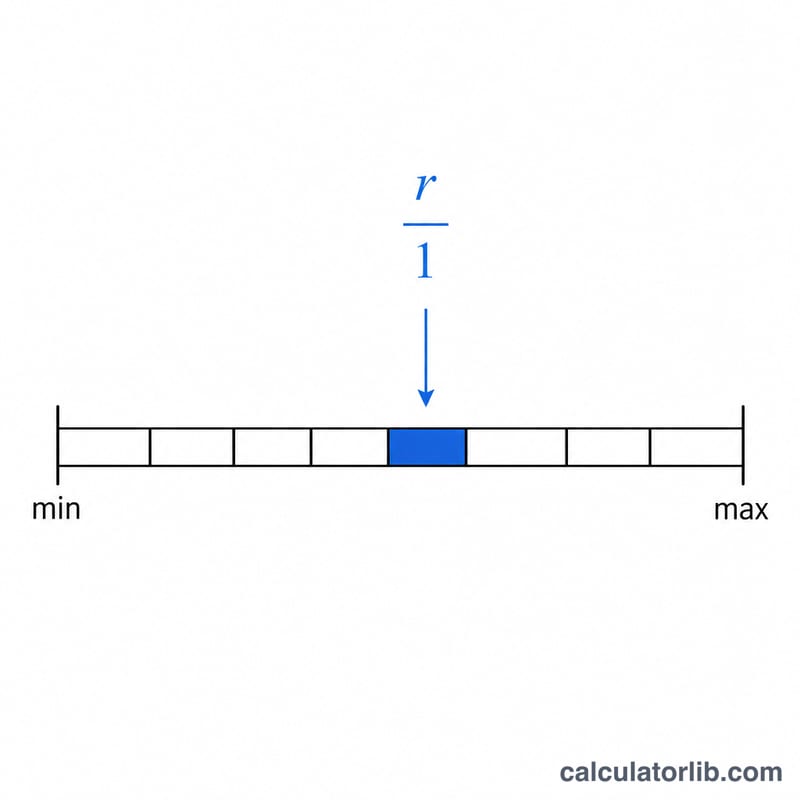
This is a random algorithm rather than a closed-form equation. Each number comes from mapping a uniform random value \(r\) (between 0 and 1) onto the chosen inclusive range with $$n = \text{min} + \left\lfloor r \times (\text{max} - \text{min} + 1) \right\rfloor.$$ For games that require distinct numbers the generator uses rejection sampling: if a drawn value is already in the set it is discarded and another is drawn, repeating until the required count of distinct numbers is reached. Digit games (the Pick series) draw with replacement, so repeated digits are allowed and order is preserved.
Worked example
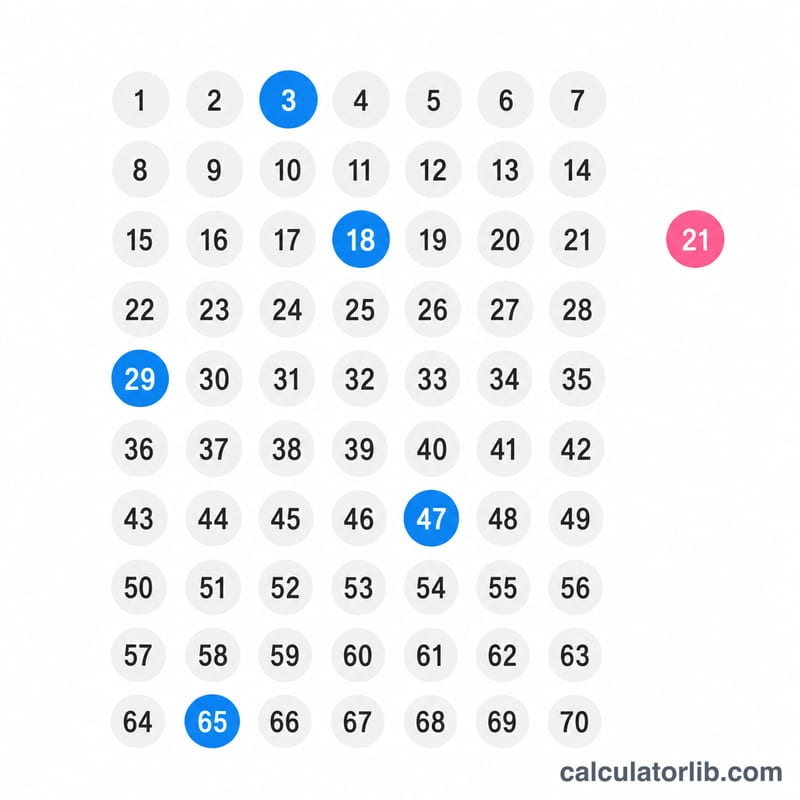
For Mega Millions (5 main numbers from 1-70 plus one Mega Ball from 1-25), suppose the random values 0.041, 0.260, 0.327, 0.668 and 0.985 are drawn for the main numbers. Applying \(n = 1 + \lfloor r \times 70 \rfloor\) gives 3, 19, 23, 47 and 69. A Mega Ball value of 0.700 gives $$1 + \lfloor 0.700 \times 25 \rfloor = 18.$$ The resulting play is 3 19 23 47 69 + [18].
Supported Lottery Games and Number Ranges
The generator draws random numbers within each game's ranges. Main numbers are drawn without repeats. Special balls are drawn from their own separate pool. The table lists the most widely documented formats. Lottery rules are set by each operator and country, so check your official lottery's current rules before playing.
| Game | Main numbers | Special / bonus numbers | Notes |
|---|---|---|---|
| Powerball (USA) | 5 from 1–69 | 1 Powerball from 1–26 | Format changed in 2015; may change again. |
| Mega Millions (USA) | 5 from 1–70 | 1 Mega Ball from 1–25 | ⚠ Format has changed over time. The Mega Ball pool was reduced from 25 to 24 in April 2025, so check the current official range. |
| EuroMillions (Europe) | 5 from 1–50 | 2 Lucky Stars from 1–12 | ⚠ Lucky Star pool has been 1–12 since 2016. Participating countries may differ in extras and prizes. |
| Eurojackpot (Europe) | 5 from 1–50 | 2 from 1–12 | ⚠ The second pool was enlarged in 2022. Older formats used a smaller pool. |
| Lotto 6/49 (Canada) | 6 from 1–49 | None in the basic format | ⚠ Official draws also include a bonus number for lower prize tiers. Extras and rules have varied over time. |
| Pick 3 / Pick 4 (digit games) | 3 or 4 digits, each 0–9, repeats allowed | None | ⚠ Names, bet types and prizes differ by region and operator. |
A custom mode lets you set your own count, minimum and maximum, and uniqueness for main and special numbers. You can also enter favorite numbers to force into each ticket.
Jackpot Odds by Game
The jackpot odds equal the number of ways to choose the main numbers, \(\binom{n}{k} = \frac{n!}{k!\,(n-k)!}\), multiplied by the number of ways to choose the bonus numbers.
| Game | Calculation | Jackpot odds |
|---|---|---|
| Powerball (USA) | \(\binom{69}{5} \times 26 = 11{,}238{,}513 \times 26\) | 1 in 292,201,338 |
| Mega Millions (USA, 24-ball Mega Ball format since April 2025) | \(\binom{70}{5} \times 24 = 12{,}103{,}014 \times 24\) | 1 in 290,472,336 |
| Mega Millions (previous format, Mega Ball 1–25) | \(\binom{70}{5} \times 25 = 12{,}103{,}014 \times 25\) | 1 in 302,575,350 |
| EuroMillions (Europe) | \(\binom{50}{5} \times \binom{12}{2} = 2{,}118{,}760 \times 66\) | 1 in 139,838,160 |
| Lotto 6/49 (Canada) | \(\binom{49}{6}\) | 1 in 13,983,816 |
Every valid combination has exactly the same chance of being drawn. A quick pick such as 1-2-3-4-5 is as likely as any other set, and a quick pick or a hand-picked ticket has identical odds. The figures above depend on the current game format. If an operator changes its number pools, the odds change with it.
Lottery Terms Glossary
- Quick pick
- A ticket whose numbers are chosen randomly instead of by the player.
- Main numbers
- The primary set of numbers on a ticket, for example 5 numbers from 1–69 in Powerball.
- Special / bonus ball
- A number drawn from a separate pool. Examples are the Powerball, the Mega Ball and the two Lucky Stars in EuroMillions.
- Play
- One complete set of numbers (one ticket line). The generator can produce several plays at once.
- Unique draw vs. draw with replacement
- In a unique draw, a number cannot appear twice in the same set. With replacement, repeats are allowed, as in Pick 3/4 digit games.
- Rejection sampling
- A method that keeps generating random values and discards any that are not allowed, such as a duplicate or a number already used as a favorite, until a valid value is obtained.
- Uniform random value
- A value in which every number in the allowed range is equally likely to be chosen.
- Pick-digit games
- Games such as Pick 3 and Pick 4 where you choose individual digits from 0–9, usually with repeats allowed. Prizes depend on matching the digits, often in exact order.
This tool is for entertainment and does not improve your chances of winning.
FAQ
Do the same numbers come up if I re-run? No. Every submission draws fresh random numbers, so results change each time. This is expected behavior.
Does this improve my chances of winning? No. All lottery outcomes are random; quick picks have exactly the same odds as any other valid combination. This tool is for convenience and entertainment only.
Can I make my own game? Yes. Select "Custom configuration" and set the main count, range, uniqueness, and an optional special-ball pool to model almost any lottery format.