





What is the Yes or No Generator?
The Yes or No Generator is a simple random decision maker. When you can't make up your mind, type your question, hit calculate, and let probability give you a clear answer: Yes or No. It is perfect for breaking ties, settling debates, or just having fun.
How to use it
Type your question if you like (it is optional and stays on your device unless you share the link), then press Ask or the Space bar. The answer, Yes or No, appears at once. By default both have the same chance; set Chance of yes to any value from 0 to 100 to tilt the odds, for example 70 for yes seven times in ten.
The line under the answer shows the chance used, and a running count of yes and no for this tab. Copy result copies the question and its answer, Full screen shows the answer large, and Copy link shares the question and the chance. Past answers stay in this tab; turn on Save on this device to keep them.
How fair is the draw?
Every result comes from crypto.getRandomValues, the cryptographic random generator built into your browser. The tool turns those numbers into an outcome with rejection sampling, so no outcome gets an extra chance from a leftover remainder, and the animation only replays a result that was decided before it started. Nothing is sent to our server.
Random does not mean even in the short run: in ten coin flips, seven heads or more happens about one time in six. Over many draws the counts settle near the stated chances. The tool cannot prove to someone else that you did not draw again, so for a prize draw, draw in front of the people taking part.
The formula explained
The tool draws a uniform random number \(r\) between 0 and 1. Your chosen "Chance of Yes" percentage is converted to a probability \(p = \text{weight} \div 100\). If \(r < p\) the result is Yes; otherwise it is No. With the default weight of 50, \(p = 0.5\), so any roll below 0.5 is Yes and any roll of 0.5 or above is No — a perfectly balanced coin toss.
$$\text{Answer} = \begin{cases} \text{Yes} & \text{if } r < \dfrac{\text{Chance of Yes (\%)}}{100} \\[1em] \text{No} & \text{otherwise} \end{cases} \qquad r \sim U(0,1)$$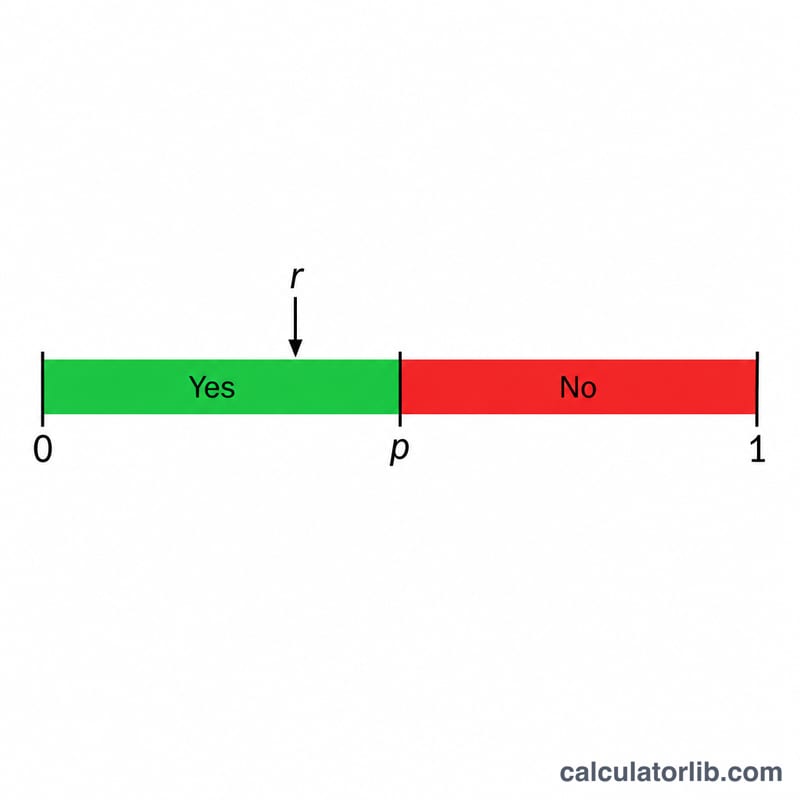
Worked example
Suppose you set the chance of Yes to 70%. Then \(p = 0.70\). If the random roll comes out as 0.42, since \(0.42 < 0.70\) the answer is Yes. If instead the roll were 0.88, since \(0.88 \geq 0.70\) the answer would be No. Over many runs roughly 70% of answers will be Yes.
How the Odds Change Your Chances
The generator draws a random number \(r\) uniformly between 0 and 1 and compares it with your "Chance of Yes" setting. If \(r\) falls below \(p = w/100\), the answer is Yes; otherwise it is No. Over \(n\) runs, the expected number of Yes answers is simply
$$E[\text{Yes}] = n \times p = n \times \frac{w}{100}$$With \(n = 10\) runs and a weight of \(w = 70\%\), that gives \(10 \times 0.70 = 7\) expected Yes answers and \(10 - 7 = 3\) expected No answers.
| Chance of Yes setting (w) | Probability p | Expected Yes per 10 runs | Expected No per 10 runs | What it feels like |
|---|---|---|---|---|
| 0% | 0.00 | 0 | 10 | Always No — the answer is fixed, no randomness at all |
| 10% | 0.10 | 1 | 9 | Long shot — Yes is a rare surprise, about 1 in 10 |
| 25% | 0.25 | 2.5 | 7.5 | Underdog — roughly one Yes in every four questions |
| 50% | 0.50 | 5 | 5 | Fair coin flip — the classic unbiased tie-breaker |
| 70% | 0.70 | 7 | 3 | Favoured Yes — leaning toward go-ahead, but No still happens |
| 90% | 0.90 | 9 | 1 | Near-certain Yes — No appears about once in ten runs |
| 100% | 1.00 | 10 | 0 | Always Yes — the answer is fixed, no randomness at all |
These are expected counts, not promises. Because each run is random, short sequences scatter around the expectation. The spread in 10 runs is measured by the standard deviation \(\sigma = \sqrt{n\,p\,(1-p)}\); at \(p = 0.5\) that is \(\sqrt{10 \times 0.5 \times 0.5} \approx 1.58\), so getting 3 or 7 Yes answers out of 10 on a fair 50/50 setting is completely ordinary. Streaks of four or five identical answers in a row also occur regularly. The proportion only settles close to your chosen percentage over hundreds or thousands of runs.
Interpreting Your Result
Every answer you get is a single independent Bernoulli trial with success probability \(p = w/100\). "Independent" means the generator carries no memory: the chance of Yes on the next click is exactly \(p\), no matter what came before. Formally, for any past sequence of results,
$$P(\text{Yes on next draw}) = p$$This is worth stressing because human intuition disagrees. After five No answers in a row at a 50% setting, it can feel as though a Yes is "due" — that belief is the gambler's fallacy. The generator is not balancing a ledger; the probability of a sixth No is still 0.5, the same as it was on the very first draw. Long runs of one answer are a normal feature of randomness, not a malfunction.
A 70% setting likewise does not guarantee 7 Yes answers in your next 10 questions. It means that in the long run, roughly 70% of answers will be Yes. In any one batch of 10 you might see 5, or 9. The law of large numbers pulls the observed share toward 70% only as the number of runs grows large.
How to read your specific answer:
- Yes or No is not advice. The result carries no information about your question — it is pure chance filtered through the weight you chose.
- Your reaction is the useful signal. Many people use a random answer as a decision prompt: if the result is No and you feel relief or disappointment, that tells you something the coin never could.
- The weight encodes your prior lean. Setting 70% instead of 50% is a way of saying you already favour Yes and want chance only to break a near-tie.
- Fix the weight before you draw. Re-rolling until you get the answer you wanted quietly turns a random process into a deliberate one — which is fine, as long as you notice you have decided.
A note on the randomness itself. This tool uses a pseudo-random number generator: a deterministic algorithm that produces sequences which pass everyday statistical tests but are computed from an internal seed rather than a physical source of entropy. That is entirely adequate for games, party questions, picking who goes first, and settling low-stakes ties. It is not suitable for cryptography or security (keys, tokens, passwords), for gambling or anything with money at stake, for lotteries or prize draws requiring auditable fairness, or for scientific randomisation such as assigning participants to treatment groups in a clinical trial. Those uses require cryptographically secure generators, certified hardware entropy sources, or documented randomisation procedures overseen by the relevant regulator or ethics committee in your jurisdiction — requirements that differ from country to country.
This page is general information about probability and random generators, not professional, legal, medical or financial advice. For decisions with real consequences for your health, money or legal position, consult a qualified professional rather than a random answer.
FAQ
Is it truly random? It uses your device's pseudo-random number generator, which is more than random enough for everyday decisions and games.
Why do I get a different answer each time? A new random number is generated on every submission, so repeating the question can flip the result — just like flipping a coin again.
Can I make it always say Yes? Yes — set the chance of Yes to 100, and the generator will always return Yes (0 always returns No).