
What this converter does
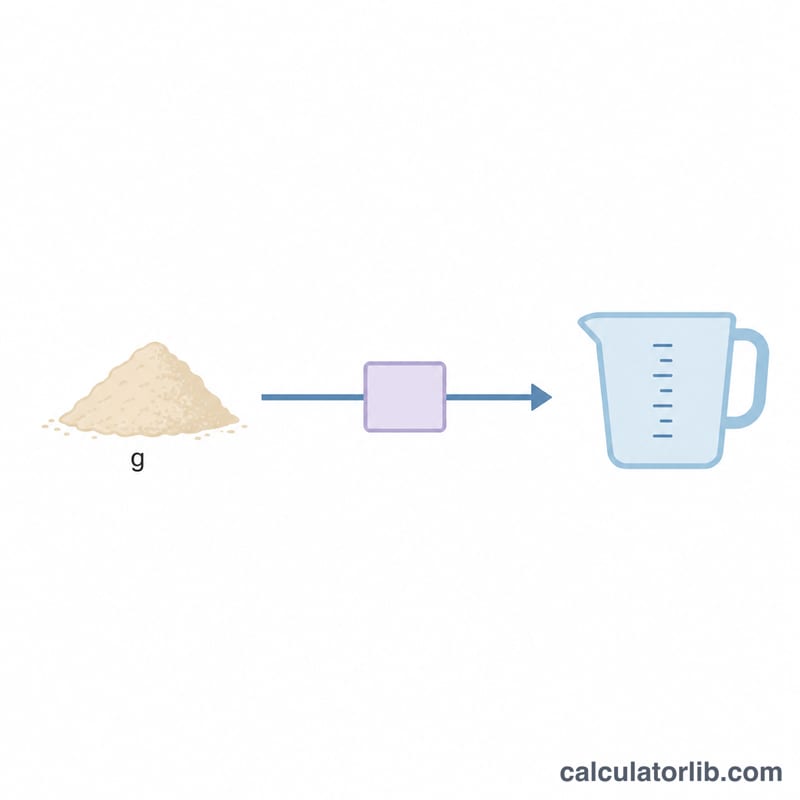
Recipes from different parts of the world measure ingredients in different ways. European and metric recipes often use grams, while US recipes use cups. This calculator converts a weight in grams into US cups (and tablespoons) for common baking ingredients such as flour and sugar. Because a cup is a unit of volume and grams measure mass, the conversion depends on the ingredient's density — light, fluffy flour weighs far less per cup than dense packed sugar.
How to use it
Enter the weight in grams, then pick your ingredient from the dropdown. The tool divides the grams by that ingredient's typical density (grams per cup) and shows the result in cups, along with the equivalent in tablespoons and the density used.
The formula explained
The core formula is simple:
$$\text{Cups} = \frac{\text{Weight (g)}}{\text{Density (g/cup)}}$$We use widely accepted baking densities: all-purpose flour \(\approx 125\) g/cup, cake flour \(\approx 120\) g/cup, granulated sugar \(\approx 200\) g/cup, and packed brown sugar \(\approx 220\) g/cup. Since 1 US cup = 16 tablespoons, we also report tablespoons by multiplying cups by 16.
Worked example
Suppose a recipe lists 250 grams of all-purpose flour. Using a density of 125 g/cup:
$$250 \div 125 = 2 \text{ cups}$$In tablespoons that is \(2 \times 16 = 32\) tbsp. For 200 grams of granulated sugar at 200 g/cup, the answer is exactly 1 cup.
FAQ
Are these conversions exact? No — flour densities vary with how it is scooped, sifted, or packed. Spooning flour gently gives about 120–130 g/cup, so treat results as close estimates.
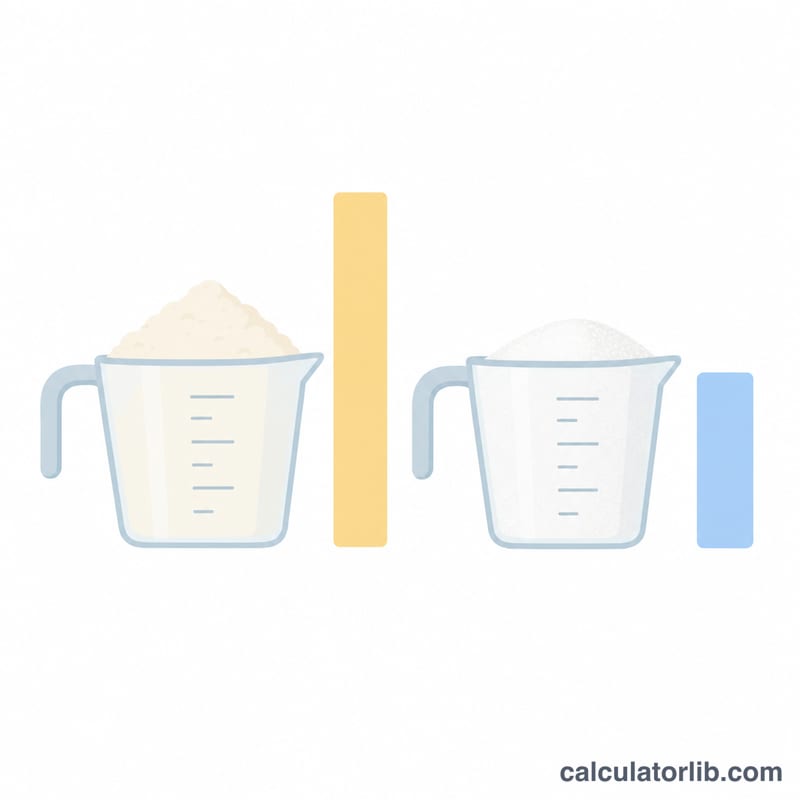
Why does sugar give fewer cups than flour for the same weight? Sugar is denser, so the same gram weight takes up less volume.
Can I use this for liquids? This tool is tuned for dry baking ingredients. Water is roughly 240 g/cup, so it would differ.