What is the Sugar Grams to Teaspoons Calculator?
This tool converts a weight of granulated sugar in grams into its equivalent volume in teaspoons. Nutrition labels list added sugar in grams, but most people picture sugar in teaspoons — so this calculator bridges the gap and makes it easy to visualize how much sugar is really in your food and drinks.
How to use it
Type the number of grams of sugar into the input box and the calculator instantly shows the equivalent teaspoons. For example, a typical can of soda contains around 39 grams of sugar — enter that to see roughly how many teaspoons that represents.
The formula explained
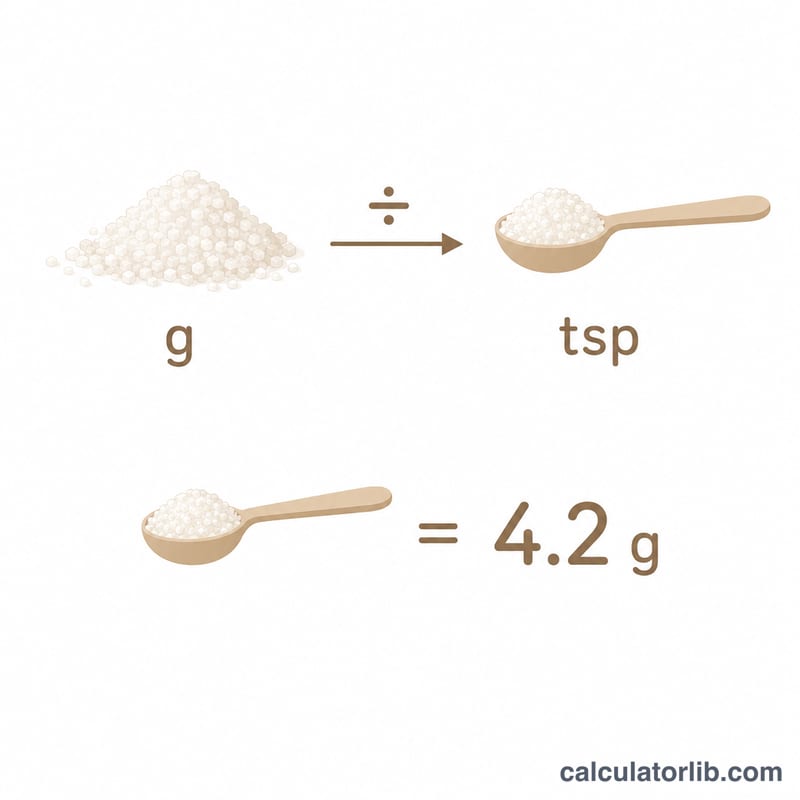
One level teaspoon of granulated white sugar weighs approximately 4.2 grams. To convert grams to teaspoons, simply divide the grams by 4.2:
$$\text{teaspoons} = \frac{\text{grams}}{4.2}$$
This is an approximation because the exact mass of a teaspoon varies slightly with crystal size and how tightly the sugar is packed, but 4.2 g per teaspoon is the widely accepted value used by dietitians and food labels.
Worked example
Suppose a chocolate bar contains 25 grams of sugar. Dividing by 4.2 gives $$25 \div 4.2 \approx 5.95 \text{ teaspoons}$$ — almost 6 teaspoons of sugar in a single bar.
Sugar in Common Foods and Drinks in Teaspoons
The table converts typical sugar amounts to teaspoons with \(\text{teaspoons} = \frac{\text{grams}}{4.2}\). The gram values are approximate and typical. Real products vary by brand, recipe and serving size, so check the Nutrition Facts label of the item you have.
| Item (typical serving) | Approx. sugar (g) | Approx. teaspoons |
|---|---|---|
| Can of cola (about 330–355 ml) | ~39 g | ~9.3 tsp |
| Chocolate bar | ~25 g | ~6 tsp |
| Flavored yogurt (single pot) | ~15 g | ~3.6 tsp |
| Glass of orange juice (about 250 ml) | ~21 g | ~5 tsp |
| Tablespoon of ketchup | ~4 g | ~1 tsp |
Worked example for the yogurt: \(15 \div 4.2 \approx 3.57\), which rounds to about 3.6 teaspoons.
The 4.2 g per teaspoon factor is a common approximation for granulated sugar. Packing, crystal size and how level the spoon is all change the actual weight.
Interpreting Your Result
The teaspoon figure shows how much granulated sugar a gram amount would fill. To judge whether that is a lot, compare it with published guidance. Most guidance targets added or free sugars, not total sugars.
- American Heart Association (United States): suggests limiting added sugar to about 25 g (about 6 tsp) per day for women and 36 g (about 9 tsp) per day for men. Check: \(25 \div 4.2 \approx 6.0\) and \(36 \div 4.2 \approx 8.6\), so about 9 tsp.
- World Health Organization (international): recommends keeping free sugars below 10% of total energy intake, with additional benefit from going below 5%. For a typical adult, 5% is roughly 25 g, or about 6 tsp, per day.
Added or free sugar vs. total sugar: The "Total Sugars" line on a label includes sugars that occur naturally in foods such as milk (lactose) and whole fruit, as well as sugars added during processing. Many labels, such as those in the US, also list "Added Sugars" separately. Free sugars, the WHO term, include added sugars plus sugars naturally present in honey, syrups and fruit juices. If you convert a total-sugar figure, the teaspoon result overstates the added sugar in foods like plain yogurt or fruit.
A single item can use up a large share of these reference amounts. For example, a can of cola at about 39 g is more than the AHA reference for either group. Serving sizes on labels may also differ from what is actually eaten, so multiply accordingly.
This is general information, not medical or professional advice.
FAQ
Why 4.2 grams per teaspoon? Because that is the standard mass dietitians use for one level teaspoon of granulated sugar; some sources round to 4 g, which would give slightly higher teaspoon counts.
Does this work for brown sugar or powdered sugar? It is calibrated for granulated white sugar. Brown and powdered sugars have different densities, so results would be approximate.
How many teaspoons is the daily recommended limit? The American Heart Association suggests no more than about 6 tsp (25 g) of added sugar per day for women and 9 tsp (36 g) for men.