
What this calculator does
This tool estimates a mealtime (bolus) insulin dose by combining two components: the insulin needed to cover the carbohydrates you are about to eat, and a correction dose to bring an elevated blood glucose back toward your target. It is intended for educational use and uses generic units (grams of carbohydrate, mg/dL for glucose). It is not a substitute for medical advice or your prescribed dosing plan.
How to use it
Enter the grams of carbohydrate in your meal, your insulin-to-carb ratio (ICR — the grams of carb covered by 1 unit of insulin), your current and target blood glucose, and your insulin sensitivity factor (ISF — how many mg/dL one unit of insulin lowers your glucose). The calculator returns the total estimated bolus along with the carbohydrate and correction components.
The formula explained
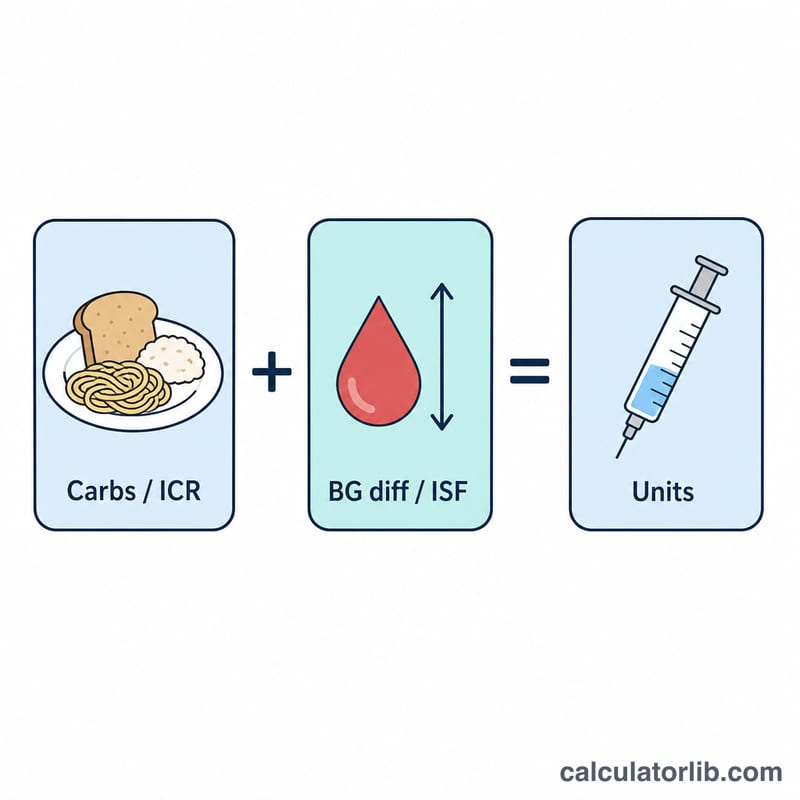
The bolus is the sum of two parts:
Carb dose = \(\text{Carbs} \div \text{ICR}\) and Correction dose = \((\text{Current BG} - \text{Target BG}) \div \text{ISF}\). The total is:
$$\text{Units} = \frac{\text{Carbs}}{\text{ICR}} + \frac{\text{Current BG} - \text{Target BG}}{\text{ISF}}$$If your glucose is below target, the correction term becomes negative, reducing the bolus. The result is floored at zero so it never suggests a negative dose.
Worked example
You eat 60 g of carbs with an ICR of 10 g/unit, your glucose is 180 mg/dL, target is 100 mg/dL, and ISF is 50 mg/dL per unit. Carb dose = \(60 \div 10 = 6\) units. Correction = \((180 - 100) \div 50 = 1.6\) units. Total =
$$6 + 1.6 = \mathbf{7.6 \text{ units}}$$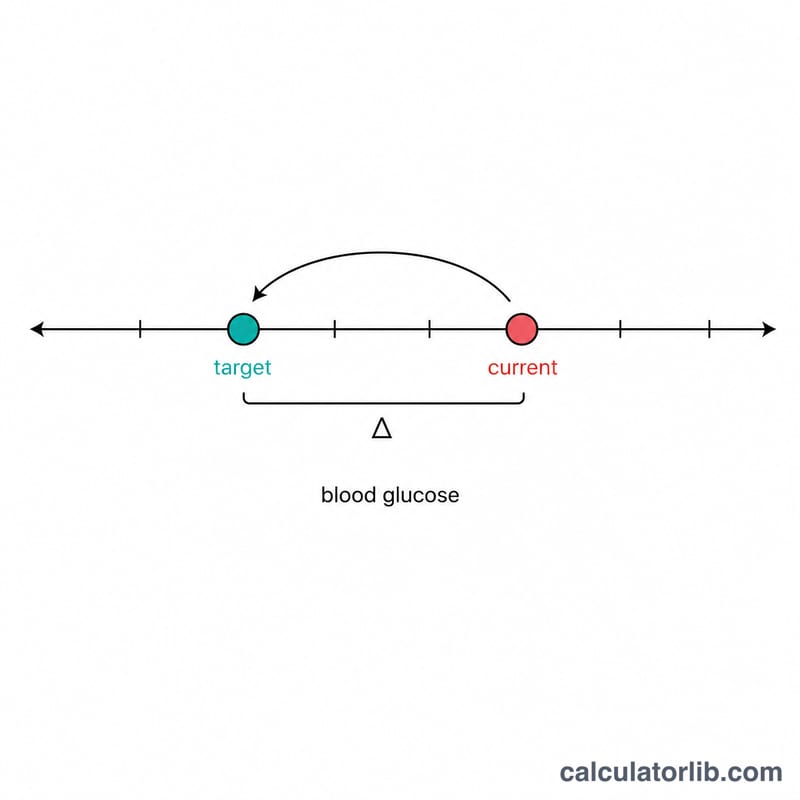
FAQ
What is a carb ratio (ICR)? It is the number of grams of carbohydrate that 1 unit of rapid-acting insulin covers. A ratio of 1:10 means 1 unit per 10 g.
What is ISF? The insulin sensitivity (correction) factor is how much one unit of insulin lowers blood glucose, e.g. 50 mg/dL per unit.
Can I rely on this for dosing? No. This is an educational estimate. Active insulin on board, activity, illness and other factors matter. Always follow your clinician's guidance.