What Is Newborn Weight Loss Percentage?
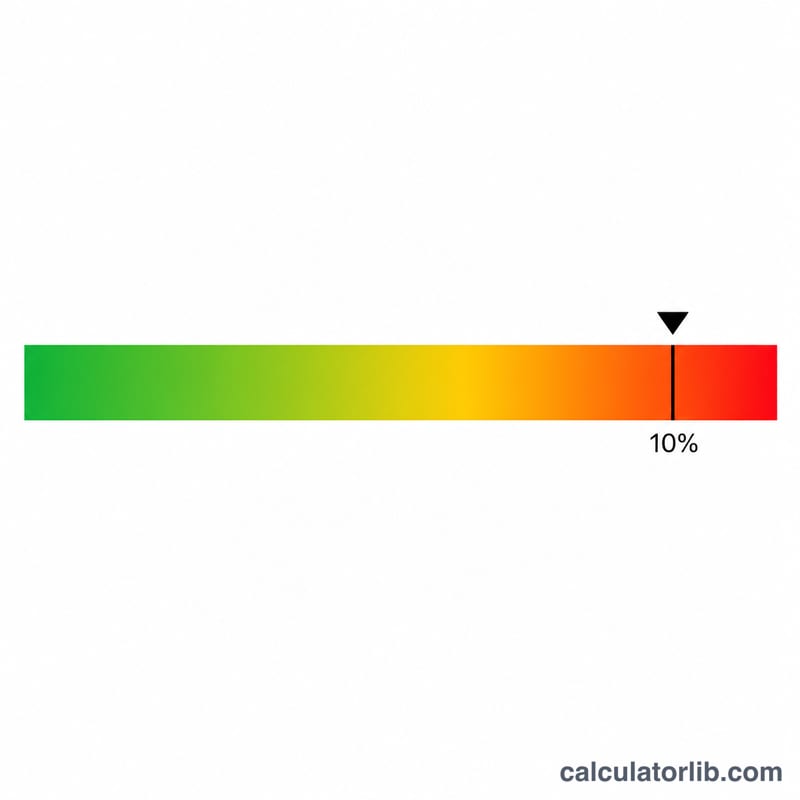
It is normal for newborns to lose some weight in the first few days of life as they shed extra fluid and begin feeding. Pediatricians track this loss as a percentage of the baby's birth weight. Most healthy newborns lose up to 7–10% of their birth weight, then regain it by about 10–14 days of age. A loss exceeding 10% may signal feeding difficulties or dehydration and usually warrants a check-up.
How to Use This Calculator
Enter your baby's birth weight and current weight, both in grams. The calculator returns the percentage of birth weight lost, the amount lost in grams, and whether the loss is within the typical range or above the 10% threshold that often prompts clinical follow-up.
The Formula
The calculation is simple subtraction and division:
$$\text{Loss \%} = \frac{\text{Birth Weight} - \text{Current Weight}}{\text{Birth Weight}} \times 100$$
A positive result means weight was lost; a negative result means the baby has gained weight above birth weight.
Worked Example
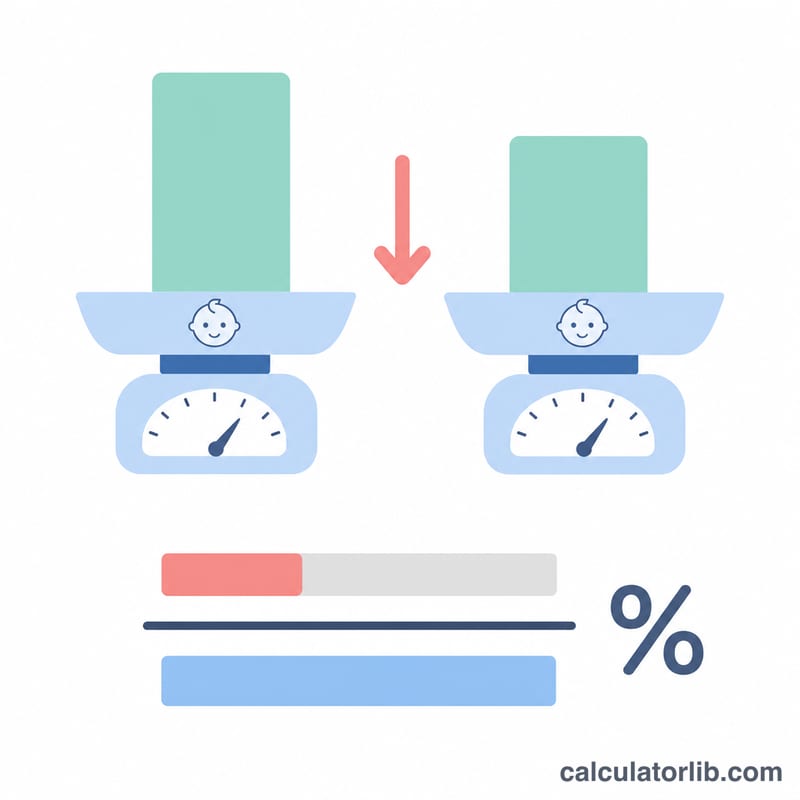
Suppose a baby weighed 3,400 g at birth and now weighs 3,150 g. Weight lost = \(3{,}400 - 3{,}150 = 250\) g. $$\text{Loss \%} = \frac{250}{3{,}400} \times 100 = 7.35\%$$ This is within the normal range, so no special concern is flagged.
Interpreting Your Baby's Weight Loss Result
Most newborns lose some weight in the first days of life. They pass extra fluid and meconium, and feeding is still getting established. The percentage from this calculator tells you how far below birth weight your baby is right now. Use these general bands to read it:
| Result | What it generally means |
|---|---|
| Negative % (for example −1.5%) | Current weight is above birth weight. The baby has regained the early loss and is gaining. |
| 0% to under 7% | Typical early weight loss for a healthy term newborn. |
| 7% to 10% | Breastfeeding guidance from the Academy of Breastfeeding Medicine (ABM) and the American Academy of Pediatrics (AAP) commonly treats a loss of about 7% or more as a reason to review feeding. That review may include latch, how often the baby feeds, milk transfer, and wet and dirty diapers. |
| Over 10% | Above the threshold where clinical evaluation is usually recommended. The clinician will check for dehydration, jaundice and feeding problems, and decide whether supplementation is needed. |
Timing matters. Weight usually reaches its lowest point around day 3–4 after birth. Most babies are back to birth weight by 10–14 days. The same percentage means more early on than it does later. For example, an 8% loss at 36 hours is a steeper drop than an 8% loss on day 4, when the weight would normally be near its lowest. If the loss is still increasing after day 4–5, or the baby is not back to birth weight by about 2 weeks, that is also worth raising with your baby's clinician.
Hour-by-hour reference curves. Researchers published the NEWT (Newborn Weight Tool) curves (Flaherman et al., Pediatrics, 2015). They are based on a large population of healthy term newborns in the United States. NEWT shows weight loss percentiles by hour of age and by delivery method. It lets a clinician see whether a baby's loss is unusual for its exact age, which is more precise than a single fixed cut-off.
Expected differences between groups. On average, babies born by caesarean section lose a little more weight than vaginally born babies. Exclusively breastfed babies also tend to lose a bit more in the first days than formula-fed babies, because the mother's milk volume rises gradually over the first several days. NEWT publishes separate curves for vaginal and caesarean births for this reason.
This is general information, not a diagnosis or medical advice. The percentage is only one piece of the picture. Your pediatrician or midwife also considers the baby's age in hours, feeding, diaper output, jaundice, alertness and overall health, and makes the clinical decision. If you are worried about your baby's weight, feeding or hydration, contact your healthcare provider promptly.
FAQ
Is some weight loss normal? Yes — losing up to about 10% in the first 3–5 days is common and expected.
What if loss is over 10%? Contact your pediatrician. It may indicate feeding problems or dehydration that benefit from evaluation and support.
Can I enter pounds and ounces? This tool uses grams. Convert first: \(1\ \text{lb} \approx 453.6\ \text{g}\) and \(1\ \text{oz} \approx 28.35\ \text{g}\).