
What is the BMI Weight Loss Calculator?
This tool turns a target Body Mass Index (BMI) into a concrete weight-loss goal. First it computes your current BMI from your weight and height, then it works out the weight that corresponds to your chosen target BMI, and finally it tells you exactly how many kilograms you need to lose (or gain) to reach it. It is a universal metric tool that works for any adult regardless of country.
How to use it
Enter your current weight in kilograms, your height in centimetres, and the target BMI you want to reach. A BMI of 18.5–24.9 is generally classed as the healthy range, so many people aim for a value such as 22. The calculator returns your current BMI, the goal weight, and the amount of weight to lose.
The formula explained
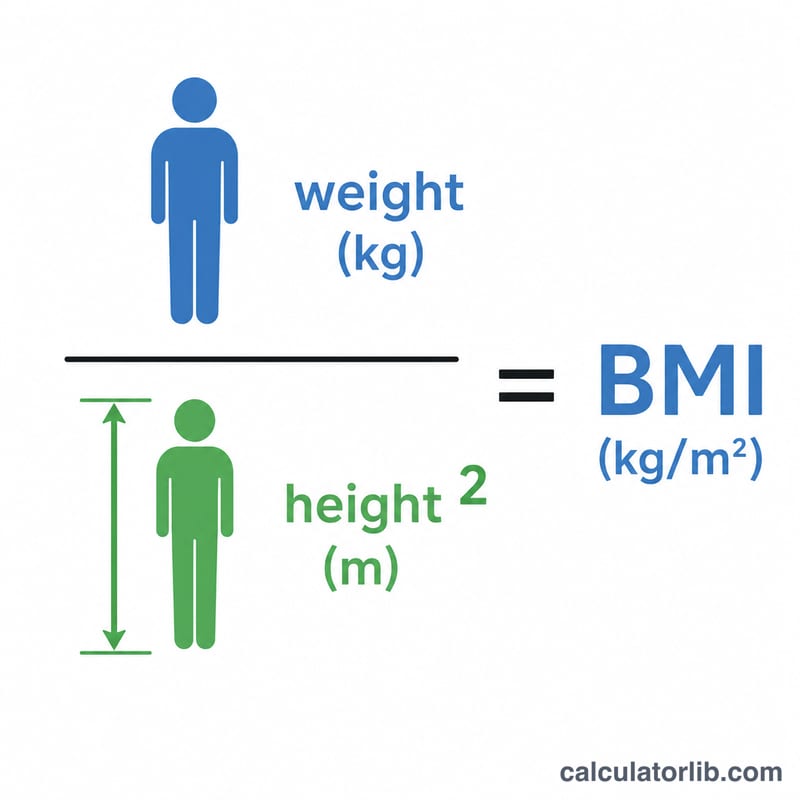
BMI equals weight in kilograms divided by height in metres squared.
$$\text{BMI} = \dfrac{\text{weight}_{kg}}{\text{height}_{m}^{2}}$$To find the goal weight we rearrange this: target weight = target BMI \(\times\) height². The weight you need to lose is simply your current weight minus that target weight.
$$\Delta w = w_{current} - (\text{BMI}_{target} \times \text{height}_{m}^{2})$$Height entered in centimetres is converted to metres by dividing by 100.
Worked example
Suppose you weigh 90 kg at a height of 175 cm (1.75 m) and want a target BMI of 22. Current BMI = \(90 \div (1.75 \times 1.75) = 90 \div 3.0625 \approx 29.39\). Target weight = \(22 \times 3.0625 = 67.375\) kg. Weight to lose = \(90 - 67.375 = 22.625\) kg.
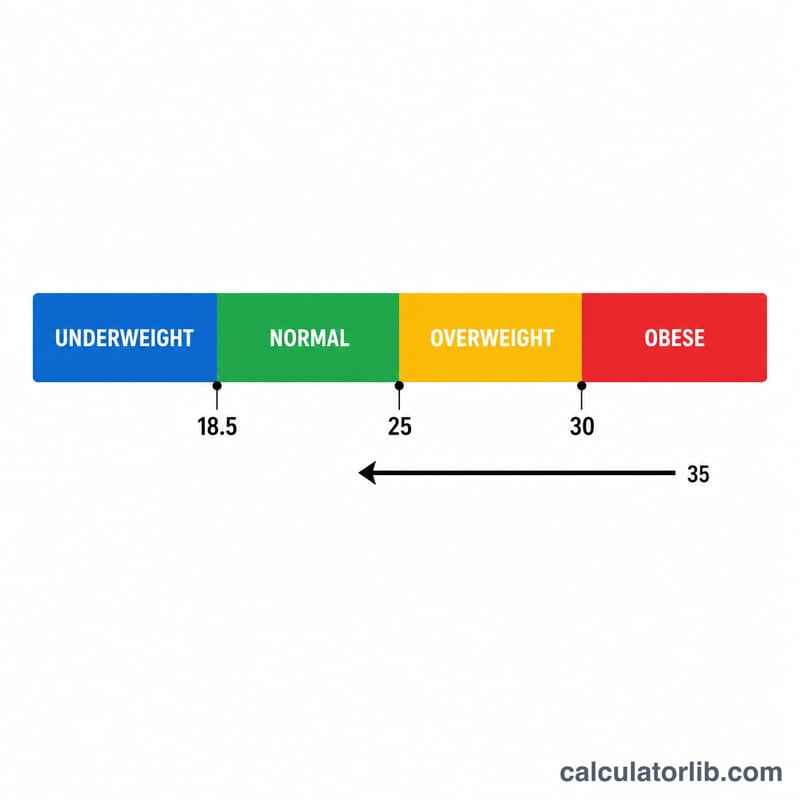
BMI Categories and Thresholds
Body Mass Index (BMI) is computed as \(\text{BMI} = \dfrac{\text{weight}_{kg}}{\text{height}_{m}^{2}}\). The World Health Organization (WHO) groups adults into the following categories based on the resulting value:
| Category | BMI range (kg/m²) |
|---|---|
| Underweight | Below 18.5 |
| Normal weight | 18.5 – 24.9 |
| Overweight (pre-obese) | 25.0 – 29.9 |
| Obese Class I | 30.0 – 34.9 |
| Obese Class II | 35.0 – 39.9 |
| Obese Class III (severe) | 40.0 and above |
These cut-offs apply to adults aged 20 and over regardless of sex. The target BMI you enter is most often set to the upper end of the normal range (24.9) for a conservative goal, or to a mid-range value such as 22 for a healthier center-of-range target.
Interpreting Your Result
The calculator reports three things: your current BMI (and its category), the target weight that corresponds to the goal BMI you entered, and the kilograms to lose to get there.
Your current category. If your current BMI falls in the overweight (25–29.9) or obese (≥30) bands, reaching a target BMI in the normal range (18.5–24.9) is generally associated with reduced risk of cardiovascular disease, type 2 diabetes and other weight-related conditions. If you are already in the normal range, the “weight to lose” is small or zero.
Reaching the target BMI. The target weight is simply \(\text{target BMI} \times \text{height}_{m}^{2}\). Hitting it places you exactly at the BMI you chose. Choosing a goal of 22 lands you near the middle of the healthy range, which leaves a margin before crossing into overweight.
A negative number means gain, not loss. If your current weight is below the target weight, the “kilograms to lose” will be negative. A negative value indicates you would need to gain that amount to reach the goal BMI — common when the goal is set above your current weight or when you are underweight.
Limitations of BMI. BMI uses only height and weight, so it does not distinguish muscle from fat. Highly muscular people (athletes, weightlifters) can register as overweight or obese despite low body fat, while older adults who have lost muscle may have a “normal” BMI yet carry excess fat. The standard cut-offs were derived largely from European-ancestry populations; for some Asian populations the WHO notes that health risk rises at lower BMI values, so additional action points (e.g. 23 and 27.5) are sometimes used. Treat BMI as a screening indicator, not a diagnosis, and pair it with measures such as waist circumference or body-fat percentage. This is general information, not medical advice — consult a healthcare professional before starting a weight-loss program.
FAQ
What is a healthy BMI? For most adults a BMI between 18.5 and 24.9 is considered healthy.
Does BMI work for athletes? BMI does not distinguish muscle from fat, so very muscular people may read as overweight even when they are not.
What if the result is negative? A negative "weight to lose" means you are already below your target BMI and would actually need to gain weight to reach it.