
What is the Meal Calorie Calculator?
The Meal Calorie Calculator turns the macronutrient content of a meal — protein, carbohydrates, fat and alcohol, measured in grams — into a total calorie (kilocalorie) figure. It uses the standard Atwater energy factors, the same numbers behind nutrition labels around the world, so it works for any meal in any country.
How to use it
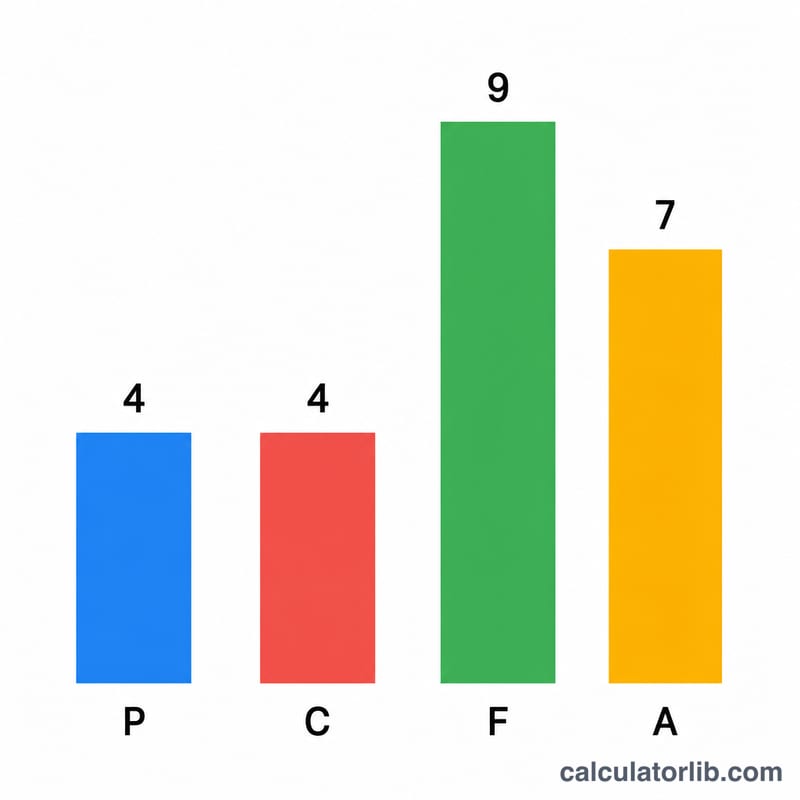
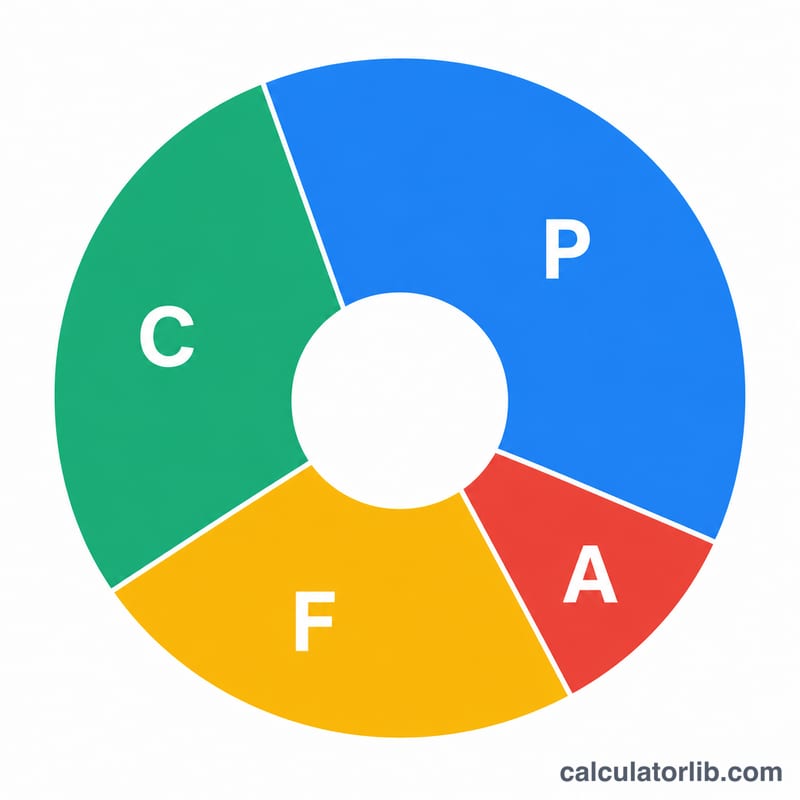
Enter the grams of each macronutrient in your meal. You can read these from a recipe, a food label, or a nutrition-tracking app. Protein and carbohydrates each provide 4 kcal per gram, fat provides 9 kcal per gram, and alcohol provides 7 kcal per gram. Leave alcohol at 0 if your meal contains none. The calculator returns the total calories plus a breakdown showing how many calories and what percentage come from each macronutrient.
The formula explained
The energy of a meal is the sum of the energy from each component:
$$\text{Calories} = (4 \times \text{protein g}) + (4 \times \text{carbs g}) + (9 \times \text{fat g}) + (7 \times \text{alcohol g})$$
Fat is the most energy-dense, packing more than double the calories per gram of protein or carbohydrate, which is why fatty foods add up quickly.
Worked example
Suppose a meal contains 30 g protein, 50 g carbohydrates and 15 g fat, with no alcohol. The protein contributes \(4 \times 30 = 120\) kcal, carbs contribute \(4 \times 50 = 200\) kcal, and fat contributes \(9 \times 15 = 135\) kcal. The total is $$120 + 200 + 135 = \mathbf{455 \text{ kcal}}$$ Fat alone makes up \(135 \div 455 \approx 29.7\%\) of the meal's energy.
FAQ
Why is fat 9 calories per gram? Fat molecules store more chemical energy per unit mass than carbohydrate or protein, so they release roughly 9 kcal per gram when metabolised.
Should I count fibre? This calculator uses total carbohydrate grams. Some labels subtract fibre to give "net carbs"; if you prefer net carbs, enter that figure in the carbohydrate field.
Are these calories the same as what my body absorbs? The Atwater factors are well-established averages. Actual absorbed energy varies slightly with food type and individual digestion, but these values are accurate enough for everyday meal planning.