What is the Weight Loss Timeline Calculator?
This calculator estimates how long it will take to reach a target body weight given your current weight and the daily calorie deficit you can sustain. It uses the widely cited rule that roughly 7,700 kilocalories equal one kilogram of body fat (about 3,500 kcal per pound). It is a planning tool, not medical advice.
How to use it
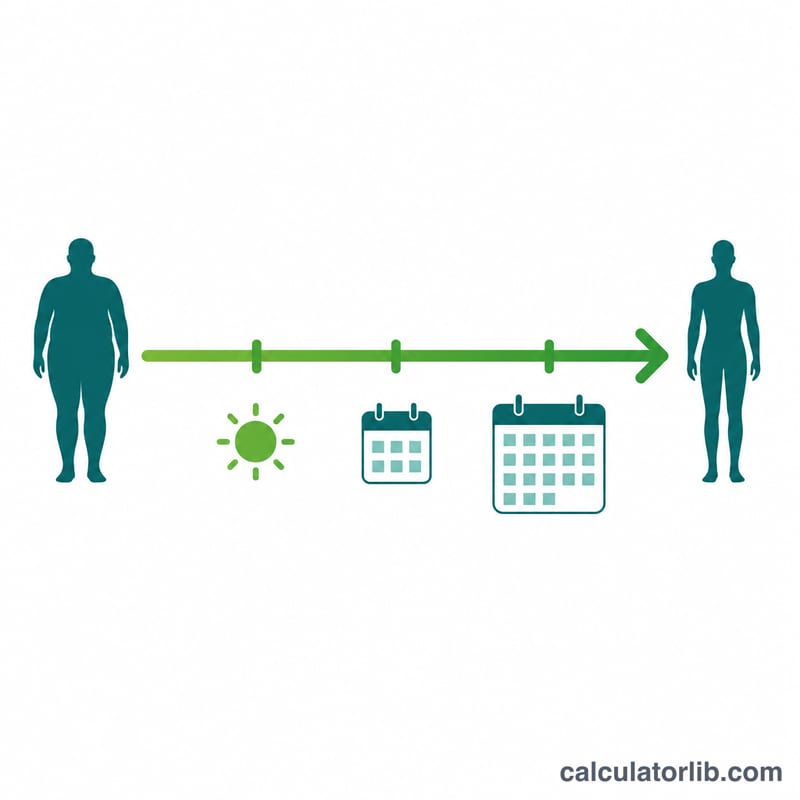
Enter your current weight and your goal weight in kilograms, then enter your average daily calorie deficit — the gap between calories burned and calories eaten. The calculator returns the number of days to reach your goal, plus the equivalent in weeks and months and your expected average weekly loss.
The formula explained
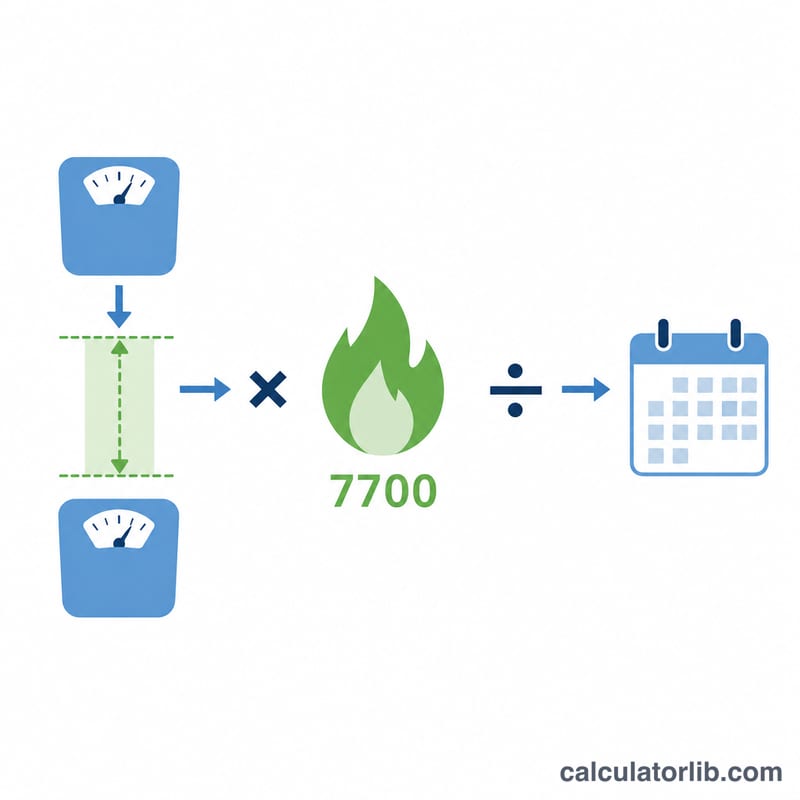
First the calculator finds the weight you need to lose: current − goal. Each kilogram of fat stores about 7,700 kcal, so the total energy deficit required is that weight multiplied by 7,700. Dividing by your daily deficit gives the number of days: $$\text{Days} = \frac{\left(\text{Current (kg)} - \text{Goal (kg)}\right) \times 7700}{\text{Deficit (kcal/day)}}$$
Worked example
Suppose you weigh 90 kg and want to reach 75 kg with a 500 kcal/day deficit. You need to lose 15 kg, which is $$15 \times 7700 = 115{,}500 \text{ kcal}.$$ Dividing by 500 gives 231 days — about 33 weeks or 7.6 months, averaging roughly 0.45 kg lost per week.
Timeline Across Common Deficit Scenarios
Every row below is computed with the same formula the calculator uses: total energy = kilograms to lose × 7700 kcal, days = total energy ÷ daily deficit, weeks = days ÷ 7, months = days ÷ 30.44. Values are rounded for display only.
| Current → goal | To lose (kg) | Daily deficit (kcal) | Total kcal required | Days | Weeks | Months | Avg weekly loss (kg) |
|---|---|---|---|---|---|---|---|
| 80 → 75 kg | 5 | 500 | 38,500 | 77 | 11.0 | 2.5 | 0.45 |
| 80 → 75 kg | 5 | 250 | 38,500 | 154 | 22.0 | 5.1 | 0.23 |
| 95 → 85 kg | 10 | 250 | 77,000 | 308 | 44.0 | 10.1 | 0.23 |
| 95 → 85 kg | 10 | 750 | 77,000 | 102.7 | 14.7 | 3.4 | 0.68 |
| 100 → 85 kg | 15 | 500 | 115,500 | 231 | 33.0 | 7.6 | 0.45 |
| 100 → 85 kg | 15 | 1000 | 115,500 | 115.5 | 16.5 | 3.8 | 0.91 |
| 110 → 85 kg | 25 | 750 | 192,500 | 256.7 | 36.7 | 8.4 | 0.68 |
| 120 → 90 kg | 30 | 500 | 231,000 | 462 | 66.0 | 15.2 | 0.45 |
| 120 → 90 kg | 30 | 1000 | 231,000 | 231 | 33.0 | 7.6 | 0.91 |
Two patterns are worth reading off the table. First, the average weekly loss depends only on the deficit, never on how much you have to lose: 250 kcal/day always projects ≈0.23 kg/week, 500 always ≈0.45 kg/week, 750 always ≈0.68 kg/week and 1000 always ≈0.91 kg/week. The size of the goal changes the duration, not the rate. Second, the relationship between deficit and time is inverse, not proportional in the way people often assume — doubling the deficit halves the days (30 kg takes 462 days at 500 kcal/day but 231 days at 1000 kcal/day), while halving it doubles them.
Sample check of one row, 110 kg → 85 kg at 750 kcal/day:
$$\text{Days} = \frac{(110 - 85) \times 7700}{750} = \frac{192{,}500}{750} \approx 256.7$$and \(256.7 \div 7 \approx 36.7\) weeks, \(256.7 \div 30.44 \approx 8.4\) months. Remember that the longer rows are the least reliable: a 462-day projection assumes an unbroken 500 kcal/day deficit for more than 15 months and no drop in maintenance calories as 30 kg comes off, which is why long timelines should be re-computed every few kilograms.
Weight and Energy Unit Conversions
This calculator works in kilograms and kilocalories. The conversions below let you enter goals originally expressed in pounds or stone (stone is used mainly in the UK and Ireland) and let you cross-check the energy figures in kilojoules, the SI unit used on food labels in Australia, New Zealand and much of Europe.
Mass: kilograms, pounds and stone
Exact definitions: \(1\ \text{kg} = 2.20462\ \text{lb}\), \(1\ \text{stone} = 14\ \text{lb} = 6.35029\ \text{kg}\).
| Kilograms (kg) | Pounds (lb) | Stone (st) | Stone + pounds |
|---|---|---|---|
| 1 | 2.20 | 0.157 | 0 st 2.2 lb |
| 5 | 11.02 | 0.787 | 0 st 11.0 lb |
| 10 | 22.05 | 1.575 | 1 st 8.0 lb |
| 15 | 33.07 | 2.362 | 2 st 5.1 lb |
| 20 | 44.09 | 3.149 | 3 st 2.1 lb |
| 25 | 55.12 | 3.937 | 3 st 13.1 lb |
| 30 | 66.14 | 4.724 | 4 st 10.1 lb |
| 6.35029 | 14.00 | 1 | 1 st 0 lb |
To convert the other way, divide pounds by 2.20462 — for example a 44 lb goal is \(44 \div 2.20462 \approx 19.96\) kg.
Energy: kcal per kilogram, per pound and in kilojoules
The 7700 kcal/kg constant is the metric form of the classic 3500 kcal-per-pound figure (Wishnofsky, 1958):
$$\frac{7700\ \text{kcal/kg}}{2.20462\ \text{lb/kg}} \approx 3492\ \text{kcal/lb} \approx 3500\ \text{kcal/lb}$$With \(1\ \text{kcal} = 4.184\ \text{kJ}\):
$$7700 \times 4.184 = 32{,}216.8\ \text{kJ/kg} \approx 32{,}200\ \text{kJ per kg}$$| Quantity | In kcal | In kJ |
|---|---|---|
| 1 kg of body mass (rule of thumb) | 7,700 | ≈ 32,200 |
| 1 lb of body mass (rule of thumb) | ≈ 3,500 | ≈ 14,640 |
| 1 kcal | 1 | 4.184 |
| 1,000 kJ | ≈ 239 | 1,000 |
Note that 7700 kcal/kg is an approximation for mixed tissue loss, not a measured constant for every individual — pure body fat is denser in energy, and real weight change includes water and some lean tissue.
Daily deficit → weekly loss
Weekly loss = (daily deficit × 7) ÷ 7700 kg.
| Daily deficit (kcal) | Weekly deficit (kcal) | Weekly loss (kg) | Weekly loss (lb) |
|---|---|---|---|
| 250 | 1,750 | 0.23 | 0.50 |
| 500 | 3,500 | 0.45 | 1.00 |
| 750 | 5,250 | 0.68 | 1.50 |
| 1,000 | 7,000 | 0.91 | 2.00 |
The familiar shorthand — 500 kcal/day ≈ 1 lb (0.45 kg) per week and 1000 kcal/day ≈ 2 lb (0.91 kg) per week — follows directly from these two lines.
Days → weeks → months
Weeks = days ÷ 7; months = days ÷ 30.44 (the average calendar month, 365.25 ÷ 12).
| Days | Weeks | Months |
|---|---|---|
| 30 | 4.3 | 1.0 |
| 77 | 11.0 | 2.5 |
| 140 | 20.0 | 4.6 |
| 231 | 33.0 | 7.6 |
| 308 | 44.0 | 10.1 |
| 365 | 52.1 | 12.0 |
| 462 | 66.0 | 15.2 |
FAQ
Why 7700 kcal per kg? It is the approximate energy stored in a kilogram of adipose tissue. Real results vary because of water, muscle and metabolic adaptation.
Will my deficit stay constant? Not exactly — as you lose weight your maintenance calories fall, so deficits often shrink and progress slows. Treat the estimate as a best-case linear projection.
Is a 500 kcal deficit safe? A 250–500 kcal/day deficit (about 0.25–0.5 kg/week) is commonly considered sustainable, but consult a healthcare professional for personal guidance.