What This Calculator Does
The Calories Burned Cycling Calculator estimates how much energy you expend on a bike ride based on three inputs: your body weight, how long you ride, and how fast you go. It uses the MET (Metabolic Equivalent of Task) system, a standardized way of comparing the energy cost of physical activities developed from exercise physiology research.
How to Use It
Enter your body weight in kilograms, the duration of your ride in minutes, and select the speed category that best matches your effort. Faster, more intense cycling carries a higher MET value and therefore burns more calories. Click calculate to see total calories burned plus per-minute and per-hour breakdowns.
The Formula Explained
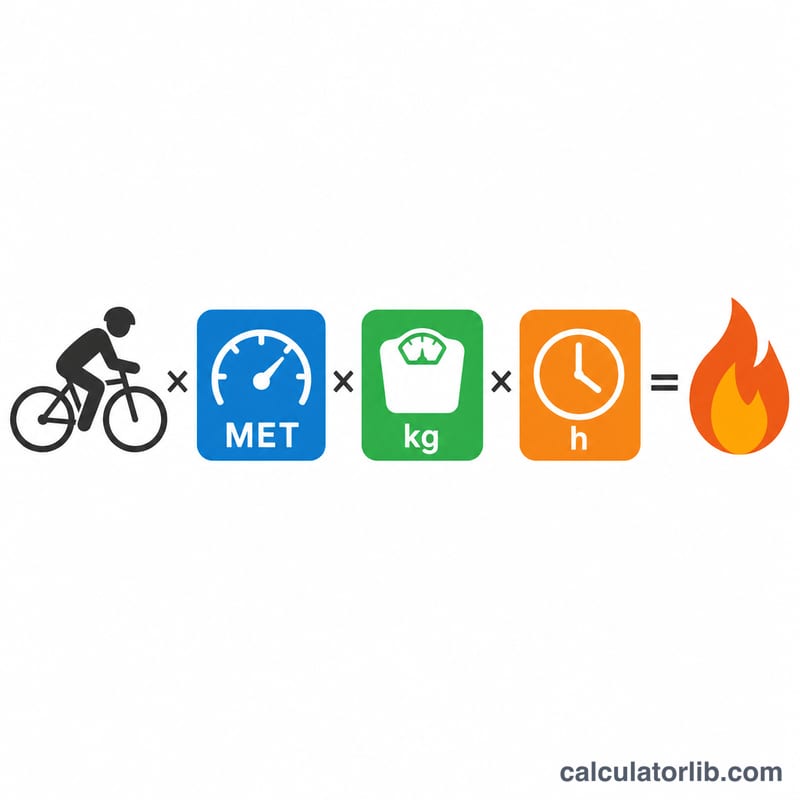
Calories burned are calculated as $$\text{kcal} = \text{MET} \times \text{weight (kg)} \times \text{hours}$$ One MET represents the energy used while sitting quietly (about 1 kcal per kg of body weight per hour). Leisurely cycling under 16 km/h is roughly 4 METs, while racing above 32 km/h reaches about 16.8 METs. We convert your minutes to hours (\(\text{minutes} \div 60\)) before multiplying.
Worked Example
A 70 kg rider cycles for 60 minutes at a moderate pace of 19–22 km/h (MET 8.0). That is $$8.0 \times 70 \times 1 \text{ hour} = 560 \text{ kcal}$$ The same rider going for just 30 minutes would burn \(8.0 \times 70 \times 0.5 = 280\) kcal.
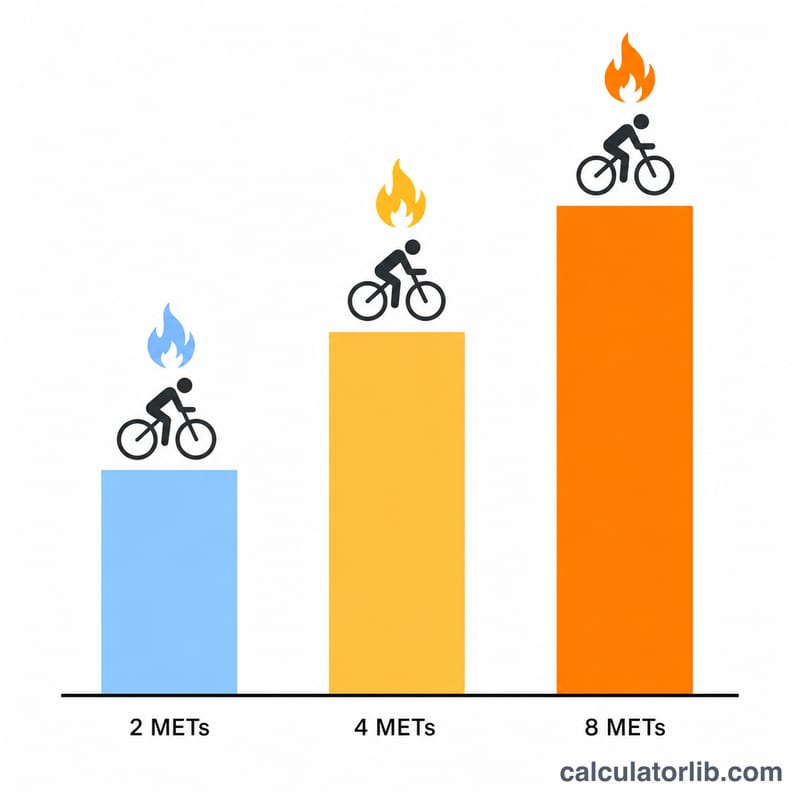
Cycling MET Values by Speed
The calculator uses MET (metabolic equivalent of task) values for bicycling from the Compendium of Physical Activities (Ainsworth et al.; maintained by the Compendium of Physical Activities project). One MET is resting energy use, roughly 1 kcal per kg of body weight per hour. The table gives the values used for general road or leisure cycling on level ground. Speed bands are approximate conversions between km/h and mph.
| Speed (km/h) | Speed (mph) | Effort description | MET value |
|---|---|---|---|
| Under 16 | Under 10 | Leisure, light effort | 4.0 |
| 16–19 | 10–11.9 | Light to moderate effort | 6.8 |
| 19–22 | 12–13.9 | Moderate effort | 8.0 |
| 22–26 | 14–15.9 | Vigorous effort | 10.0 |
| 26–30 | 16–19 | Very vigorous effort | 12.0 |
| Over 32 | Over 20 | Racing | 16.8 |
Source: Compendium of Physical Activities, bicycling category. Values are averages for groups of people and are not exact for any one rider.
Calories Burned by Weight, Speed and Duration
Each value is calculated as kcal = MET × body weight (kg) × duration (hours). For example, a 70 kg rider cycling for 60 minutes at MET 4.0 burns \(4.0 \times 70 \times 1 = \) 280 kcal. A 60 kg rider cycling for 60 minutes at MET 12.0 burns \(12.0 \times 60 \times 1 = \) 720 kcal.
| Intensity (MET) | Duration | 60 kg | 70 kg | 85 kg |
|---|---|---|---|---|
| Leisurely (4.0) | 30 min | 120 kcal | 140 kcal | 170 kcal |
| Leisurely (4.0) | 60 min | 240 kcal | 280 kcal | 340 kcal |
| Moderate (8.0) | 30 min | 240 kcal | 280 kcal | 340 kcal |
| Moderate (8.0) | 60 min | 480 kcal | 560 kcal | 680 kcal |
| Vigorous (12.0) | 30 min | 360 kcal | 420 kcal | 510 kcal |
| Vigorous (12.0) | 60 min | 720 kcal | 840 kcal | 1,020 kcal |
Calories scale linearly with both weight and time. Doubling the duration doubles the total, and a heavier rider burns proportionally more at the same MET.
Interpreting Your Result
Gross, not net. The MET method gives gross energy expenditure. This includes the energy your body would use at rest during the same time (about 1 MET). To estimate only the extra energy from riding, subtract 1 MET: for a 70 kg rider cycling 1 hour at MET 4.0, the gross figure is 280 kcal and the net figure is \((4.0 - 1) \times 70 \times 1 = 210\) kcal.
An estimate. MET values are averages from measured groups. Individual energy use can differ because of body composition, age, sex, cycling efficiency and metabolic rate. Treat the result as an approximation, not a precise measurement.
Intensity categories. In the standard physical activity classification, activities below 3 METs are light, 3 to 6 METs are moderate, and above 6 METs are vigorous. On this scale, leisure cycling at MET 4.0 is moderate. The 6.8, 8.0, 10.0, 12.0 and 16.8 MET bands are all vigorous.
Factors that shift actual burn.
- Terrain: climbing raises energy use well above the level-ground MET value, while long descents lower it.
- Wind: a headwind increases the power needed to hold a given speed. A tailwind reduces it, so speed alone is an imperfect measure of effort.
- Bike type: mountain bikes, heavier bikes and wide, knobbly tyres need more effort at the same speed than a light road bike. Stationary bikes are rated by effort level rather than speed.
- Fitness and technique: more efficient riders may use somewhat less energy at the same speed. Drafting in a group also lowers the effort needed at a given speed.
FAQ
Why does speed matter so much? Higher speeds require dramatically more power to overcome air resistance, so the MET value rises sharply, increasing calorie burn.
Is this exact? MET-based estimates are good approximations but real burn varies with fitness, terrain, wind, bike type and body composition. Use it as a guide, not a precise measurement.
What if I weigh in pounds? Divide your weight in pounds by 2.205 to get kilograms before entering it.