What this calculator does
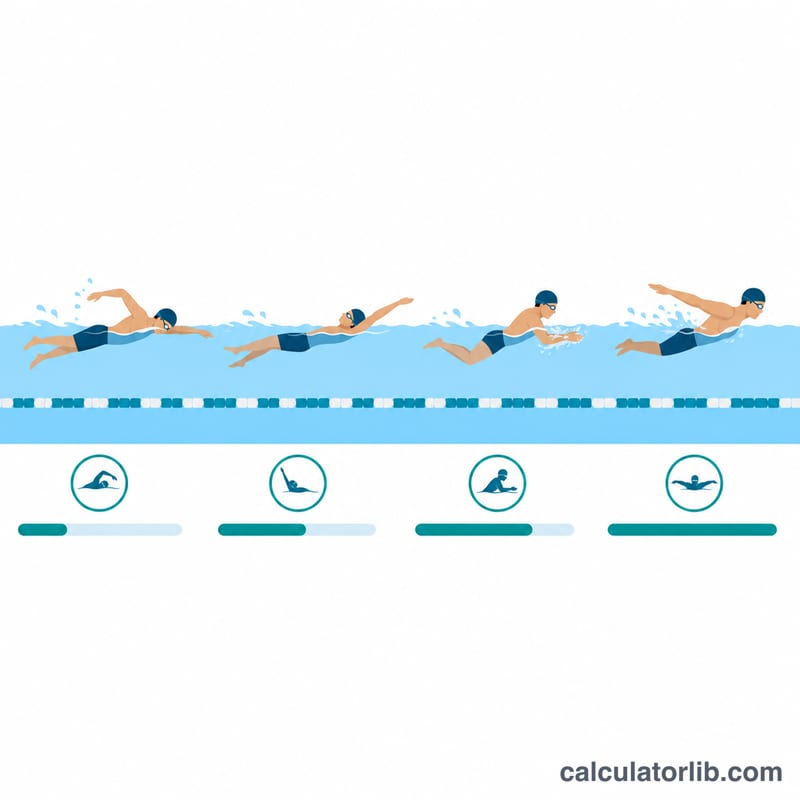
The Calories Burned Swimming Calculator estimates how many calories you expend in the water based on your swimming intensity (stroke), your body weight, and how long you swim. Swimming is a full-body, low-impact workout, and energy expenditure varies a lot between an easy float and a hard butterfly set — this tool captures that with stroke-specific MET values.
How to use it
Pick the stroke or intensity that best matches your session, enter your body weight in kilograms, and enter the duration of your swim in minutes. The calculator returns total calories burned plus your burn rate per minute and per hour so you can compare workouts.
The formula explained
The calculation uses the standard MET (Metabolic Equivalent of Task) energy equation: $$\text{kcal} = \frac{\text{MET} \times 3.5 \times \text{weight(kg)}}{200} \times \text{minutes}$$. One MET is the energy cost of sitting quietly (about 3.5 ml of oxygen per kg per minute). Multiplying by 3.5 and dividing by 200 converts oxygen use into kilocalories. Faster, more demanding strokes have higher MET values — leisurely swimming is around 6, vigorous freestyle around 9.8, and butterfly around 13.8.
Worked example
A 70 kg swimmer doing 30 minutes of light/moderate freestyle (MET 5.8): $$\text{kcal} = \frac{5.8 \times 3.5 \times 70}{200} \times 30 = 213.15 \text{ calories}$$ — roughly 7.1 kcal per minute, or about 426 kcal per hour.
Swimming MET Values by Stroke and Intensity
A MET (metabolic equivalent of task) expresses exercise intensity as a multiple of resting energy use. The values below are approximate and follow the swimming entries of the Adult Compendium of Physical Activities (2024). Different Compendium editions list slightly different numbers, so published tables and apps rarely match exactly. This calculator uses a fixed set of presets (4.8, 5.3, 5.8, 6.0, 9.5, 9.8, 10.3 and 13.8), shown in the last column where they apply.
| Activity | Approx. Compendium MET | Calculator preset |
|---|---|---|
| Treading water, moderate effort | 3.5 | not a preset |
| Treading water, vigorous effort | 9.8 | not a preset |
| Leisurely general swimming | 6.0 | 6 |
| Backstroke, recreational | 4.8 | 4.8 |
| Backstroke, laps | 9.5 | 9.5 |
| Breaststroke, recreational | 5.3 | 5.3 |
| Breaststroke, laps | 10.3 | 10.3 |
| Freestyle, light to moderate effort | 5.8 | 5.8 |
| Freestyle, vigorous effort | 9.8 | 9.8 |
| Butterfly | 13.8 | 13.8 |
If your source lists a different value, choose the closest preset.
Calories Burned by Body Weight, Stroke and Duration
Each value is the energy burned in 30 minutes, computed with
$$\text{kcal} = \text{MET} \times 3.5 \times \frac{\text{kg}}{200} \times \text{minutes}$$
For 30 minutes this simplifies to kcal = MET × kg × 0.525. Example: MET 6 at 100 kg gives 6 × 3.5 × 100 / 200 × 30 = 315 kcal. Likewise, MET 9.8 at 100 kg gives 9.8 × 3.5 × 100 / 200 × 30 = 515 kcal.
| Body weight | Leisurely (MET 6) | Light/moderate freestyle (MET 5.8) | Vigorous freestyle (MET 9.8) | Butterfly (MET 13.8) |
|---|---|---|---|---|
| 55 kg | 173 kcal | 167 kcal | 283 kcal | 398 kcal |
| 70 kg | 221 kcal | 213 kcal | 360 kcal | 507 kcal |
| 85 kg | 268 kcal | 259 kcal | 437 kcal | 616 kcal |
| 100 kg | 315 kcal | 305 kcal | 515 kcal | 725 kcal |
Values are rounded to the nearest whole kcal. Energy scales linearly with time, so 60 minutes doubles each figure and 15 minutes halves it.
Interpreting Your Calorie Estimate
The MET formula returns gross energy expenditure: the total energy used during the swim, including the resting metabolism your body would have spent anyway over the same minutes. It is not the extra energy above resting. At 1 MET the formula gives about 1 kcal per kg per hour, which is the resting baseline.
MET values are commonly grouped into intensity categories: light is below 3 METs, moderate is 3 to under 6 METs, and vigorous is 6 METs or more. Most swimming presets in this calculator (6 and above) fall in the vigorous range. Only slow recreational backstroke or breaststroke and easy treading water fall in the moderate range.
The formula uses one fixed MET per activity and ignores several things that change real energy use:
- Skill and stroke efficiency: a technically efficient swimmer covers a given distance with less energy than a beginner at the same speed.
- Water temperature: cold water can raise energy use through thermoregulation, and very warm water can change heart rate and effort.
- Drafting and rest intervals: swimming behind another swimmer, pushing off walls and pausing between sets all lower the average intensity below the nominal MET.
- Body composition: the formula uses total body weight only. Fat mass, muscle mass and buoyancy are not considered.
MET-based estimates typically carry an error of roughly 5–15% for an average person. For an individual swimmer the gap can be larger, because swimming is harder to standardize than walking or running. Treat the result as an approximate figure for comparing sessions, not a precise measurement. This page gives general information only and does not offer medical or weight-loss advice.
FAQ
Are these numbers exact? No. MET-based estimates are population averages. Your real burn depends on fitness, efficiency, water temperature and effort.
What if I weigh in pounds? Convert to kilograms first: divide pounds by 2.205. A 154 lb swimmer is about 70 kg.
Which stroke burns the most? Butterfly (MET ~13.8) is the most demanding, followed by vigorous freestyle and breaststroke. Easy recreational swimming burns the least.