What Is the METs to VO2 Conversion Calculator?
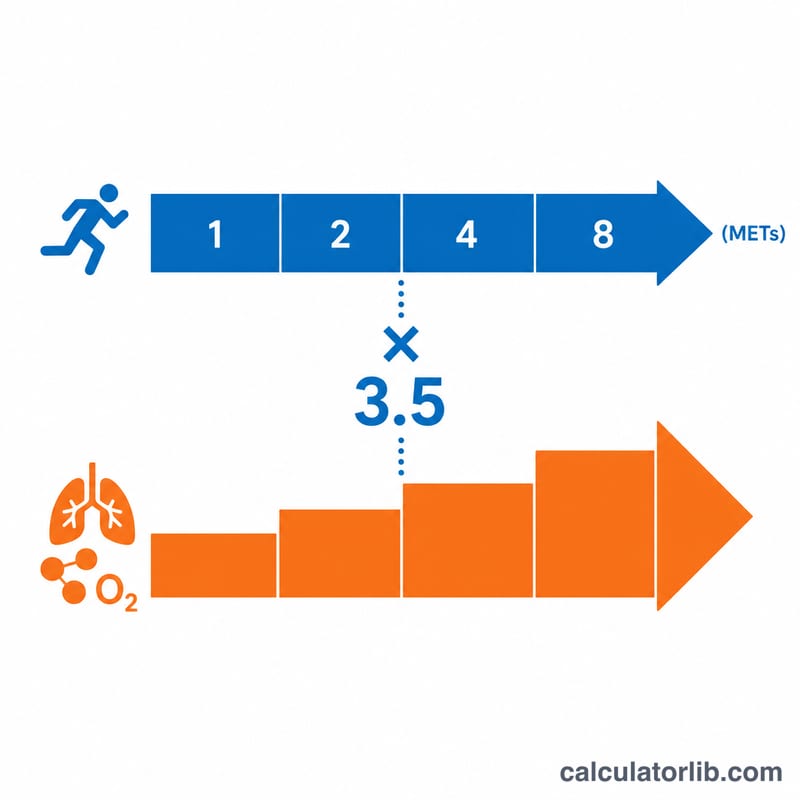
This calculator converts a metabolic equivalent of task (MET) value into oxygen consumption (VO2) expressed in milliliters of oxygen per kilogram of body weight per minute (mL/kg/min). One MET represents the resting metabolic rate — the amount of oxygen your body uses while sitting quietly. By convention, 1 MET equals 3.5 mL/kg/min of oxygen uptake. The tool is universal and applies to any healthy adult regardless of country.
How to Use It
Enter the activity intensity in METs (for example, brisk walking is roughly 4 METs and running is 8–11 METs). Optionally enter your body weight in kilograms to also see your absolute oxygen consumption in liters per minute. Click calculate to view your relative VO2 and, if weight is provided, your absolute VO2.
The Formula Explained
The core relationship is $$\text{VO}_2 = \text{METs} \times 3.5 \ \text{mL/kg/min}$$. To convert this relative figure to an absolute rate, multiply by body weight and divide by 1000 to change milliliters to liters: $$\text{VO}_2^{\,abs} = \frac{\text{METs} \times 3.5 \times \text{Weight (kg)}}{1000} \ \text{L/min}$$.
Worked Example
Suppose an activity is rated at 8 METs for a 70 kg person. Relative VO2 = \(8 \times 3.5 = 28\) mL/kg/min. Absolute VO2 = \(28 \times 70 \div 1000 = 1.96\) L/min. So this activity demands about 28 mL/kg/min, or just under 2 liters of oxygen per minute for this individual.
Exercise Intensity Categories by METs
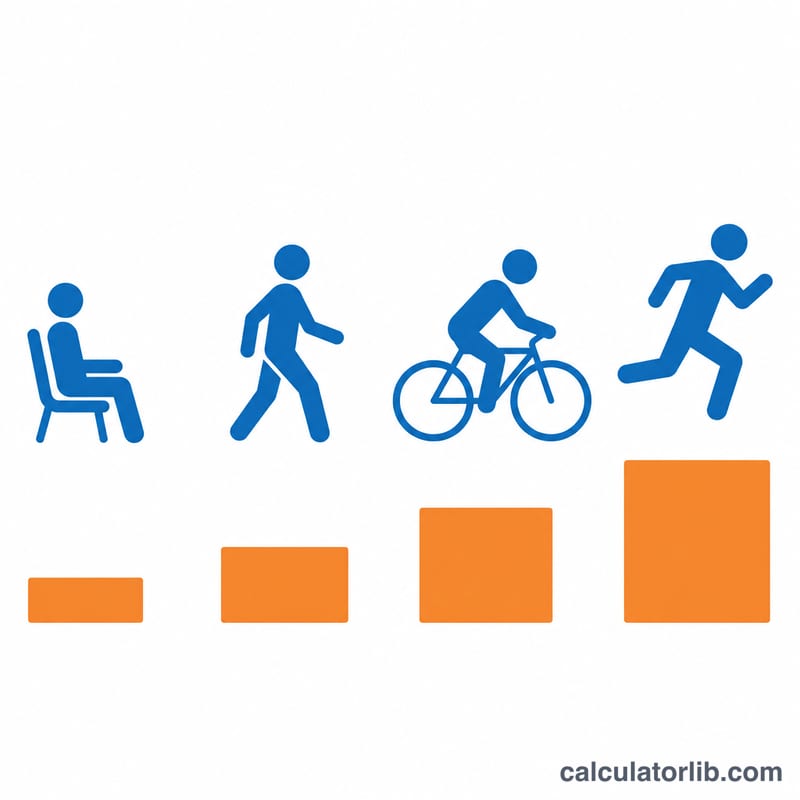
Public-health guidance, including the Physical Activity Guidelines for Americans (U.S. Department of Health and Human Services, 2nd edition, 2018), the CDC, and the American College of Sports Medicine (ACSM), classifies absolute intensity by MET value:
| Category | METs | VO2 (mL/kg/min) |
|---|---|---|
| Sedentary behavior | below 1.5 (while sitting or reclining) | below about 5.3 |
| Light intensity | 1.5-2.9 | about 5.3-10.2 |
| Moderate intensity | 3.0-5.9 | 10.5-20.7 |
| Vigorous intensity | 6.0 or higher | 21.0 or higher |
These are absolute-intensity cutoffs. They do not account for an individual's fitness: the same activity can feel moderate to a fit person and vigorous to a less fit one. The thresholds are used in the guidelines of these bodies (US-based, widely referenced internationally), and other organizations may use slightly different cutoffs.
Interpreting Your VO2 Result
The result is the estimated oxygen demand of an activity, based on its MET value. It is not a measurement of your fitness or of your VO2max (the highest rate of oxygen use you can reach during maximal exercise). A result of 34.3 mL/kg/min for running at 6 mph means the activity is estimated to require that much oxygen per kilogram of body mass. It does not mean you can sustain that effort.
For context, VO2max is commonly reported in roughly these ranges: many untrained adults fall around 25-40 mL/kg/min, regularly active people often fall in the 40s to 50s, and elite endurance athletes can exceed 70 mL/kg/min. Values vary widely with age and sex. Dividing a VO2max by 3.5 gives a rough maximal MET capacity (for example, 35 mL/kg/min ≈ 10 METs).
Keep these limits in mind:
- The 3.5 mL/kg/min per MET is a standard approximation of resting oxygen use. Actual resting values vary with age, sex, body composition, and fitness.
- Compendium MET values are averages for groups doing an activity. Your own cost depends on speed, terrain, technique, body size, and environment.
- Per-kilogram values scale poorly for people with higher body fat. Absolute VO2 in L/min equals mL/kg/min × body weight (kg) ÷ 1000.
This is general educational information, not medical advice. For questions about exercise intensity or testing your fitness, consult a qualified health or exercise professional.
FAQ
Why is 1 MET equal to 3.5 mL/kg/min? It is the standard reference value for resting oxygen uptake adopted by exercise physiologists, though actual resting metabolism varies between people.
Do I need to enter weight? No. Weight is only needed if you want absolute oxygen consumption in L/min; the relative value (mL/kg/min) does not require it.
Can I convert VO2 back to METs? Yes — simply divide your VO2 in mL/kg/min by 3.5 to get the equivalent METs.