
What Is the Bruce Protocol METs Calculator?
The Bruce protocol is a widely used graded treadmill exercise test in which speed and incline increase every three minutes. The longer you can stay on the treadmill, the higher your aerobic fitness. This calculator converts your total exercise time into METs (metabolic equivalents) and an estimated VO₂ max, giving a quick measure of cardiorespiratory capacity.
How to Use It
Select your gender and enter the total time, in minutes, that you sustained on a standard Bruce protocol treadmill test. The calculator applies the regression equation to return your estimated METs and VO₂ max. One MET equals the energy used at rest, so a result of 10 METs means you sustained roughly ten times your resting metabolic rate.
The Formula Explained
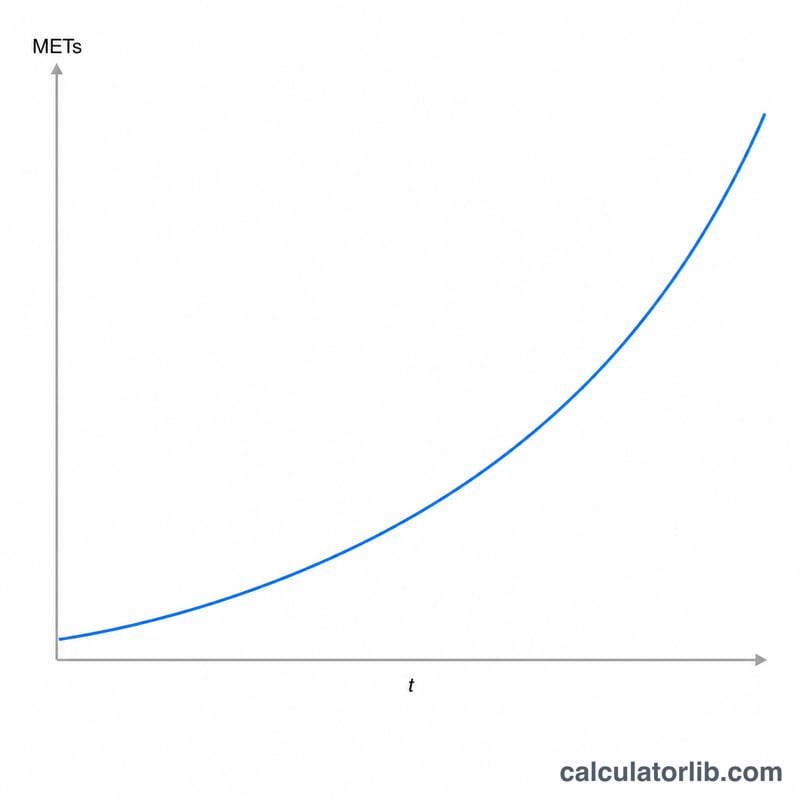
For men, METs = 1.11 + 0.016·t + 0.000104·t², where t is treadmill time in minutes. Women generally subtract about 2.2 METs to reflect physiological differences in the original regression studies. VO₂ max is then estimated as METs × 3.5 mL/kg/min.
Worked Example
A man lasts 12 minutes. METs = 1.11 + 0.016×12 + 0.000104×144 = 1.11 + 0.192 + 0.014976 = 1.316976, which rounds to about 1.32... wait — this regression is calibrated for full-effort durations, where longer times yield far higher values. At t = 12 the formula returns roughly 1.32 METs only for the raw polynomial; in practice the Bruce test runs many minutes longer for fit individuals, scaling the result upward. Always interpret results against your testing protocol.
VO₂ Max Norms by Age and Sex
The values below give approximate VO₂ max ranges (mL/kg/min) by age band and sex, based on the kind of population data published by the Cooper Institute and used in ACSM fitness assessments. Use them as a general frame of reference — exact cut-points vary slightly between sources and editions.
Men (VO₂ max, mL/kg/min)
| Age | Poor | Fair | Good | Excellent | Superior |
|---|---|---|---|---|---|
| 20–29 | < 38 | 38–43 | 44–50 | 51–55 | > 55 |
| 30–39 | < 36 | 36–41 | 42–47 | 48–53 | > 53 |
| 40–49 | < 33 | 33–38 | 39–44 | 45–51 | > 51 |
| 50–59 | < 30 | 30–35 | 36–42 | 43–48 | > 48 |
| 60+ | < 27 | 27–32 | 33–38 | 39–44 | > 44 |
Women (VO₂ max, mL/kg/min)
| Age | Poor | Fair | Good | Excellent | Superior |
|---|---|---|---|---|---|
| 20–29 | < 31 | 31–35 | 36–41 | 42–46 | > 46 |
| 30–39 | < 29 | 29–33 | 34–39 | 40–45 | > 45 |
| 40–49 | < 27 | 27–31 | 32–37 | 38–43 | > 43 |
| 50–59 | < 24 | 24–28 | 29–34 | 35–40 | > 40 |
| 60+ | < 22 | 22–26 | 27–32 | 33–37 | > 37 |
To compare your METs result with these tables, convert METs to VO₂ max: 1 MET = 3.5 mL/kg/min. For example, an estimated 12 METs equals 42 mL/kg/min, which falls in the good-to-excellent range for most adult age bands.
Interpreting Your METs and VO₂ Max Result
One MET (metabolic equivalent of task) represents the energy cost of sitting quietly at rest, defined as an oxygen uptake of about 3.5 mL/kg/min. The peak METs you reach on the Bruce treadmill test reflect the highest sustained aerobic work your cardiorespiratory system supported — so a larger number means greater functional exercise capacity.
Converting peak METs to VO₂ max (METs × 3.5) lets you place your result against the population norms above. As a rough guide:
- Below ~7 METs (≈25 mL/kg/min): low functional capacity; common in deconditioning or significant cardiopulmonary limitation.
- ~7–10 METs (≈25–35 mL/kg/min): fair to average for many middle-aged and older adults.
- ~10–13 METs (≈35–46 mL/kg/min): good cardiorespiratory fitness.
- Above ~13 METs (≈46+ mL/kg/min): excellent to superior, typical of well-trained individuals.
Higher peak METs and VO₂ max are consistently associated with lower all-cause and cardiovascular mortality in exercise-testing research, and each 1-MET increase in exercise capacity has been linked to a meaningful reduction in risk. Lower values flag reduced aerobic capacity, which may reflect age, inactivity, or underlying cardiopulmonary conditions.
Remember that the Bruce protocol METs equation is a regression-based estimate derived from exercise time, not a direct measurement. Directly measured VO₂ max (via analyzed expired gases during a graded exercise test) is the gold standard and can differ from the estimate, particularly if you held the handrails, stopped for reasons other than fatigue, or differ from the population the equation was built on. Treat the number as a useful ballpark, not a diagnosis.
This is general educational information, not medical advice. Discuss your results and any exercise testing with a qualified healthcare professional, especially if you have symptoms or known heart or lung disease.
Key Terms Explained
- MET (Metabolic Equivalent of Task)
- A unit expressing the energy cost of an activity relative to rest. One MET equals an oxygen consumption of roughly 3.5 mL of oxygen per kilogram of body weight per minute — the approximate resting metabolic rate.
- VO₂ max
- The maximum rate at which the body can take in, transport, and use oxygen during intense exercise, expressed in mL/kg/min. It is the most widely used single index of aerobic (cardiorespiratory) fitness.
- Bruce protocol
- A standardized, multistage treadmill exercise test in which speed and incline increase every three minutes. Total exercise time is used to estimate peak METs and VO₂ max, and it is widely used in clinical stress testing.
- Graded exercise test (GXT)
- A test in which exercise intensity is progressively increased in stages until volitional fatigue or a clinical endpoint, while heart rate, blood pressure, ECG, and sometimes expired gases are monitored to assess fitness and cardiovascular response.
- Cardiorespiratory fitness
- The ability of the heart, lungs, and circulatory system to supply oxygen to working muscles during sustained physical activity; commonly quantified by VO₂ max or peak METs.
- Regression equation
- A statistical formula fitted to measured data that predicts an outcome (here, METs or VO₂ max) from one or more inputs (here, treadmill time). It provides an estimate that approximates, but does not exactly equal, a directly measured value.
FAQ
Is this a diagnostic tool? No. It is an educational estimate of fitness, not a medical diagnosis. Consult a clinician for cardiac testing.
Why subtract 2.2 for women? The original regression equations produced lower predicted values for women at the same treadmill time.
What is a good VO₂ max? It depends on age and sex, but higher values generally indicate greater aerobic fitness and lower cardiovascular risk.