
What Is the Heart Rate Zone Calculator?
This calculator splits your effort into five training zones based on a percentage of your maximum heart rate (HRmax). Each zone targets a different physiological adaptation — from gentle recovery to all-out sprints — so you can train with intent instead of guessing how hard to push.

How to Use It
Enter your age and the tool estimates HRmax using the classic 220 − age formula. If you know your true HRmax from a lab or field test, choose the manual option and type it in for more accurate zones. The results table shows the beats-per-minute range for each of the five zones.
The Formula Explained
First, maximum heart rate is estimated:
$$\text{HR}_{\max} = 220 - \text{Age}$$Each zone is then a window of that maximum:
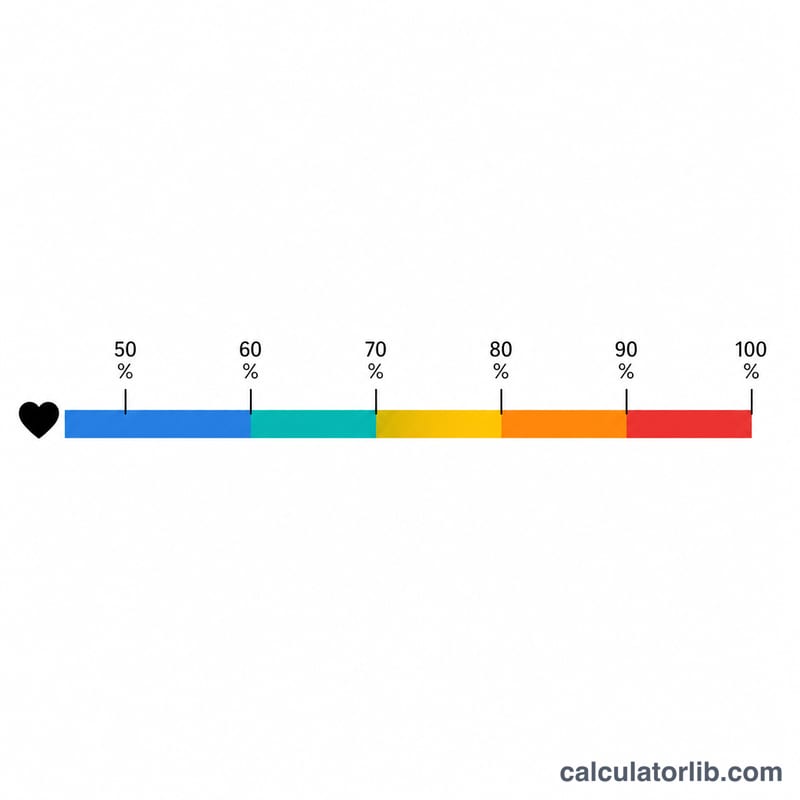
Zone 1 (50–60%) very light/recovery, Zone 2 (60–70%) light/fat burn and base endurance, Zone 3 (70–80%) moderate/aerobic, Zone 4 (80–90%) hard/anaerobic threshold, Zone 5 (90–100%) maximum/VO₂ max. Each boundary is simply \(\text{HR}_{\max} \times \text{percentage}\).
Worked Example
For a 30-year-old:
$$\text{HR}_{\max} = 220 - 30 = 190\ \text{bpm}$$Zone 2 runs from \(190 \times 0.60 = 114\) to \(190 \times 0.70 = 133\) bpm. Zone 4 runs from \(190 \times 0.80 = 152\) to \(190 \times 0.90 = 171\) bpm. So an easy endurance run should keep the heart around 114–133 bpm.
FAQ
Is 220 − age accurate? It is a population average and can be off by 10–12 bpm for any individual. A measured HRmax from a max-effort test is more reliable.
Which zone burns the most fat? Zones 2–3 use a high proportion of fat as fuel, but total calorie burn (and overall fitness) improves across all zones.
How often should I train hard? Most plans keep about 80% of time in Zones 1–2 and 20% in Zones 4–5, a pattern called polarized training.