
What the Target Heart Rate Calculator Does
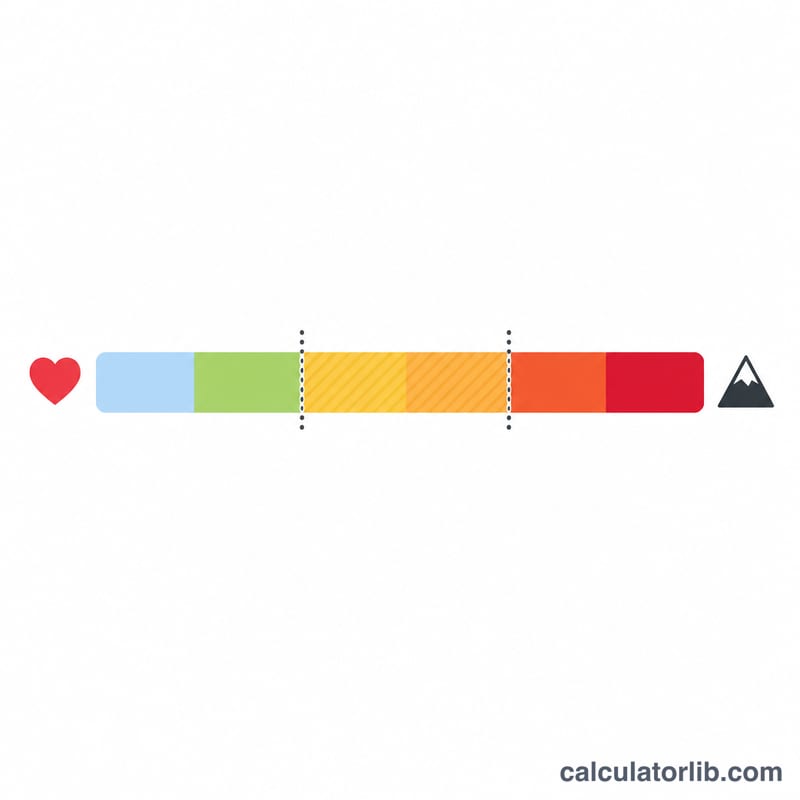
This calculator works out the heart rate zones you should aim for during exercise, based on two simple inputs. Instead of using a one-size-fits-all percentage of maximum heart rate, it applies the Karvonen method, which factors in your resting heart rate to give a more personalized training range. The result is five intensity zones, each with a minimum and maximum beats-per-minute (bpm) target.
The Two Inputs You Enter
- Age: Used to estimate your maximum heart rate. If left blank, the calculator defaults to 30.
- Resting Heart Rate (bpm): Your pulse when fully at rest, ideally measured first thing in the morning. Defaults to 70 if not entered.
The Formula Explained
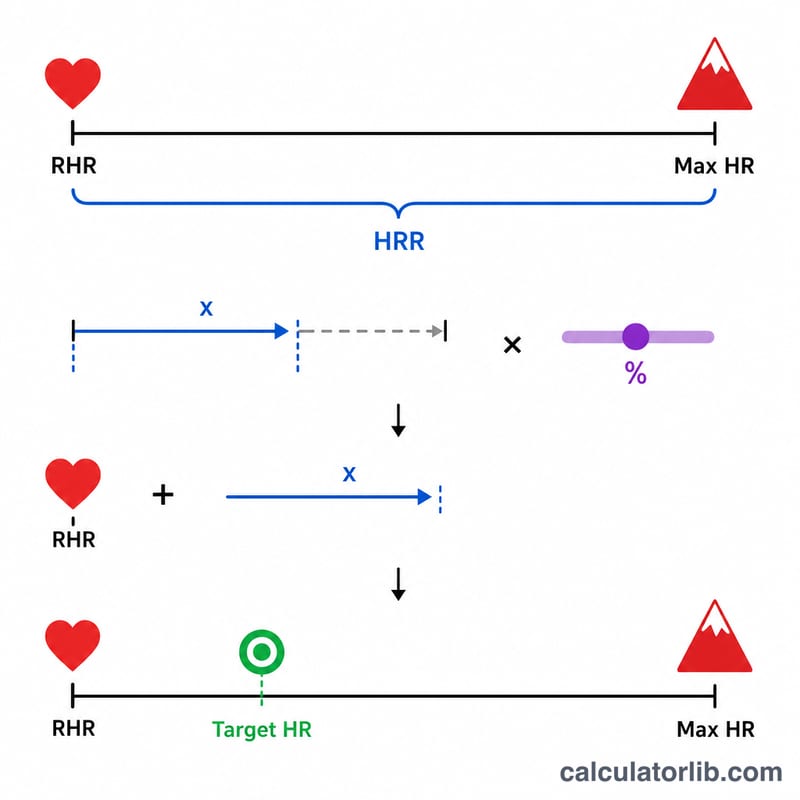
The calculator uses the Karvonen heart rate reserve method in three steps:
- Maximum heart rate = \(220 - \text{Age}\)
- Heart Rate Reserve (HRR) = Max heart rate − Resting heart rate
- Target rate = Resting heart rate + (HRR × intensity %)
The full formula is:
$$\text{THR} = \text{RHR} + \left[\left(220 - \text{Age} - \text{RHR}\right) \times \%\,\text{Intensity}\right]$$Each zone uses a percentage band of your reserve: Very Light (30–40%), Light (40–50%), Moderate (50–60%), Hard (60–70%) and Maximum (70–80%).
Worked Example
Suppose you are 30 years old with a resting heart rate of 70 bpm:
- Maximum heart rate = \(220 - 30 = \) 190 bpm
- Heart Rate Reserve = \(190 - 70 = \) 120 bpm
- Moderate zone (50–60%): \(70 + (120 \times 0.5) = 130\) bpm up to \(70 + (120 \times 0.6) = \) 142 bpm
- Hard zone (60–70%): 142 bpm up to \(70 + (120 \times 0.7) = \) 154 bpm
So during a moderate cardio session, this person would aim to keep their heart rate between roughly 130 and 142 bpm.
Frequently Asked Questions
Why does the calculator ask for resting heart rate? Including resting heart rate via the Karvonen method makes the zones more individual. Two people the same age but with different fitness levels (and therefore different resting rates) get different targets, which a plain percentage-of-max formula cannot capture.
How do I measure my resting heart rate? Count your pulse for 60 seconds while still in bed in the morning, before getting up or drinking caffeine. Repeat over a few days and take the average for accuracy.
Which zone should I train in? Light and moderate zones suit endurance building and fat-burning steady cardio, while hard and maximum zones suit shorter high-intensity intervals. Mixing zones across the week generally produces the best fitness gains. The \(220 - \text{age}\) formula is an estimate, so consult a doctor if you have any heart conditions.