
What Is the Karvonen Formula?
The Karvonen formula is a widely used method for calculating your target heart rate (THR) during exercise. Unlike the simpler percentage-of-maximum approach, it factors in your resting heart rate, making it personalized to your individual fitness level. The method is based on your heart rate reserve (HRR) — the gap between your maximum heart rate and your resting heart rate.
How to Use This Calculator
Enter your age, your resting heart rate (measured first thing in the morning before getting up), and the lower and upper intensity percentages that define your training zone. The calculator returns the target beats per minute (bpm) for both ends of the zone, plus your estimated maximum heart rate and heart rate reserve.
The Formula Explained
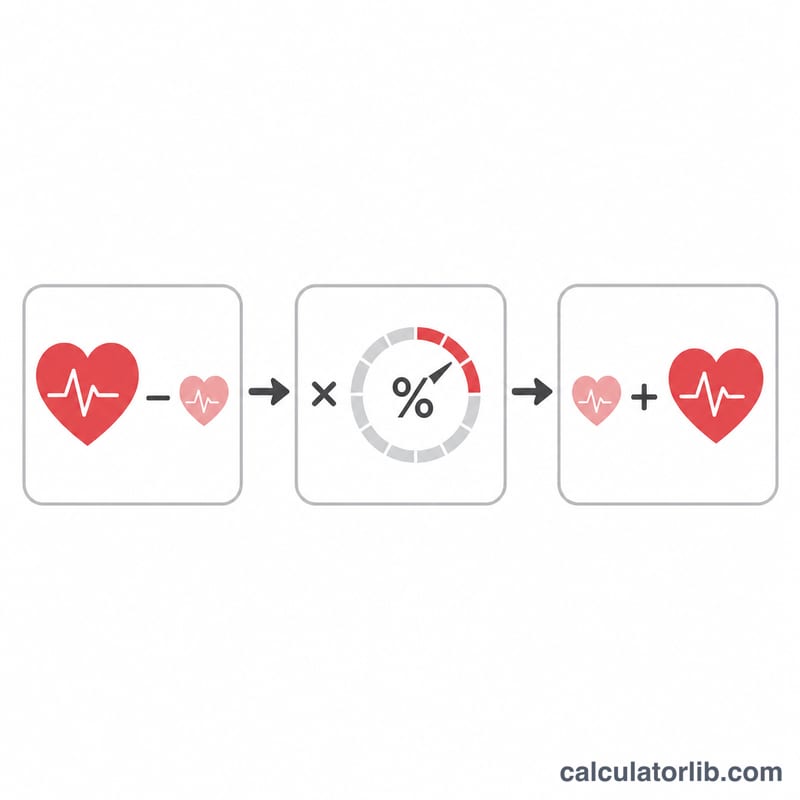
First, estimate maximum heart rate as 220 − age. Subtract resting heart rate to get the heart rate reserve. Multiply that reserve by your chosen intensity (as a decimal), then add the resting heart rate back:
$$\text{THR} = \left(\left(220 - \text{Age}\right) - \text{RHR}\right) \times \frac{\text{Intensity \%}}{100} + \text{RHR}$$
Worked Example
Suppose you are 30 years old with a resting heart rate of 60 bpm, training at 70% intensity. Maximum HR = \(220 - 30 = 190\). Reserve = \(190 - 60 = 130\). Target:
$$\text{Target} = 130 \times 0.70 + 60 = 91 + 60 = \mathbf{151 \text{ bpm}}$$
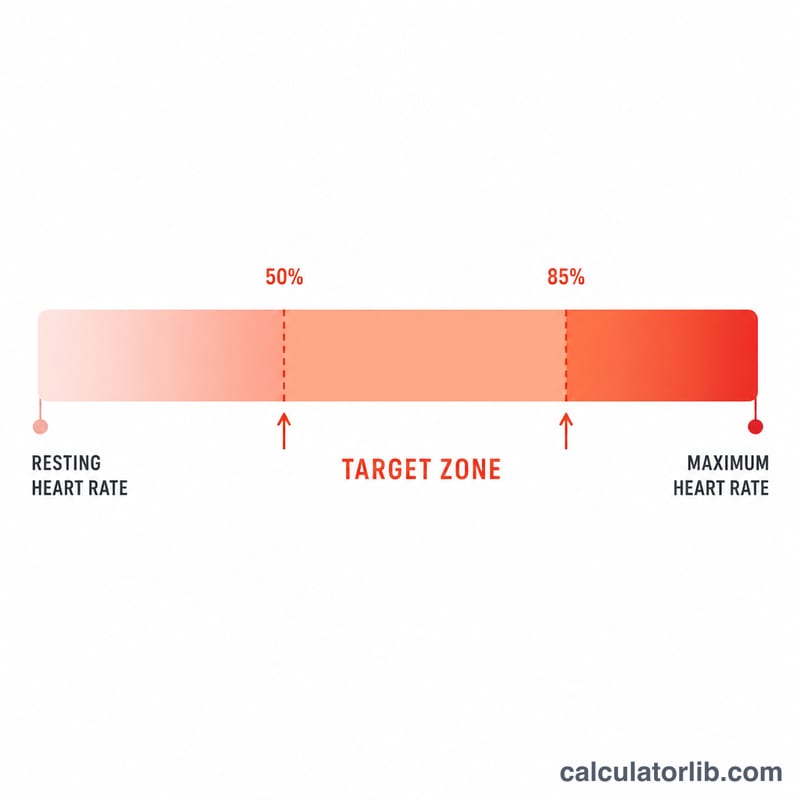
For a 50%–85% zone, the range would be 125 bpm to 170.5 bpm.
FAQ
What intensity should I use? Moderate aerobic training is typically 50–70% of HRR; vigorous training is around 70–85%.
Is 220 − age accurate? It is a population estimate and can vary by ±10–12 bpm between individuals. For best accuracy, use a measured maximum heart rate if you have one.
How do I measure resting heart rate? Count your pulse for 60 seconds while still in bed before rising, ideally averaged over several mornings.