
What Are Heart Rate Training Zones?
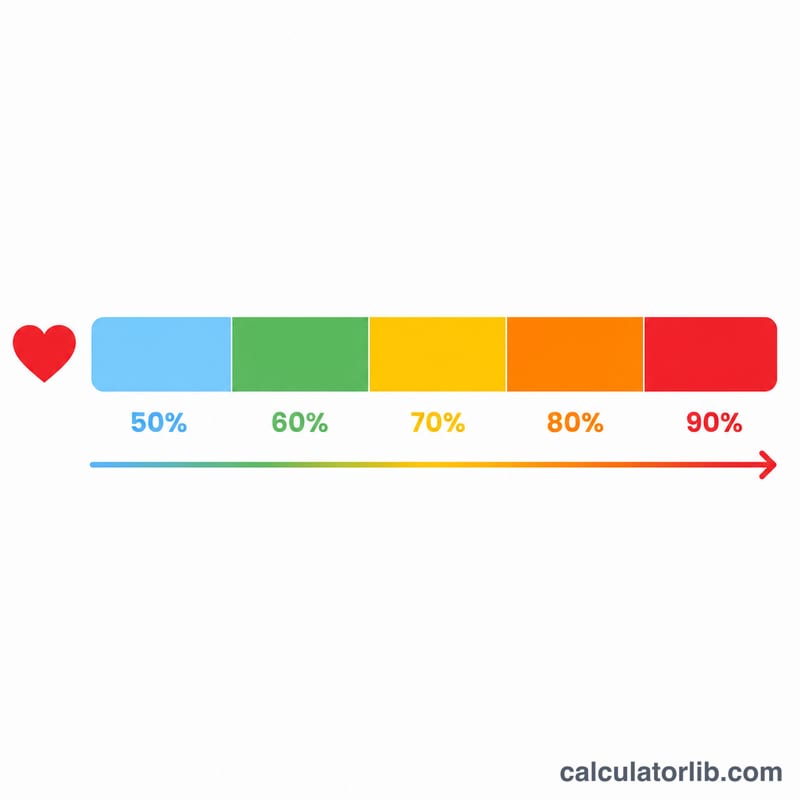
Heart rate training zones split your effort into five intensity bands based on a percentage of your maximum heart rate (MHR). Training in specific zones helps you target goals like fat burning, building aerobic endurance, or improving anaerobic power. This calculator estimates your MHR from your age and gives the heart-rate boundary for each of the five zones at 50%, 60%, 70%, 80% and 90%.
How to Use This Calculator
Enter your age in years. Optionally, you can note your resting heart rate for reference. The tool instantly computes your estimated maximum heart rate and the lower beats-per-minute boundary of each training zone. Use the table to plan workouts — for steady cardio aim for Zone 2–3, and for intervals push toward Zone 4–5.
The Formula Explained
The most widely used estimate of maximum heart rate is \(\text{MHR} = 220 - \text{age}\). Each zone boundary is then a fixed percentage of that maximum: Zone 1 = 50% × MHR, Zone 2 = 60%, Zone 3 = 70%, Zone 4 = 80% and Zone 5 = 90%. These are estimates; individual maximum heart rates can vary by 10–20 bpm, so treat the numbers as a starting guide.
$$\text{MHR} = 220 - \text{age}, \quad \text{Zone bound} = \%\text{MHR} \times \text{MHR}$$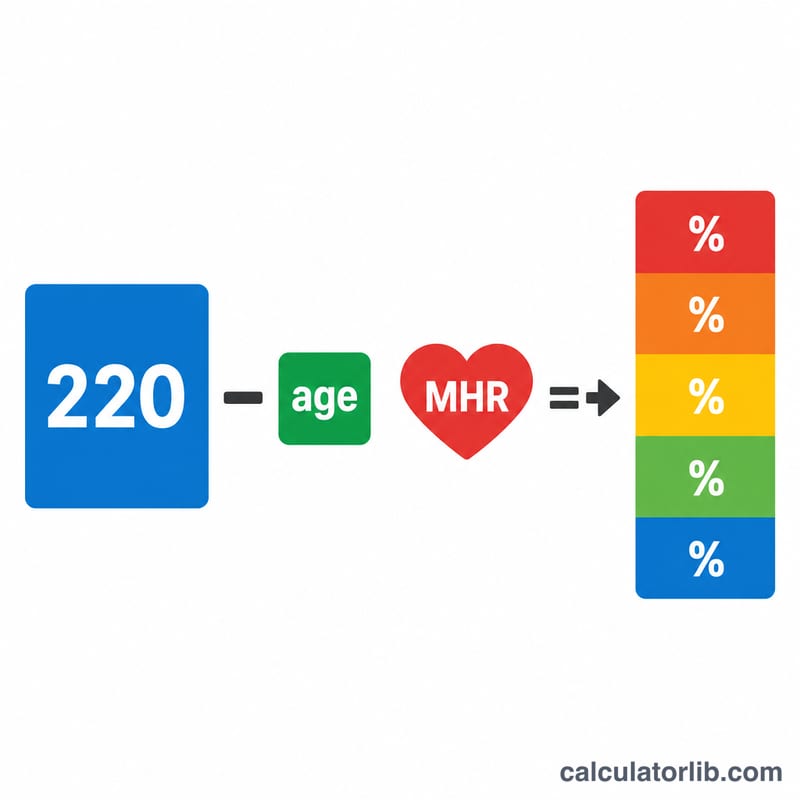
Worked Example
For a 30-year-old:
$$\text{MHR} = 220 - 30 = 190 \text{ bpm}$$Zone 1 lower bound = \(0.50 \times 190 = 95\) bpm, Zone 2 = \(0.60 \times 190 = 114\) bpm, Zone 3 = \(0.70 \times 190 = 133\) bpm, Zone 4 = \(0.80 \times 190 = 152\) bpm, and Zone 5 = \(0.90 \times 190 = 171\) bpm.
FAQ
Is the 220−age formula accurate? It is a simple population estimate. It works well for general fitness planning but may be off for any given individual; a measured field test is more precise.
Which zone burns the most fat? Lower zones (2–3) burn a higher proportion of fat, while higher zones burn more total calories. Both contribute to fat loss over time.
Can I use this if I'm on heart medication? Beta-blockers and similar drugs lower heart rate, making these estimates unreliable. Consult your doctor for personalized targets.