What is the Weight Loss Goal Date Calculator?
This calculator estimates how long it will take to reach your target weight, and on what date you'll get there, based on the daily calorie deficit you can sustain. It uses the widely accepted approximation that roughly 7,700 kcal equals 1 kilogram of body fat (about 3,500 kcal per pound).
How to use it
Enter your current weight in kilograms, your goal weight in kilograms, and the average calorie deficit you maintain each day (the gap between calories eaten and calories burned). The tool returns the number of weeks and days required, your average weekly loss, and an estimated calendar date.
The formula explained
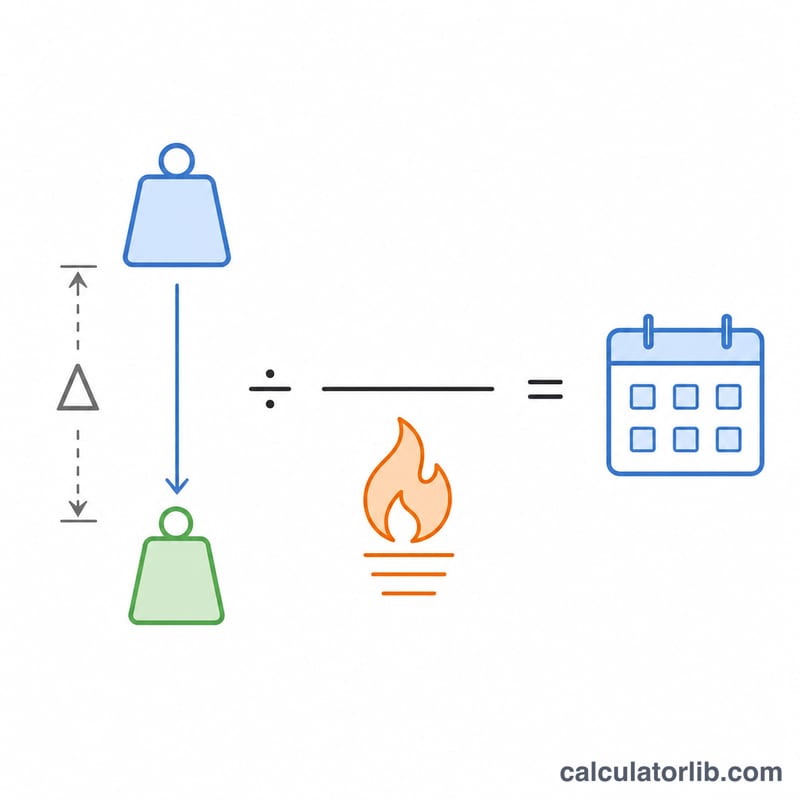
First the weekly deficit is found by multiplying your daily deficit by 7. Dividing that by 7,700 gives the kilograms of fat lost per week. Finally, the total weight to lose (current minus goal) is divided by that weekly loss to give the number of weeks: $$\text{weeks} = \frac{\text{current} - \text{goal}}{(\text{deficit}/\text{day} \times 7) / 7700}$$
Worked example
Suppose you weigh 80 kg, want to reach 70 kg, and run a 500 kcal/day deficit. Weekly deficit = \(500 \times 7 = 3{,}500\) kcal, equal to \(3{,}500 / 7{,}700 \approx 0.4545\) kg/week. To lose 10 kg: $$10 / 0.4545 \approx \textbf{22 weeks}$$ or about 154 days.
Goal Date Under Different Daily Deficits
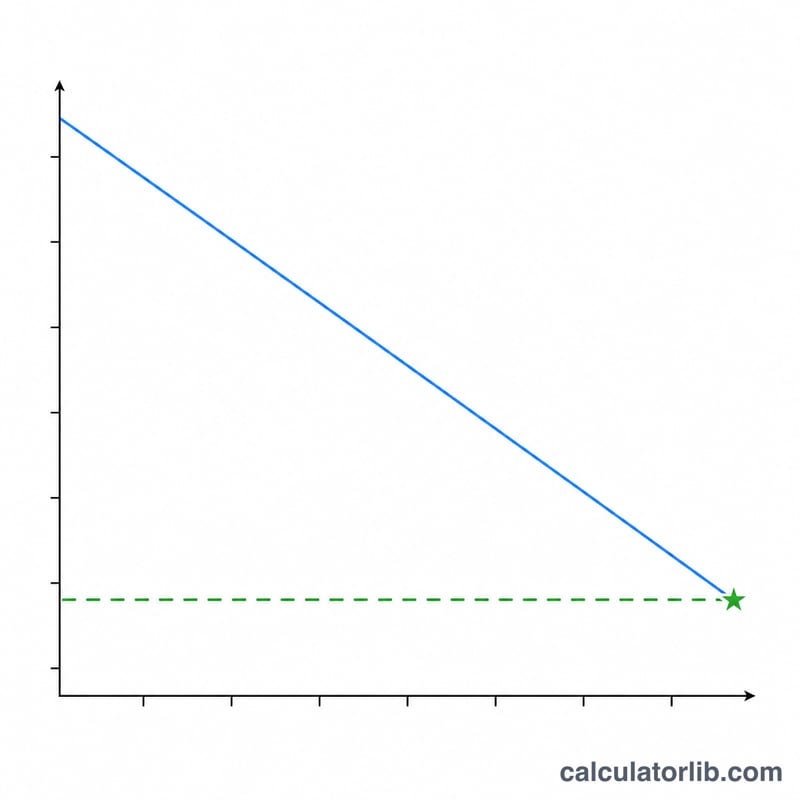
The table shows a fixed 10 kg loss (for example 80 kg to 70 kg) at four daily calorie deficits. It uses the common approximation of 7,700 kcal per kg of body weight, so 10 kg corresponds to 77,000 kcal. The calculator's formula reduces to \(\text{Days} = \frac{ \text{kg to lose} \times 7700}{\text{daily deficit}}\).
| Daily deficit (kcal) | Weekly loss (kg) | Weeks required | Days required |
|---|---|---|---|
| 250 | 0.23 (250 × 7 ÷ 7,700 = 0.227) | 44.0 | 308 |
| 500 | 0.45 (0.455) | 22.0 | 154 |
| 750 | 0.68 (0.682) | 14.7 (about 15) | 103 (102.7) |
| 1000 | 0.91 (0.909) | 11.0 | 77 |
Example for the 500 kcal row: \(\text{Days} = \frac{(80 - 70) \times 7700}{500} = \frac{77000}{500} = 154\) days, which is 22 weeks. Dividing 10 kg by the rounded 0.23 kg/week gives about 43.5 weeks for the 250 kcal row, so you may see 43 or 44 weeks depending on rounding. Unrounded, it is 44 weeks.
Interpreting Your Estimated Goal Date
The goal date is a linear estimate. It assumes the same daily deficit every day and that each 7,700 kcal of deficit removes exactly 1 kg of body weight. Real bodies do not follow a straight line, so treat the result as a central estimate within a range, not an exact deadline.
- Commonly cited rate: Public health bodies such as the US Centers for Disease Control and Prevention (CDC) describe a gradual loss of about 1-2 lb per week (roughly 0.5-1 kg per week) as typical guidance for people losing weight.
- Faster rates: A result that implies more than about 1 kg per week (above roughly 1,100 kcal/day of deficit by this formula) is generally flagged as faster than typical guidance. Very large deficits are also harder to sustain.
- Metabolic adaptation: As weight falls, energy needs usually fall too, so a fixed deficit tends to shrink over time and the actual finish can be later than the estimate.
- Water and glycogen: Early changes on the scale often include water and stored carbohydrate, which can make the first weeks look faster and later weeks slower. Daily weight also fluctuates with sodium, hydration and digestion.
- Lean mass: Part of the weight lost can be lean tissue rather than fat, which changes the energy value of each kilogram lost. The 7,700 kcal/kg figure is an average, not a constant.
A practical approach is to compare your date with a version using a slightly smaller deficit and plan for the span between the two. This is general information, not medical or personal advice. A healthcare professional can advise on a rate that suits your circumstances.
kcal, Kilogram and Pound Conversions
| Quantity | Equivalent |
|---|---|
| 1 kg | 2.2046 lb |
| 1 lb | 0.4536 kg |
| 1 kg of body weight (calculator assumption) | 7,700 kcal |
| 1 lb of body weight | 7,700 ÷ 2.2046 ≈ 3,493 kcal (commonly rounded to 3,500 kcal) |
| Loss rate | Weekly deficit (kcal) | Approx. daily deficit (kcal) |
|---|---|---|
| 0.25 kg/week | 1,925 | 275 |
| 0.5 kg/week | 3,850 | 550 |
| 0.75 kg/week | 5,775 | 825 |
| 1 kg/week | 7,700 | 1,100 |
Daily deficit = weekly loss in kg × 7,700 ÷ 7. For example, \(0.5 \times 7700 \div 7 = 550\) kcal/day. The 7,700 kcal/kg value is an approximation, not an exact physiological constant.
FAQ
Is the 7,700 kcal figure exact? No — it's a useful average. Real fat loss varies with metabolism, water weight, and muscle changes, so treat the date as an estimate.
What deficit is safe? Many guidelines suggest a deficit producing about 0.5–1 kg loss per week. Extreme deficits can be unhealthy and harder to sustain.
Why is my early progress faster? Initial weeks often show extra loss from water and glycogen, which this steady-rate model doesn't capture.