
What is the Goal Weight Date Calculator?
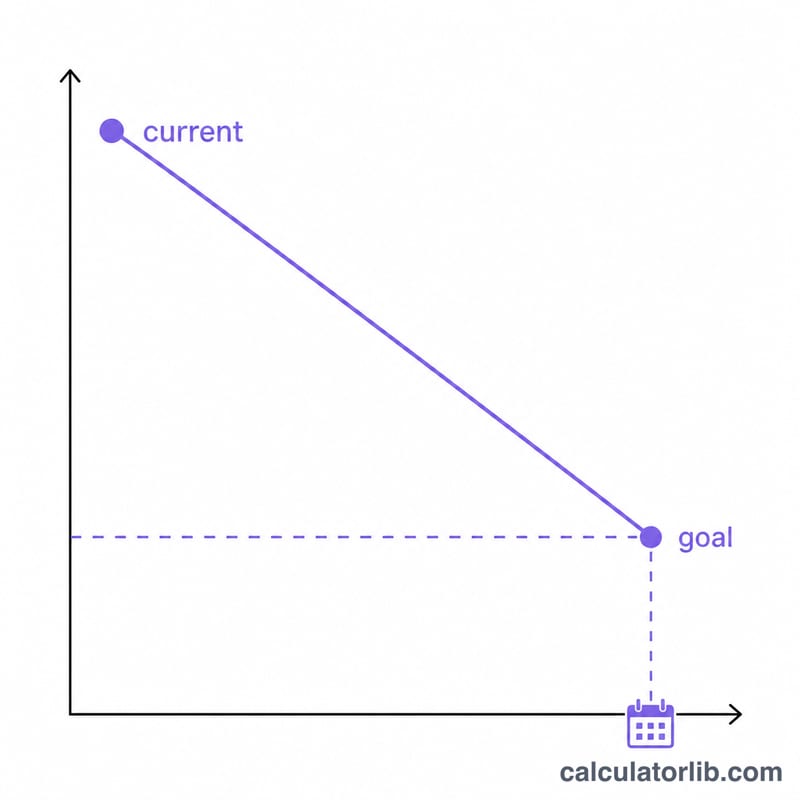
This tool estimates how long it will take to reach a target weight given a consistent daily calorie deficit. It is based on the widely used approximation that roughly 7,700 kilocalories equal one kilogram of body fat. Enter your current weight, your goal weight, and the daily calorie deficit you plan to maintain, and the calculator returns the number of weeks, the total days, your weekly loss rate, and an estimated calendar date.
How to use it
1. Enter your current weight in kilograms. 2. Enter your goal weight in kilograms (must be lower). 3. Enter the daily calorie deficit you can realistically sustain — the gap between calories burned and calories eaten each day. The result updates with your projected timeline and target date counted forward from today.
The formula explained
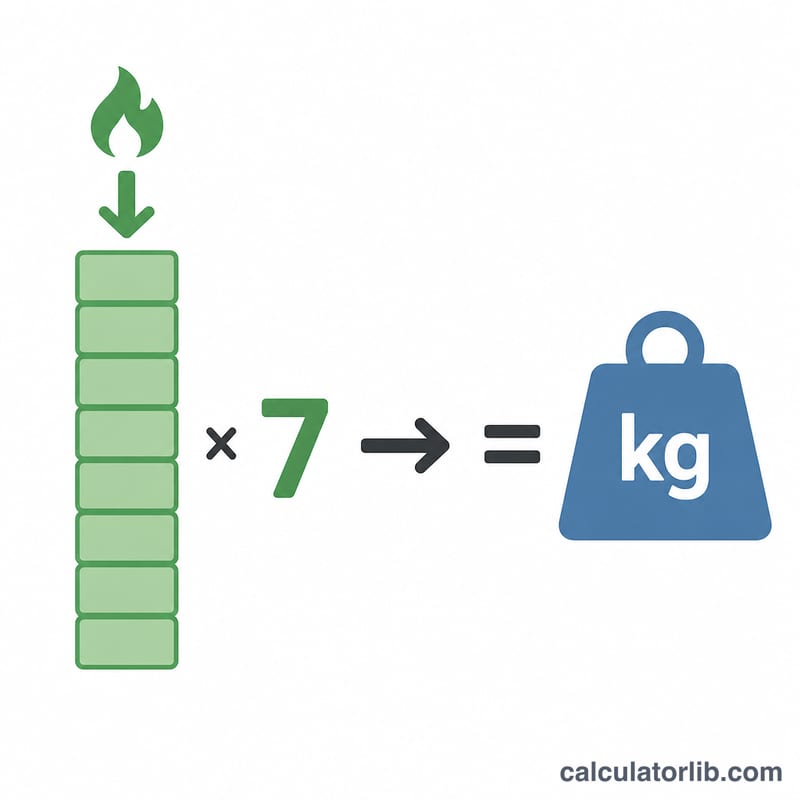
A daily deficit multiplied by 7 gives the weekly energy deficit. Dividing that by 7,700 converts the energy into kilograms of fat lost per week. The total weight to lose divided by this weekly loss gives the number of weeks: $$\text{weeks} = \frac{\text{current} - \text{goal}}{\left(\dfrac{\text{deficit} \times 7}{7700}\right)}$$ Multiplying weeks by 7 gives total days, which we add to today's date.
Worked example
Suppose you weigh 80 kg, want to reach 70 kg, and maintain a 500 kcal daily deficit. Weekly deficit = \(500 \times 7 = 3{,}500\) kcal, which is \(3500 \div 7700 \approx 0.4545\) kg per week. To lose 10 kg: \(10 \div 0.4545 \approx 22\) weeks (about 154 days).
Interpreting Your Estimated Date
Public health bodies such as the NHS (UK) and the CDC (US) commonly cite a gradual loss of about 0.5–1 kg (roughly 1–2 lb) per week as a sustainable range for most adults. In the table above, a 500 kcal/day deficit (about 0.45 kg/week) sits just below that range and 750 kcal/day (about 0.68 kg/week) sits inside it. A 1,000 kcal/day deficit (about 0.91 kg/week) is near the upper end. A 250 kcal/day deficit (about 0.23 kg/week) is slow but gentle. If your estimate implies a rate well above 1 kg per week, the date may be unrealistic or hard to sustain.
Real progress is rarely linear:
- Water shifts: Day-to-day scale changes of 1–2 kg can come from fluid, salt, carbohydrate intake, and digestive contents, and these can mask fat loss for days or weeks.
- Metabolic adaptation: The body can reduce energy expenditure somewhat during prolonged dieting, so the actual deficit may shrink.
- Lower body mass: A lighter body burns fewer calories at rest and during activity. Keeping the same intake gives a smaller deficit over time, so later kilograms often take longer.
- Plateaus: Stalls of a few weeks are common and do not always mean the plan has failed.
Treat the result as a planning estimate. It uses a fixed energy-per-kilogram rule, and body composition changes (such as muscle) are not modelled. This is general information, not medical advice. Consult a doctor or registered dietitian before starting a significant calorie restriction, especially with a medical condition, pregnancy, or a very large planned deficit.
Constants and Conversions Used
| Constant | Value | Unit / note |
|---|---|---|
| Energy per kg of body fat | 7,700 | kcal/kg (sources range from about 7,000 to 7,700) |
| Energy per lb of body fat | ≈ 3,500 | kcal/lb (7,700 ÷ 2.2046 ≈ 3,493) |
| Days per week | 7 | days |
| Mass conversion | 1 kg = 2.2046 lb | kg to lb |
| Energy conversion | 1 kcal = 4.184 kJ | so 7,700 kcal ≈ 32,217 kJ |
These are approximations. Actual energy content depends on the mix of fat and lean tissue lost, and the rule does not account for metabolic adaptation. Using 7,000 kcal/kg instead of 7,700 would shorten the estimated time by about 9%.
FAQ
Is the 7,700 kcal rule exact? No — it is an estimate. Real fat loss varies with metabolism, water, and muscle changes, but it is a solid planning baseline.
What is a safe deficit? Most guidance suggests 0.5–1 kg per week, roughly a 500–1,000 kcal daily deficit. Consult a professional for personal advice.
Why might my actual date differ? Adherence, metabolic adaptation, and plateaus all affect the real timeline. Treat the date as a goal, not a guarantee.