
What the PST to EST Converter Does
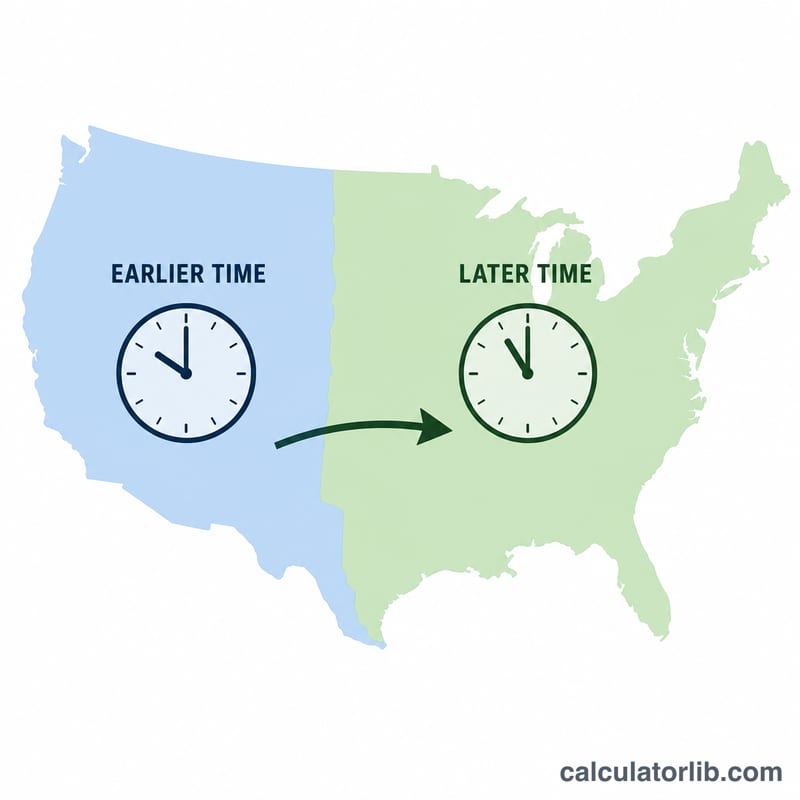
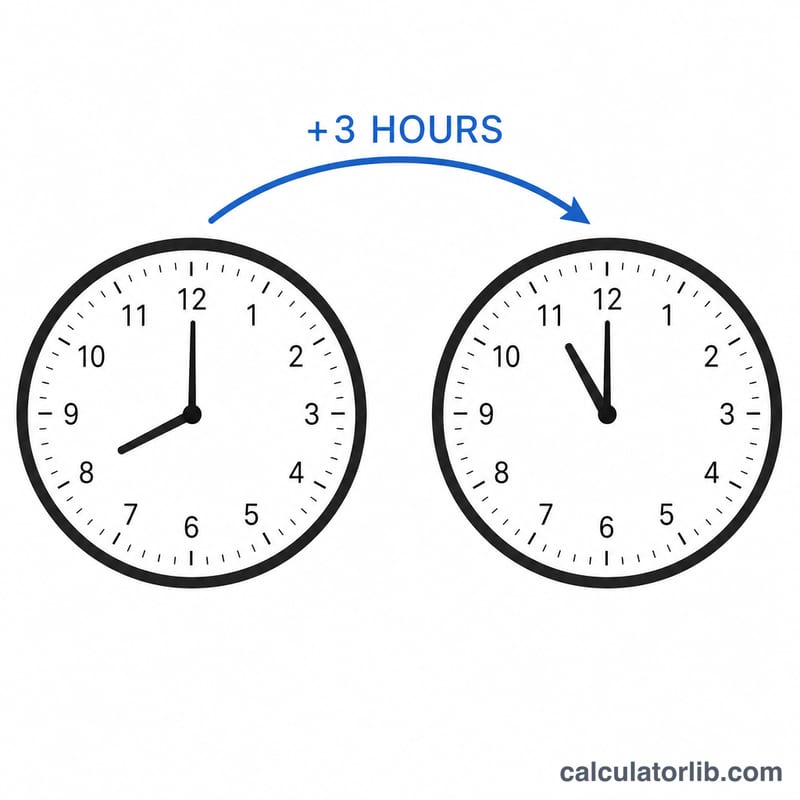
This calculator converts a time in Pacific Standard Time (PST) to Eastern Standard Time (EST) — both used in the United States and Canada. PST and EST are separated by a fixed three-hour gap: the East Coast is always three hours ahead of the West Coast. Enter any PST clock time and the tool instantly returns the matching EST time, and flags when the conversion rolls over into the next day.
The Two Inputs
- Hour (PST) — the hour in 24-hour format, from 0 to 23. Values below 0 are treated as 0 and values above 23 are capped at 23.
- Minute — the minutes past the hour, from 0 to 59. Out-of-range values are clamped the same way.
The Formula
The tool first converts your input to total minutes since midnight, then adds the 3-hour offset and wraps around a 24-hour day:
- $$\text{totalMinutes} = (\text{PST hour} \times 60) + \text{PST minute}$$
- $$\text{estMinutes} = (\text{totalMinutes} + 180) \bmod 1440$$
- $$\text{EST hour} = \left\lfloor \tfrac{\text{estMinutes}}{60} \right\rfloor, \quad \text{EST minute} = \text{estMinutes} \bmod 60$$
- $$\text{dayOffset} = 1 \text{ if } (\text{totalMinutes} + 180) \geq 1440, \text{ otherwise } 0$$
The day offset of 1 means the EST time falls on the following calendar day — useful for late-evening PST times.
Worked Example
Suppose it is 10:30 PST.
$$\text{totalMinutes} = (10 \times 60) + 30 = 630$$Adding 180 gives 810, which is below 1440, so there is no day rollover.
$$\text{estMinutes} = 810 \bmod 1440 = 810$$ $$\text{EST hour} = \left\lfloor \tfrac{810}{60} \right\rfloor = 13, \quad \text{EST minute} = 810 \bmod 60 = 30$$The result is 13:30 EST (1:30 PM), same day.
Now try 22:00 PST: \(\text{totalMinutes} = 1320\), plus 180 = 1500. Since \(1500 \geq 1440\), dayOffset = 1.
$$\text{estMinutes} = 1500 \bmod 1440 = 60$$so EST = 01:00 the next day.
FAQ
Does this account for daylight saving time? No. It uses the standard-time offset of exactly 3 hours. During daylight saving (PDT to EDT) the gap is still 3 hours, but if only one zone has shifted, the live offset can differ.
Why does it show "next day"? Because adding 3 hours to a late PST time can push it past midnight Eastern. The day offset tells you the EST time belongs to the following day.
What time format should I use? Enter the hour in 24-hour format (0–23). For example, 3 PM PST is hour 15.