What the IST to PST Converter Does
This tool converts a time in Indian Standard Time (IST, used across India and Sri Lanka) into Pacific Standard Time (PST, used in the western United States and Canada, such as California, Washington and British Columbia). You enter a single IST time and the converter instantly returns the equivalent PST time, including a note when the result falls on the previous or next calendar day.
How to Use It
The calculator has one input: IST Time, which you provide as an hour and a minute (24-hour format). Type the hour you want to convert from India time, add the minutes, and the tool does the rest. There are no other settings to worry about — the time-zone offsets are built in.
- Enter the IST hour (0–23).
- Enter the IST minutes (0–59).
- Read off the converted PST hour and minute, plus any day-shift flag.
The Formula Explained
IST is 5 hours and 30 minutes ahead of UTC, and PST is 8 hours behind UTC. The tool works in two steps:
- IST → UTC: subtract 5 hours 30 minutes. If subtracting 30 minutes makes the minutes negative, it adds 60 minutes back and borrows one hour.
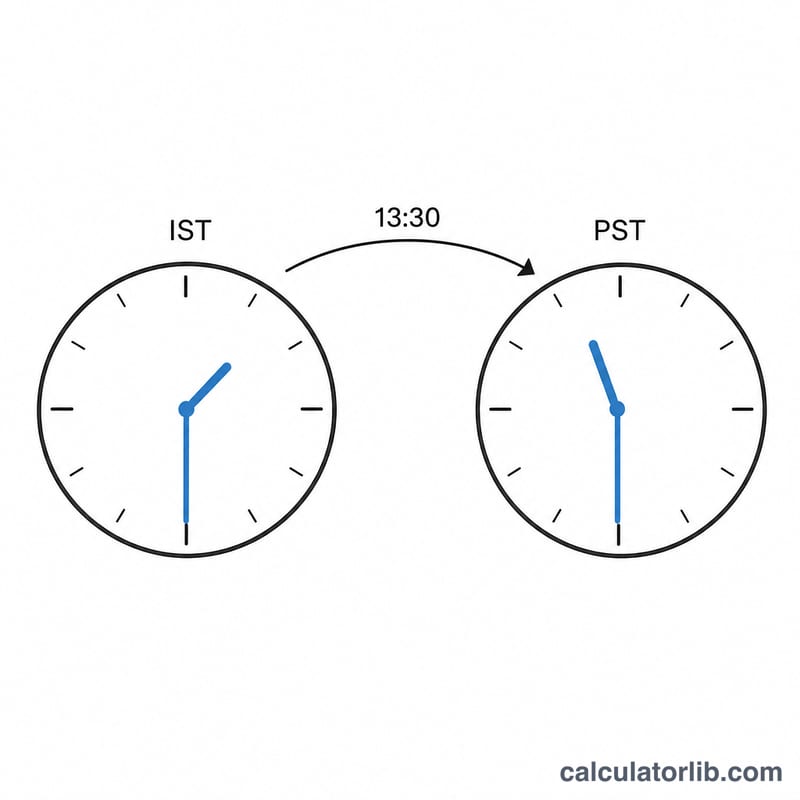
- UTC → PST: subtract a further 8 hours. The net difference is therefore 13 hours 30 minutes behind IST.
If the resulting hour drops below 0, the tool adds 24 and flags the result as the previous day; if it goes to 24 or more, it subtracts 24 and flags the next day.
Worked Example
Suppose you enter 10:00 IST. First, IST to UTC: 10:00 − 5:30 = 4:30 UTC. Then UTC to PST: 4:30 − 8:00 = −3:30, so add 24 hours to get 20:30 PST, flagged as the previous day. So a 10 AM meeting in India lands at 8:30 PM the day before on the US Pacific coast.
IST to PST/PDT Quick Conversion Table
India Standard Time (IST) is UTC+5:30. US/Canada Pacific Standard Time (PST) is UTC−8:00, so PST is 13 hours 30 minutes behind IST. Pacific Daylight Time (PDT) is UTC−7:00, so it is 12 hours 30 minutes behind IST:
$$\text{PST} = \text{IST} - 13\text{:}30 \qquad \text{PDT} = \text{IST} - 12\text{:}30$$The table shows every whole IST hour. "Prev. day" means the Pacific time falls on the calendar day before the IST date.
| IST (24h [12h]) | PST (IST − 13:30) | PDT (IST − 12:30) |
|---|---|---|
| 00:00 [12:00 AM] | 10:30 [10:30 AM], prev. day | 11:30 [11:30 AM], prev. day |
| 01:00 [1:00 AM] | 11:30 [11:30 AM], prev. day | 12:30 [12:30 PM], prev. day |
| 02:00 [2:00 AM] | 12:30 [12:30 PM], prev. day | 13:30 [1:30 PM], prev. day |
| 03:00 [3:00 AM] | 13:30 [1:30 PM], prev. day | 14:30 [2:30 PM], prev. day |
| 04:00 [4:00 AM] | 14:30 [2:30 PM], prev. day | 15:30 [3:30 PM], prev. day |
| 05:00 [5:00 AM] | 15:30 [3:30 PM], prev. day | 16:30 [4:30 PM], prev. day |
| 06:00 [6:00 AM] | 16:30 [4:30 PM], prev. day | 17:30 [5:30 PM], prev. day |
| 07:00 [7:00 AM] | 17:30 [5:30 PM], prev. day | 18:30 [6:30 PM], prev. day |
| 08:00 [8:00 AM] | 18:30 [6:30 PM], prev. day | 19:30 [7:30 PM], prev. day |
| 09:00 [9:00 AM] | 19:30 [7:30 PM], prev. day | 20:30 [8:30 PM], prev. day |
| 10:00 [10:00 AM] | 20:30 [8:30 PM], prev. day | 21:30 [9:30 PM], prev. day |
| 11:00 [11:00 AM] | 21:30 [9:30 PM], prev. day | 22:30 [10:30 PM], prev. day |
| 12:00 [12:00 PM] | 22:30 [10:30 PM], prev. day | 23:30 [11:30 PM], prev. day |
| 13:00 [1:00 PM] | 23:30 [11:30 PM], prev. day | 00:30 [12:30 AM], same day |
| 14:00 [2:00 PM] | 00:30 [12:30 AM], same day | 01:30 [1:30 AM], same day |
| 15:00 [3:00 PM] | 01:30 [1:30 AM], same day | 02:30 [2:30 AM], same day |
| 16:00 [4:00 PM] | 02:30 [2:30 AM], same day | 03:30 [3:30 AM], same day |
| 17:00 [5:00 PM] | 03:30 [3:30 AM], same day | 04:30 [4:30 AM], same day |
| 18:00 [6:00 PM] | 04:30 [4:30 AM], same day | 05:30 [5:30 AM], same day |
| 19:00 [7:00 PM] | 05:30 [5:30 AM], same day | 06:30 [6:30 AM], same day |
| 20:00 [8:00 PM] | 06:30 [6:30 AM], same day | 07:30 [7:30 AM], same day |
| 21:00 [9:00 PM] | 07:30 [7:30 AM], same day | 08:30 [8:30 AM], same day |
| 22:00 [10:00 PM] | 08:30 [8:30 AM], same day | 09:30 [9:30 AM], same day |
| 23:00 [11:00 PM] | 09:30 [9:30 AM], same day | 10:30 [10:30 AM], same day |
The PST date changes at exactly 13:30 IST, which equals 00:00 PST on the same day. Any earlier IST time falls on the previous day in PST. For PDT, the switch happens at 12:30 IST.
Working-hour overlap: The most useful window for live calls is 20:30–23:30 IST, which is 07:00–10:00 PST (or 08:00–11:00 PDT). That is late evening in India and early morning on the US/Canada West Coast. A second, less common option is 06:00–08:30 IST, which is 16:30–19:00 PST on the previous evening.
Daylight saving note: PDT applies in most of the US Pacific time zone and in British Columbia, Canada. It runs from the second Sunday in March to the first Sunday in November (the US rule in force since 2007). India does not use daylight saving time, so IST stays UTC+5:30 all year. This converter subtracts 13:30, which gives PST. During the PDT period, add 1 hour to its result.
More Conversion Examples
Each example uses two steps. First convert IST to UTC by subtracting 5:30. Then convert UTC to PST by subtracting 8:00. If a step gives a negative time, add 24:00 and move the date back one day.
Example 1: 18:15 IST
- IST to UTC: \(18\text{:}15 - 5\text{:}30 = 12\text{:}45\) UTC. The minutes need a borrow: 18:15 = 17:75, and 17:75 − 5:30 = 12:45.
- UTC to PST: \(12\text{:}45 - 8\text{:}00 = 4\text{:}45\)
- Result: 04:45 PST (4:45 AM), same day.
Example 2: 21:45 IST
- IST to UTC: \(21\text{:}45 - 5\text{:}30 = 16\text{:}15\) UTC
- UTC to PST: \(16\text{:}15 - 8\text{:}00 = 8\text{:}15\)
- Result: 08:15 PST (8:15 AM), same day. This is a good time for a call: early evening in India and the start of the workday on the Pacific coast.
- PDT version (March to November): add 1 hour, so \(8\text{:}15 + 1\text{:}00 = 9\text{:}15\) PDT. You can also calculate it directly: \(21\text{:}45 - 12\text{:}30 = 9\text{:}15\).
Example 3: 02:10 IST (crossing midnight)
- IST to UTC: 10 minutes minus 30 minutes needs a borrow, and the hours also go below zero: \(02\text{:}10 - 5\text{:}30 = -3\text{:}20\)
- Add 24 hours: \(-3\text{:}20 + 24\text{:}00 = 20\text{:}40\) UTC on the previous day.
- UTC to PST: \(20\text{:}40 - 8\text{:}00 = 12\text{:}40\)
- Result: 12:40 PST (12:40 PM) on the previous day. For example, 02:10 IST on a Tuesday is 12:40 PM PST on Monday.
Why the result is never "next day"
IST is ahead of Pacific time all year: 13:30 ahead of PST and 12:30 ahead of PDT. Converting from IST to PST always subtracts time, so the PST result is either on the same calendar day or the previous one. It can never fall on the next day. The previous day applies for IST times before 13:30 (PST) or before 12:30 (PDT).
FAQ
Does this account for Daylight Saving Time? No. The tool uses a fixed offset of 13 hours 30 minutes (PST, standard time). During US daylight months the Pacific zone shifts to PDT (12.5 hours behind IST), so adjust by one hour in summer.
Why does the result sometimes show a different day? Because PST is so far behind IST, many morning and early-afternoon IST times convert to the previous calendar day in PST. The converter flags this automatically.
What is the exact time difference? IST is 13 hours and 30 minutes ahead of PST.