
What is the PST to IST Converter?
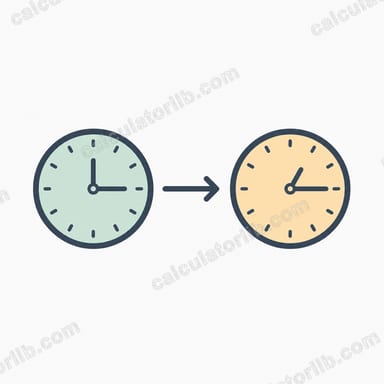
This tool converts a time given in Pacific Standard Time (PST, UTC−8) to India Standard Time (IST, UTC+5:30). Because IST runs 13 hours and 30 minutes ahead of PST, the converter adds that fixed offset and automatically rolls the result into the next day when the sum passes midnight. Note: PST is the winter (standard) offset for the US West Coast; during summer the region observes PDT (UTC−7), which is only 12:30 behind IST. India does not observe daylight saving time.
How to use it
Enter the hour (0–23) and minute (0–59) of the Pacific time you want to convert, then read the IST equivalent below. A note tells you whether the converted time falls on the same day, the next day, or the previous day.
The formula explained
The conversion is simply IST = PST + 13:30. Internally we turn the PST time into minutes after midnight, add 810 minutes (13×60 + 30), and take the result modulo 1440 (minutes per day). The number of whole 1440-minute wraps becomes the day offset.
$$\text{IST} = \left(\left(\text{Hour (PST)} \times 60 + \text{Minute}\right) + 810\right) \bmod 1440$$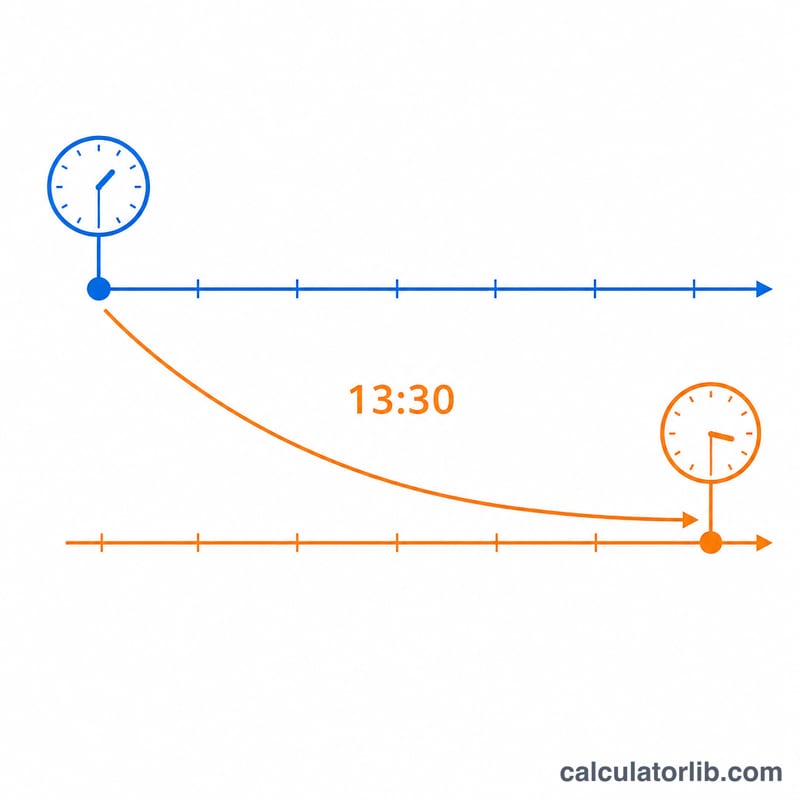
Worked example
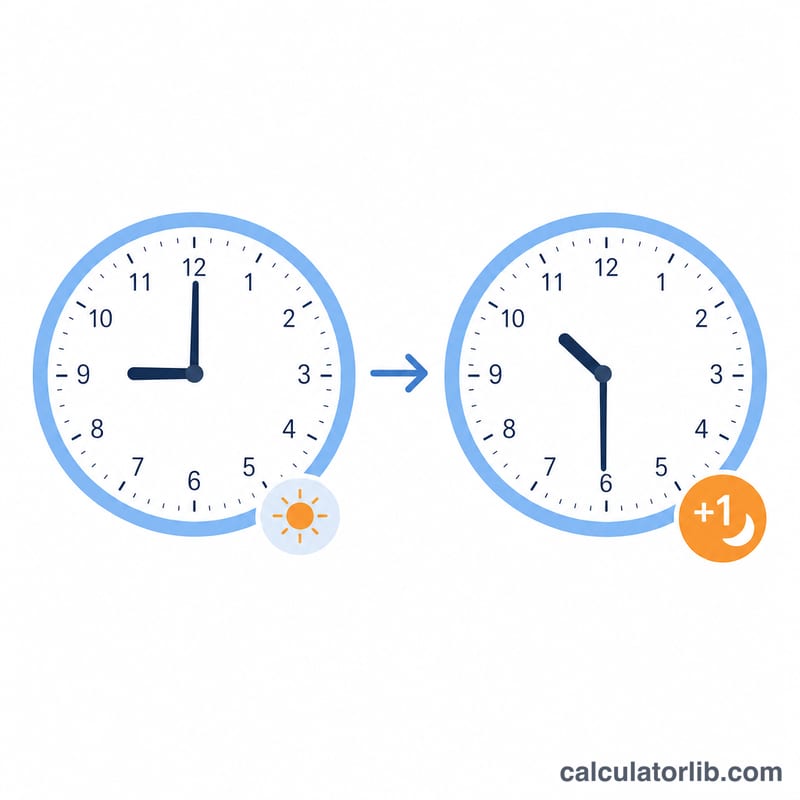
Suppose a meeting is scheduled for 9:00 PST. In minutes: \(9 \times 60 = 540\). Add 810 \(\to\) 1350 minutes. \(1350 \div 60 = 22\) remainder 30, so IST = 22:30 (10:30 PM) the same day.
Now try 23:30 PST: \(23 \times 60 + 30 = 1410\). Add 810 \(\to\) 2220. \(2220 - 1440 = 780\) minutes = 13:00 IST, next day.
FAQ
How many hours ahead is IST of PST? Exactly 13 hours 30 minutes during Pacific Standard Time.
Does this handle daylight saving? No — it uses the fixed PST (UTC−8) offset. If California is on PDT (summer), subtract one hour from the IST result, making the gap 12:30.
Why does IST have a 30-minute offset? India uses a single national time zone centered near 82.5°E, which sits at UTC+5:30 rather than a whole hour.