

What is the 2x2 Eigenvalue Calculator?
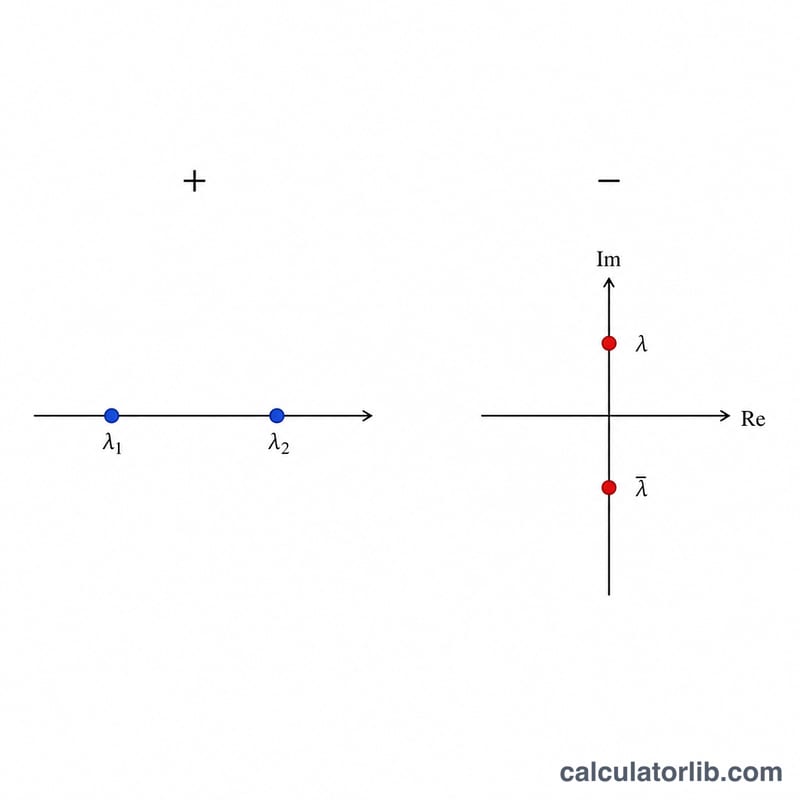
This tool finds the eigenvalues of any 2×2 matrix [[a, b], [c, d]]. Eigenvalues are the scalars \(\lambda\) for which \(Av = \lambda v\) has a nonzero solution \(v\). For a 2×2 matrix there are always two eigenvalues (counting multiplicity), and they may be real or a complex-conjugate pair. The calculator reports both eigenvalues along with the trace, determinant, and discriminant so you can see exactly how the answer was obtained.
How to use it
Enter the four matrix entries: a and b on the first row, c and d on the second row. Press calculate. If the discriminant is zero or positive you get two real eigenvalues; if it is negative you get a conjugate pair shown as \(p + qi\) and \(p - qi\).
The formula explained
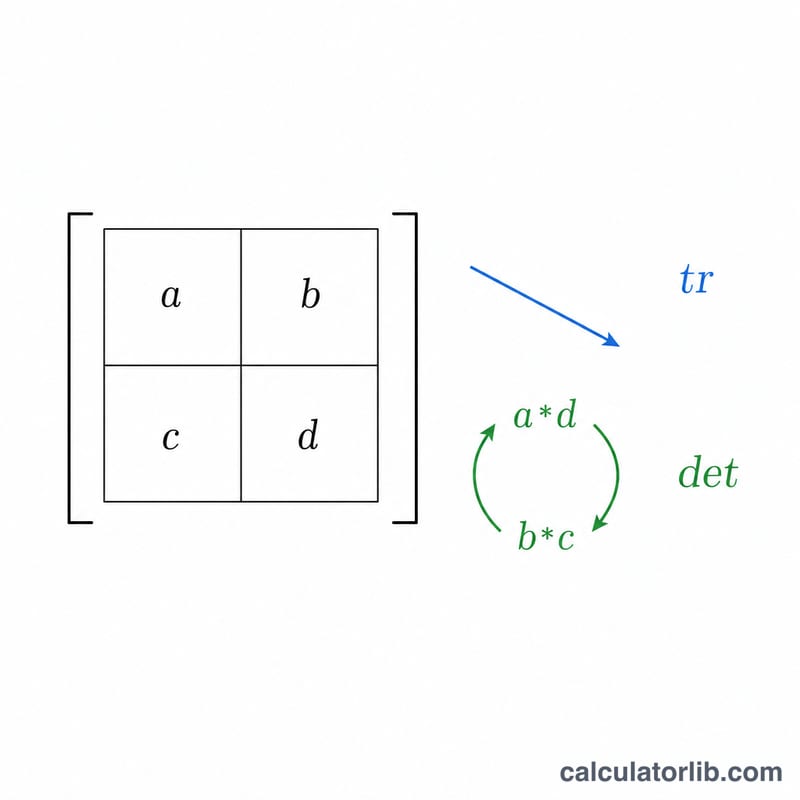
The characteristic polynomial of a 2×2 matrix is \(\lambda^{2} - (a+d)\lambda + (ad-bc) = 0\). Writing the trace \(\text{tr} = a + d\) and the determinant \(\det = ad - bc\), the quadratic formula gives
$$\lambda = \frac{\text{tr} \pm \sqrt{\text{tr}^{2} - 4\cdot\det}}{2}$$The quantity under the root, \(\text{tr}^{2} - 4\cdot\det\), is the discriminant. When it is negative, the real part of each eigenvalue is \(\text{tr}/2\) and the imaginary part is \(\sqrt{4\cdot\det - \text{tr}^{2}} / 2\).
Worked example
Take the rotation matrix [[0, −1], [1, 0]]. Here \(a=0\), \(b=-1\), \(c=1\), \(d=0\), so \(\text{tr} = 0\) and \(\det = (0)(0) - (-1)(1) = 1\). The discriminant is
$$0^{2} - 4\cdot 1 = -4$$which is negative. The real part is \(0/2 = 0\) and the imaginary part is \(\sqrt{4} / 2 = 1\). The eigenvalues are therefore \(0 + 1i\) and \(0 - 1i\), i.e. \(\pm i\).
FAQ
What does a negative discriminant mean? The matrix has no real eigenvalues; instead it has a complex-conjugate pair, common for rotation-like matrices.
Can the two eigenvalues be equal? Yes. When the discriminant is exactly zero the matrix has a single repeated (degenerate) eigenvalue equal to \(\text{tr}/2\).
How do eigenvalues relate to trace and determinant? The sum of the eigenvalues equals the trace, and their product equals the determinant.