
What is a 2x2 Matrix Inverse?
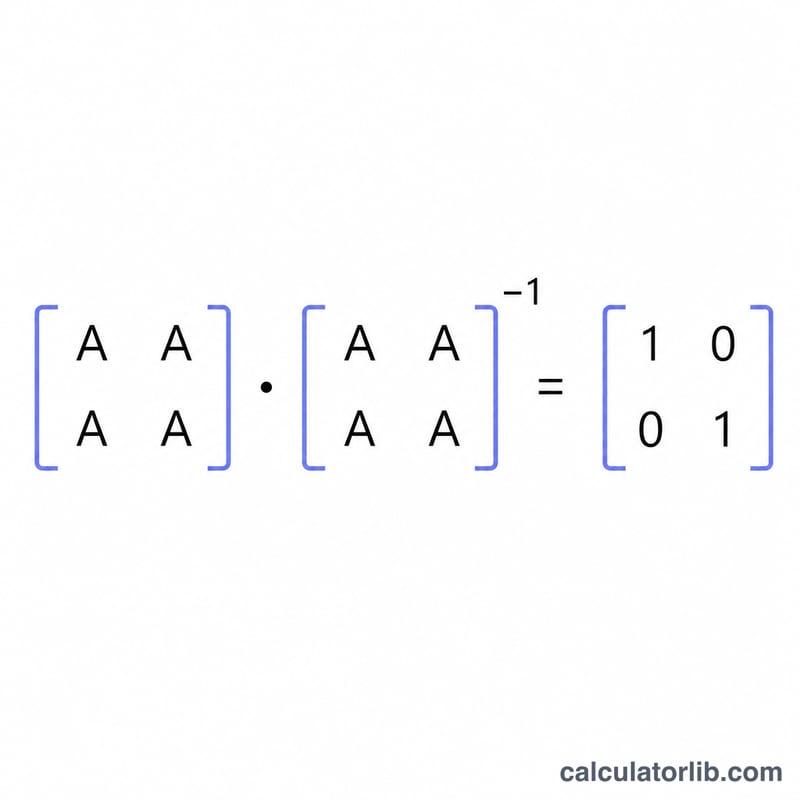
The inverse of a square matrix A, written \(A^{-1}\), is the matrix that satisfies \(A \cdot A^{-1} = I\), where \(I\) is the identity matrix. For a 2x2 matrix, the inverse can be found with a single compact formula. This calculator computes the determinant and every element of the inverse instantly, and tells you when no inverse exists.
How to Use It
Enter the four entries of your matrix: a and b in the top row, c and d in the bottom row. The calculator first computes the determinant \(ad - bc\). If it is non-zero, it returns the full inverse matrix; if it is zero, it flags the matrix as singular (no inverse exists).
The Formula Explained
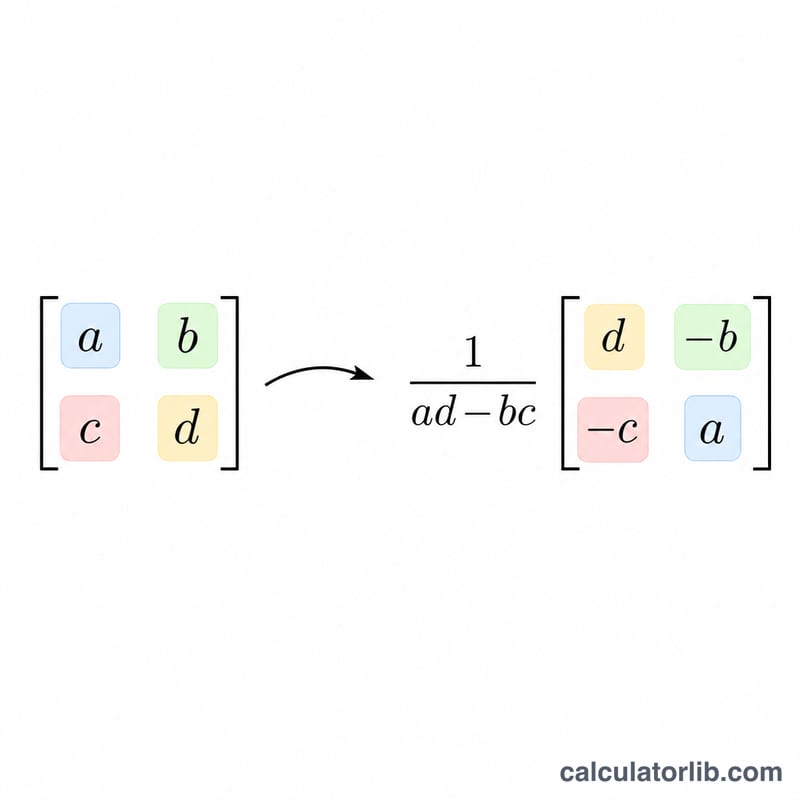
For a matrix \(A = \begin{bmatrix} a & b \\ c & d \end{bmatrix}\), the determinant is
$$\det(A) = ad - bc$$The inverse is
$$A^{-1} = \frac{1}{ad-bc}\begin{bmatrix} d & -b \\ -c & a \end{bmatrix}$$In words: swap a and d, negate b and c, then divide every entry by the determinant. When \(\det = 0\) the division is undefined, so the matrix has no inverse.
Worked Example
Take \(A = \begin{bmatrix} 4 & 7 \\ 2 & 6 \end{bmatrix}\). The determinant is
$$(4 \cdot 6) - (7 \cdot 2) = 24 - 14 = 10$$So
$$A^{-1} = \frac{1}{10}\begin{bmatrix} 6 & -7 \\ -2 & 4 \end{bmatrix} = \begin{bmatrix} 0.6 & -0.7 \\ -0.2 & 0.4 \end{bmatrix}$$You can verify by multiplying \(A \cdot A^{-1}\) to get the identity matrix.
More Worked Examples
For a 2×2 matrix \(A = \begin{bmatrix} a & b \\ c & d \end{bmatrix}\), the inverse is \(A^{-1} = \frac{1}{ad-bc}\begin{bmatrix} d & -b \\ -c & a \end{bmatrix}\), valid only when the determinant \(ad-bc \neq 0\).
Example 1 — A matrix with negative entries
Let \(A = \begin{bmatrix} 2 & -3 \\ 4 & -1 \end{bmatrix}\), so \(a=2,\ b=-3,\ c=4,\ d=-1\).
- Determinant: \(ad - bc = (2)(-1) - (-3)(4) = -2 + 12 = \)10.
- Swap \(a\) and \(d\), negate \(b\) and \(c\): \(\begin{bmatrix} -1 & 3 \\ -4 & 2 \end{bmatrix}\).
- Divide by the determinant: \(A^{-1} = \frac{1}{10}\begin{bmatrix} -1 & 3 \\ -4 & 2 \end{bmatrix} = \begin{bmatrix} -0.1 & 0.3 \\ -0.4 & 0.2 \end{bmatrix}\).
Check: \(A\,A^{-1} = \begin{bmatrix} 1 & 0 \\ 0 & 1 \end{bmatrix}\), the identity matrix.
Example 2 — A singular matrix (no inverse)
Let \(A = \begin{bmatrix} 2 & 4 \\ 1 & 2 \end{bmatrix}\), so \(a=2,\ b=4,\ c=1,\ d=2\).
- Determinant: \(ad - bc = (2)(2) - (4)(1) = 4 - 4 = \)0.
- Because the determinant is \(0\), the factor \(\frac{1}{ad-bc}\) is undefined (division by zero).
- Therefore \(A\) is singular and has no inverse. Here the second row \((1,2)\) is exactly half the first row \((2,4)\), so the rows are linearly dependent.
Example 3 — Clean fractional entries
Let \(A = \begin{bmatrix} 1 & 2 \\ 3 & 4 \end{bmatrix}\), so \(a=1,\ b=2,\ c=3,\ d=4\).
- Determinant: \(ad - bc = (1)(4) - (2)(3) = 4 - 6 = -2\).
- Build the adjugate: \(\begin{bmatrix} 4 & -2 \\ -3 & 1 \end{bmatrix}\).
- Divide by \(-2\): \(A^{-1} = \frac{1}{-2}\begin{bmatrix} 4 & -2 \\ -3 & 1 \end{bmatrix} = \begin{bmatrix} -2 & 1 \\ \tfrac{3}{2} & -\tfrac{1}{2} \end{bmatrix}\).
You can verify by multiplying \(A\) and \(A^{-1}\) with the product; the result should be the identity matrix.
Key Terms Explained
- Determinant
- A single scalar value computed from the matrix. For a 2×2 matrix it equals \(ad - bc\). It measures how the matrix scales area and indicates whether an inverse exists: the inverse exists only when the determinant is nonzero.
- Singular matrix
- A square matrix whose determinant is \(0\). A singular matrix has no inverse because the formula requires dividing by the determinant. Its rows (and columns) are linearly dependent.
- Invertible / non-singular matrix
- A square matrix with a nonzero determinant. It has a unique inverse \(A^{-1}\) such that \(A\,A^{-1} = A^{-1}A = I\). "Invertible" and "non-singular" mean the same thing.
- Identity matrix
- The square matrix with \(1\)s on the main diagonal and \(0\)s elsewhere, written \(I = \begin{bmatrix} 1 & 0 \\ 0 & 1 \end{bmatrix}\) for the 2×2 case. Multiplying any matrix by \(I\) leaves it unchanged, and \(A\,A^{-1}=I\).
- Inverse matrix \((A^{-1})\)
- The matrix that "undoes" \(A\): the unique matrix satisfying \(A\,A^{-1} = I\). For a 2×2 matrix it is found by swapping \(a\) and \(d\), negating \(b\) and \(c\), and dividing every entry by the determinant.
- The entries \(a, b, c, d\)
- The four numbers of the matrix \(\begin{bmatrix} a & b \\ c & d \end{bmatrix}\): \(a\) is top-left (row 1, column 1), \(b\) is top-right (row 1, column 2), \(c\) is bottom-left (row 2, column 1), and \(d\) is bottom-right (row 2, column 2). \(a\) and \(d\) form the main diagonal.
FAQ
When does a 2x2 matrix have no inverse? When its determinant \(ad - bc\) equals zero. Such a matrix is called singular.
Can the inverse contain decimals? Yes — dividing by the determinant often produces fractional entries.
How do I check my answer? Multiply the original matrix by the computed inverse; the result should be the 2x2 identity matrix \(\begin{bmatrix} 1 & 0 \\ 0 & 1 \end{bmatrix}\).