
What Is the Inverse Tangent Calculator?
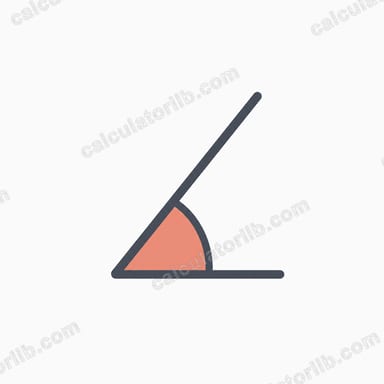
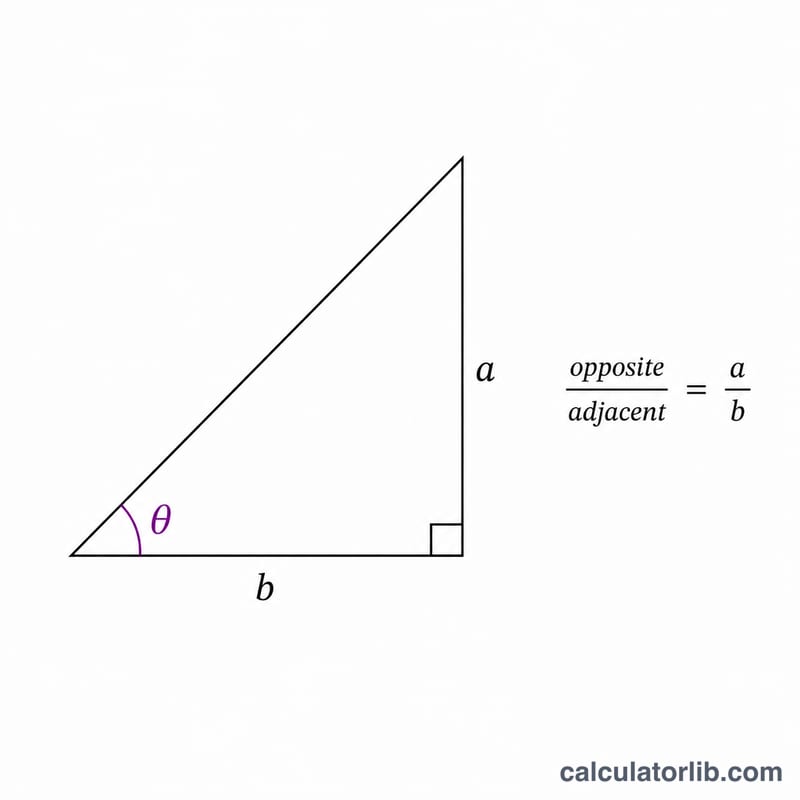
The Inverse Tangent Calculator finds the arctangent (written as arctan or tan⁻¹) of any number you enter. The tangent function takes an angle and returns a ratio; the inverse tangent does the opposite — it takes a ratio and returns the angle whose tangent equals that value. This tool gives you the answer in both radians and degrees, so you can use whichever your trigonometry problem requires.
How to Use It
The calculator has a single input field:
- Number (x): Enter any real number — positive, negative, a decimal, or zero. This is the value whose inverse tangent you want to find.
Once you submit, the calculator returns two results: the angle in radians and the same angle converted to degrees.
The Formula Explained
Behind the scenes, the calculator performs exactly two steps:
- Radians:
radians = atan(x)— the standard arctangent function. - Degrees:
degrees = radians × (180 / π)— converting the radian result to degrees.
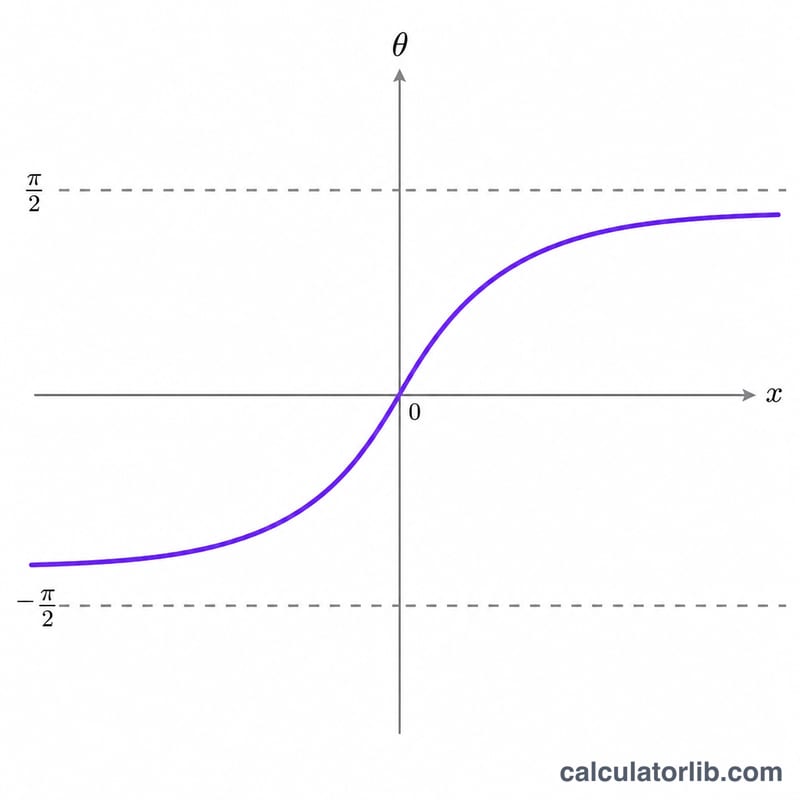
Because tangent repeats infinitely, the inverse tangent is defined to return a single "principal" value. The result always falls between −π/2 and +π/2 radians (−90° to +90°), never including the endpoints. This means arctan of any number — no matter how large — will always land inside this range.
Worked Example
Suppose you enter x = 1:
- radians = atan(1) ≈ 0.7854
- degrees = 0.7854 × (180 / π) ≈ 45°
This makes sense: the tangent of 45° is exactly 1, so the inverse tangent of 1 returns 45°. As another check, entering x = 0 returns 0 radians and 0 degrees, while entering a large value like x = 1000 returns a result very close to (but never reaching) 90°.
Frequently Asked Questions
What's the difference between radians and degrees?
They are two ways of measuring angles. A full circle is 360 degrees or 2π radians. Higher-level math and physics often use radians, while everyday geometry tends to use degrees. This calculator displays the result in both units so you can use whichever your problem requires.
Why is the answer always between −90° and 90°?
The inverse tangent returns only the principal value, so each input maps to exactly one output. The tangent function repeats every 180°, meaning many angles share the same tangent. The calculator selects the angle nearest to zero, which falls in the range −90° to 90° (or −π/2 to π/2 radians).
Can I enter negative numbers?
Yes. Because arctan is an odd function, a negative input returns a negative angle of the same size. For example, arctan(−1) gives −0.7854 radians, or −45°, while arctan(1) gives +45°. Zero returns exactly 0 in both radians and degrees.
What is the formula for the inverse tangent?
If tan(θ) = x, then arctan(x) = θ, where θ is restricted to (−90°, 90°). The calculator computes θ from any real number x. To convert radians to degrees, multiply by 180/π; to convert degrees to radians, multiply by π/180.
What is the largest angle arctan can produce?
Arctan never quite reaches ±90°. As the input grows toward positive infinity, the result approaches 90° (π/2 radians) but never equals it. Likewise, very large negative inputs approach −90°. For example, arctan(1000) is about 89.94°, and arctan(1,000,000) is roughly 89.99994°.
How accurate are the results?
The calculator uses standard floating-point arctangent functions, accurate to many decimal places — well beyond what most homework or engineering tasks require. Tiny rounding differences may appear in the final displayed digits, but they have no practical effect on typical trigonometry calculations.