
What is the 3x3 Matrix Inverse Calculator?
This tool computes the inverse A-1 of any 3x3 matrix of real numbers. The inverse is the unique matrix that satisfies \(A\cdot A^{-1} = A^{-1}\cdot A = I\), where I is the 3x3 identity matrix. An inverse exists only when the determinant of A is non-zero; otherwise the matrix is called singular and has no inverse.
How to use it
Enter the nine entries of your matrix cell by cell (row by row). The labels a11..a33 mean row i, column j. Enter plain decimal numbers (fractions like 1/3 are not parsed). Optionally choose the number of significant digits for the displayed output. Press calculate to see the inverse matrix and the determinant.
The formula
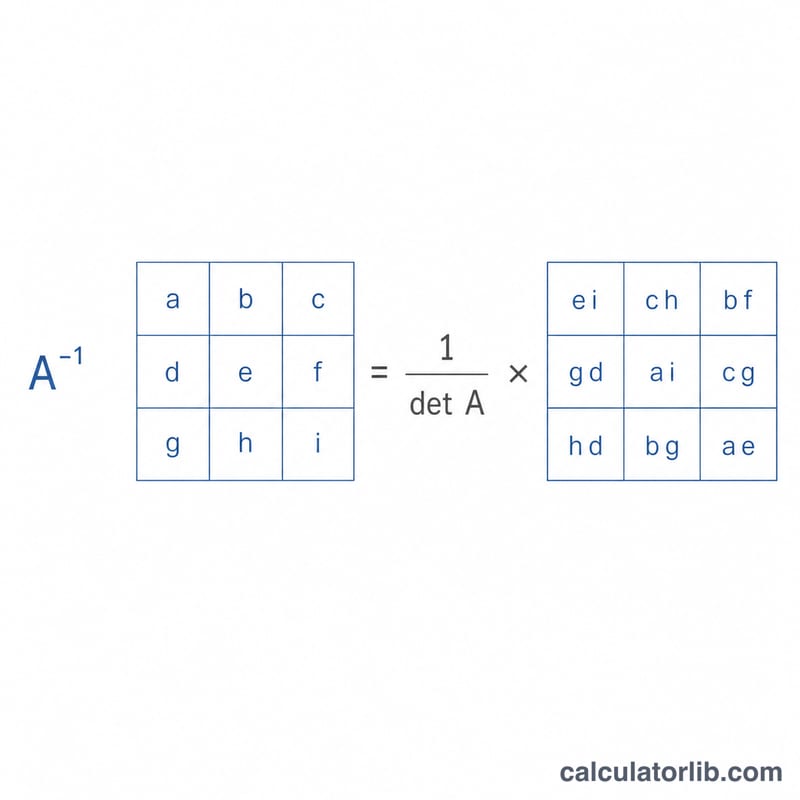
For A = [[a11,a12,a13],[a21,a22,a23],[a31,a32,a33]] the determinant is $$\det A = a_{11}(a_{22}a_{33}-a_{23}a_{32}) - a_{12}(a_{21}a_{33}-a_{23}a_{31}) + a_{13}(a_{21}a_{32}-a_{22}a_{31})$$ The inverse is the transpose of the cofactor matrix (the adjugate) divided by the determinant: $$b_{ij} = \frac{C_{ji}}{\det A}$$
Worked example
Take A = [[1,2,3],[0,1,4],[5,6,0]]. $$\det A = 1(0-24) - 2(0-20) + 3(0-5) = -24 + 40 - 15 = 1$$ The inverse is $$A^{-1} = \begin{bmatrix} -24 & 18 & 5 \\ 20 & -15 & -4 \\ -5 & 4 & 1 \end{bmatrix}$$ You can verify \(A\cdot A^{-1} = I\).
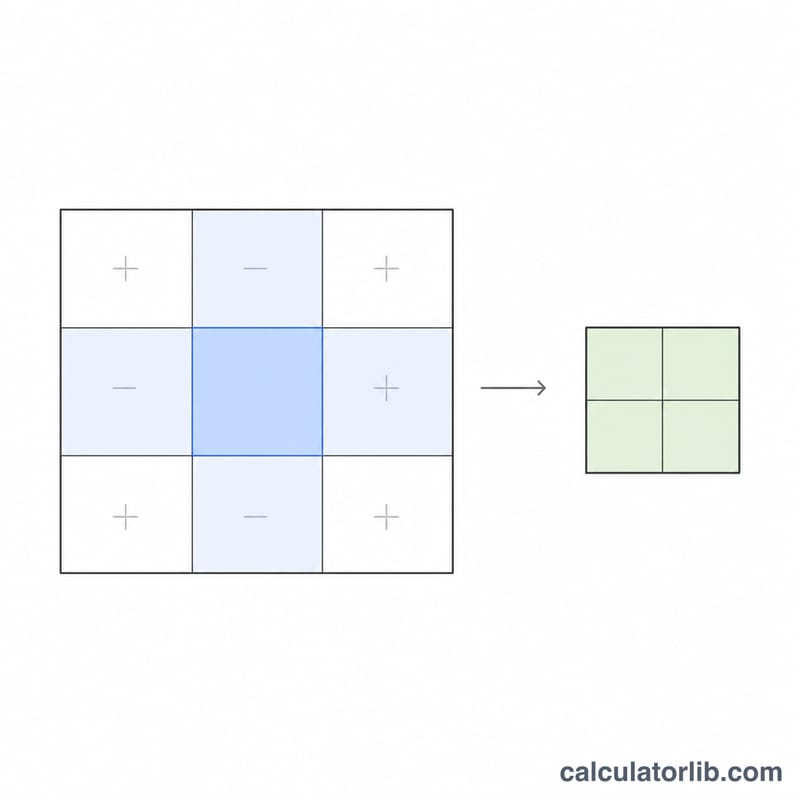
Key Terms & Definitions
- Determinant
- A single scalar \(\det A\) computed from the entries of a square matrix. For a 3×3 matrix it can be found by cofactor expansion. It tells you whether the matrix is invertible: \(A^{-1}\) exists if and only if \(\det A \neq 0\).
- Minor
- The minor \(M_{ij}\) is the determinant of the smaller matrix left after deleting row \(i\) and column \(j\). For a 3×3 matrix every minor is a 2×2 determinant.
- Cofactor
- A signed minor: \(C_{ij}=(-1)^{i+j}M_{ij}\). The cofactors are the building blocks of both the determinant and the adjugate.
- Adjugate (adjoint)
- The transpose of the matrix of cofactors, written \(\operatorname{adj}(A)\). The inverse formula is \(A^{-1}=\tfrac{1}{\det A}\operatorname{adj}(A)\). (In linear algebra this "adjoint" is distinct from the conjugate-transpose adjoint used in complex matrices.)
- Identity matrix
- The square matrix \(I\) with 1s on the main diagonal and 0s elsewhere. It acts as a multiplicative identity: \(AI=IA=A\), and by definition \(A\,A^{-1}=A^{-1}A=I\).
- Singular matrix
- A square matrix whose determinant is zero. A singular matrix has no inverse because dividing by \(\det A=0\) is undefined.
- Transpose
- The matrix \(A^{\mathsf T}\) obtained by swapping rows and columns, so entry \((i,j)\) becomes entry \((j,i)\). Transposing the cofactor matrix yields the adjugate.
- Sign / checkerboard pattern
- The arrangement of \((-1)^{i+j}\) signs applied to the minors, which alternates like a checkerboard: \(\begin{pmatrix} + & - & + \\ - & + & - \\ + & - & +\end{pmatrix}\). It turns each minor into the correct cofactor.
FAQ
What if the determinant is zero? The matrix is singular and no inverse exists; the calculator shows a clear message.
Why are my results huge? If the determinant is very close to zero, the matrix is near-singular and the inverse becomes numerically unstable, producing very large entries.
Does the identity invert to itself? Yes, the inverse of the identity matrix is the identity matrix.