
What is the Escape Velocity Calculator?
This calculator computes two related quantities using Newtonian gravitation. First, the surface escape velocity: the minimum speed an object needs at a body's surface to break free of that body's gravity. Second, the Solar-System escape velocity: the speed (relative to the Sun) needed to leave the Solar System starting from a body's orbital distance. Pick a preset (Sun through Neptune, plus the Moon and the asteroids Itokawa and Ceres) to auto-fill the physical values, or type your own. This is pure physics and applies universally.
How to use it
Select a body from the dropdown. Its mass M (kg), radius r (km), orbital semi-major axis R (AU) and central body mass Mc (kg) fill in automatically. You may edit any field. The gravitational constant G defaults to the CODATA value 6.67430e-11 and can be changed. Press calculate to see both escape velocities in m/s and km/s.
The formula explained
Setting total mechanical energy to zero gives \((1/2)v^2 = GM/d\), so \(v = \sqrt{2GM/d}\). For the surface case, \(d\) is the body's radius converted to metres (\(r \times 1000\)). For the Solar-System case, \(M\) becomes the central mass \(M_c\) and \(d\) is the orbital distance converted to metres (\(R \times 1.495978707 \times 10^{11}\) m per AU).
$$v_{esc} = \sqrt{\dfrac{2\,\text{G}\,\text{M}}{1000\cdot\text{r (km)}}}$$$$v_{solar} = \sqrt{\dfrac{2\,\text{G}\,\text{M}_c}{1.495978707\times 10^{11}\cdot\text{R (AU)}}}$$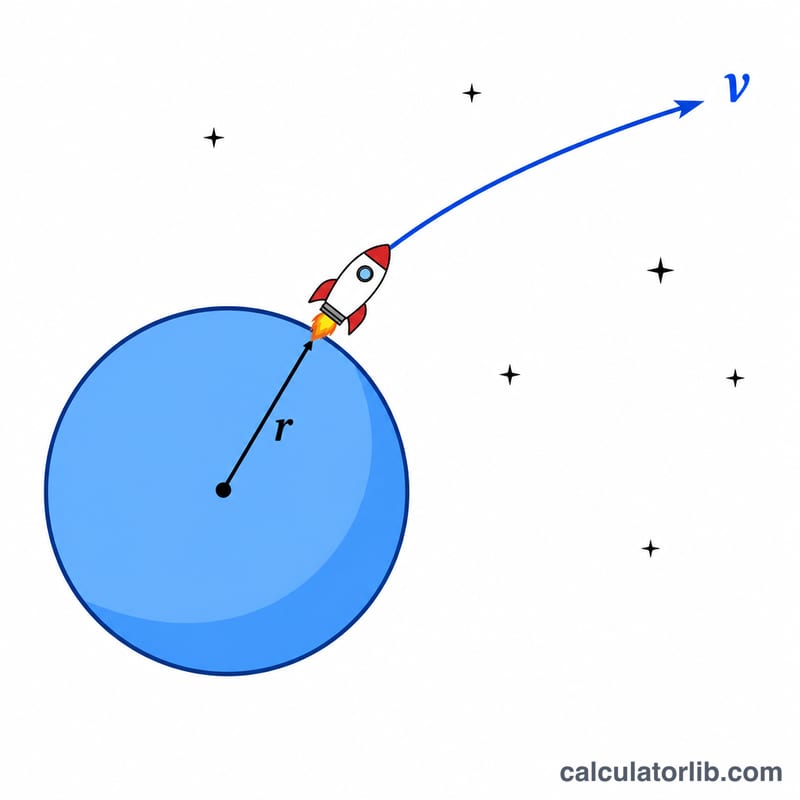
Worked example: Earth
With \(M = 5.97237 \times 10^{24}\) kg, \(r = 6371\) km, the surface escape velocity is $$\sqrt{2 \times 6.67430 \times 10^{-11} \times 5.97237 \times 10^{24} / 6.371 \times 10^{6}} \approx 11186 \text{ m/s} \approx 11.19 \text{ km/s}.$$ At Earth's orbit (\(R = 1\) AU, \(M_c = 1.9885 \times 10^{30}\) kg), the Solar-System escape velocity is $$\sqrt{2 \times 6.67430 \times 10^{-11} \times 1.9885 \times 10^{30} / 1.495978707 \times 10^{11}} \approx 42123 \text{ m/s} \approx 42.1 \text{ km/s}.$$
FAQ
Why is the Solar-System value N/A for the Sun? The Sun does not orbit another body, so its orbital radius is zero and that calculation is undefined.
Does escape velocity depend on launch direction? No. Because it comes from energy conservation, only speed matters, not direction (ignoring atmosphere and rotation).
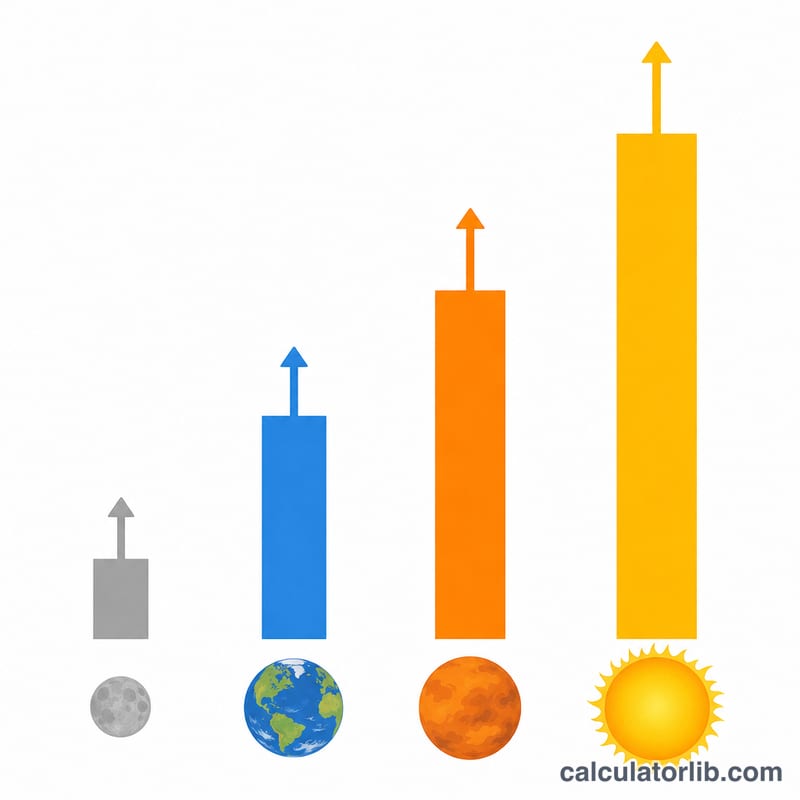
Why is the Solar-System escape so much larger than Earth's surface escape? The Sun is vastly more massive than Earth, so escaping its gravity well requires much more speed even at 1 AU distance.