
What This Calculator Does
The Solar Panel System Size Calculator estimates how large a solar array (in kilowatts) you need to cover your daily electricity use. It then converts that into an approximate number of panels based on the wattage of the panels you plan to install. This is a universal tool — the physics of sunlight and energy conversion apply everywhere — though peak sun hours vary by location and season.
How to Use It
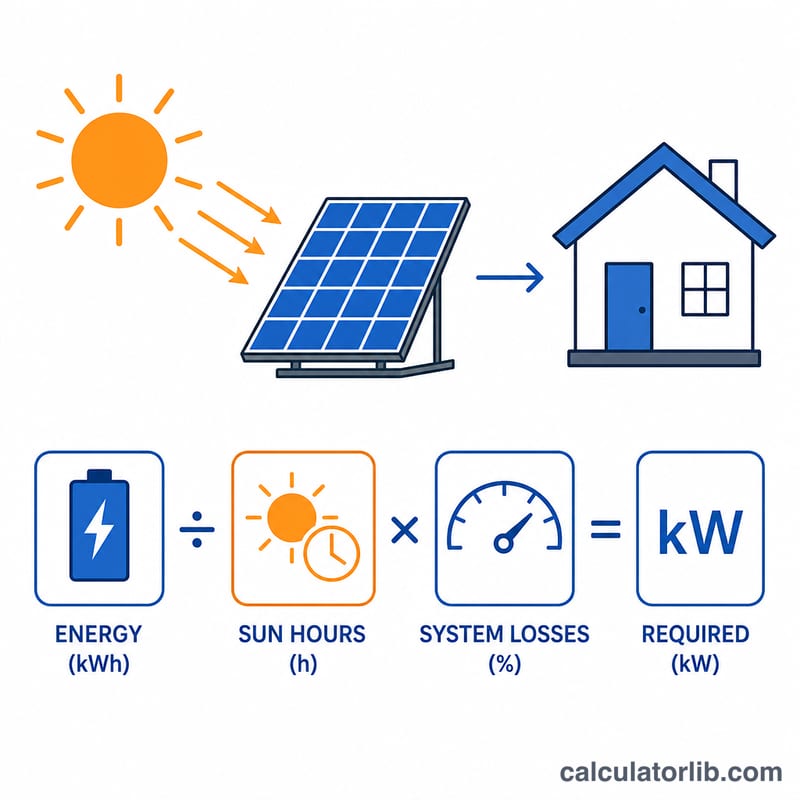
Enter your average daily energy consumption in kilowatt-hours (kWh) — you can find this on your electricity bill by dividing monthly usage by 30. Enter the peak sun hours for your area (a measure of usable full-strength sunlight, typically 3–6 hours per day). Add a system efficiency to account for real-world losses from inverters, wiring, heat, and dust (75–85% is typical). Optionally, enter the wattage of one panel to estimate how many you need.
The Formula Explained
The core equation is $$\text{System Size (kW)} = \frac{\text{Daily Energy (kWh)}}{\text{Peak Sun Hours} \times \dfrac{\text{Efficiency (\%)}}{100}}$$. Peak sun hours tell you how many productive hours of generation you get each day, and efficiency derates the output for losses. Dividing your needed energy by this effective daily production yields the array size. The number of panels is the total system watts divided by each panel's wattage, rounded up.
$$\text{Panels} = \left\lceil \frac{\text{System Size (kW)} \times 1000}{\text{Panel Wattage (W)}} \right\rceil$$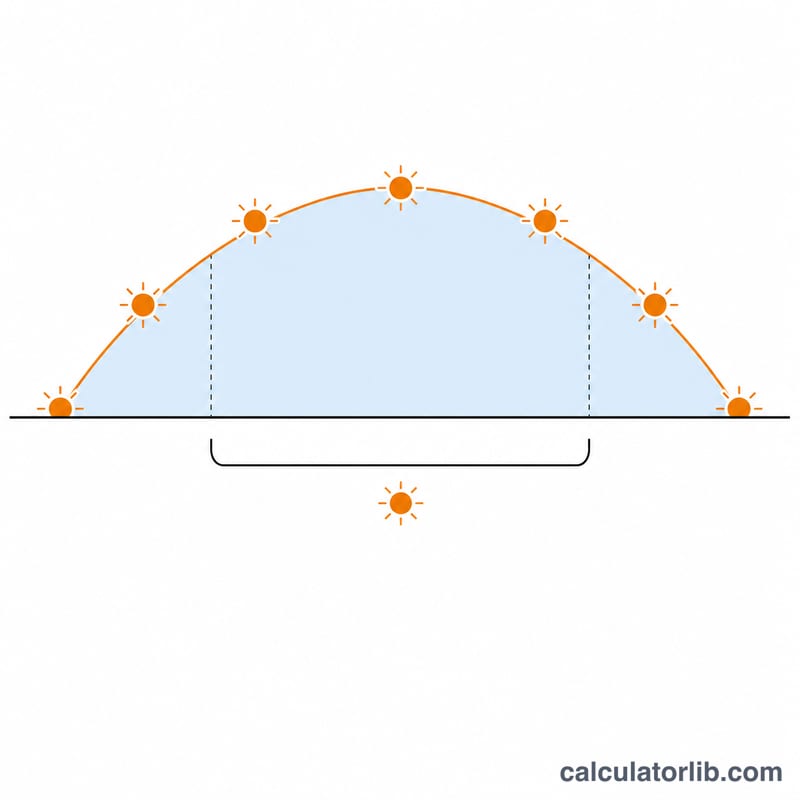
Worked Example
Suppose you use 30 kWh per day, get 5 peak sun hours, and assume 80% efficiency. The effective production factor is \(5 \times 0.80 = 4\). System size = \(30 \div 4 = 7.5\) kW. With 400 W panels, you need \(7{,}500 \div 400 = 18.75\), rounded up to 19 panels.
FAQ
What are peak sun hours? They represent the equivalent number of hours per day when sunlight averages 1,000 W/m². It is not the same as daylight hours.
Why include efficiency? Real systems lose energy to inverters, heat, shading, and wiring. Ignoring this would undersize your system.
Is this an exact quote? No — it is a planning estimate. A professional site assessment accounts for roof angle, shading, and local sun data.