
What Is BSFC?
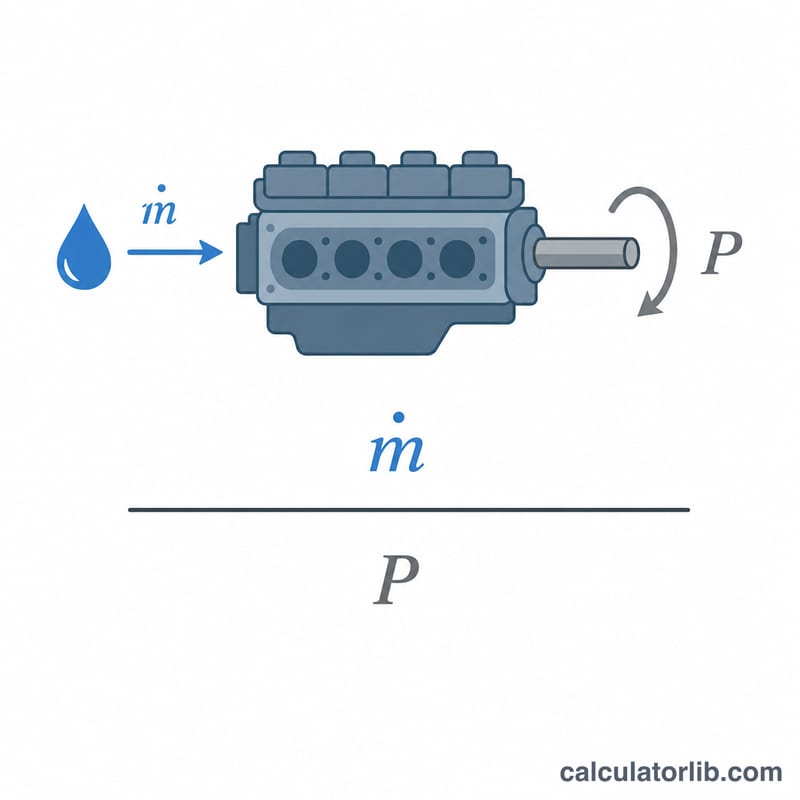
Brake Specific Fuel Consumption (BSFC) is a measure of how efficiently an engine converts fuel into useful work at the crankshaft (brake) output. It expresses the mass of fuel consumed per unit of power produced per unit of time, typically in grams per kilowatt-hour, g/(kW·h). A lower BSFC means the engine produces more power from less fuel — it is more efficient. BSFC is a universal physics/engineering metric and applies to any internal combustion engine regardless of country.
How to Use This Calculator
Enter the engine's fuel consumption rate in kilograms per hour (kg/h) and the brake power output in kilowatts (kW). The calculator divides fuel rate by power to give BSFC in kg/(kW·h), then multiplies by 1000 to show the more common g/(kW·h) figure. If you only know volumetric fuel flow (L/h), multiply it by the fuel density (about 0.745 kg/L for gasoline, 0.835 kg/L for diesel) to get the mass rate first.
The Formula Explained
$$\text{BSFC} = \frac{\text{Fuel Rate (kg/h)}}{\text{Power (kW)}} \times 1000$$ BSFC = fuel consumption rate ÷ power output. Because fuel rate is a mass-per-time quantity (kg/h) and power is energy-per-time (kW), the time units cancel cleanly, leaving fuel mass per energy. Good modern gasoline engines run around 250–350 g/(kW·h) at their best operating point, while efficient diesels can reach below 200 g/(kW·h).
Worked Example
Suppose an engine burns 20 kg of fuel per hour while producing 100 kW. $$\text{BSFC} = 20 \div 100 = 0.2 \ \text{kg/(kW}\cdot\text{h)}$$ which equals 200 g/(kW·h) — a very efficient figure typical of a strong diesel.
Typical BSFC Values by Engine Type
Brake Specific Fuel Consumption (BSFC) measures how much fuel an engine burns per unit of useful work delivered at the crankshaft. Lower numbers mean better fuel efficiency. The figures below show the best-zone (most efficient operating point) BSFC for common engine categories using typical liquid hydrocarbon fuels.
| Engine type | Best-zone BSFC g/(kW·h) | Approx. brake thermal efficiency |
|---|---|---|
| Gasoline, naturally aspirated | 250–350 | ~25–33% |
| Gasoline, turbocharged (modern) | 230–290 | ~30–37% |
| Modern automotive diesel | 200–230 | ~36–42% |
| Large marine / stationary diesel | 155–185 | ~45–52% |
| Industrial gas turbine | 200–340 | ~25–40% |
Because diesel fuel has a higher energy content per kilogram than gasoline, a given BSFC corresponds to a slightly different thermal efficiency depending on the fuel's lower heating value. Best-in-class two-stroke marine diesels approach ~155 g/(kW·h), which is among the most efficient prime movers ever built.
Fuel Flow & Density Conversions
The BSFC formula requires fuel rate in kilograms per hour and power in kilowatts. Many measurements come in as volumetric flow (L/h) or as horsepower, so the conversions below let you normalize your inputs before applying $$\text{BSFC} = \frac{\text{Fuel Rate (kg/h)}}{\text{Power (kW)}}\times 1000.$$
Fuel densities (approximate, at ~15 °C)
| Fuel | Density (kg/L) | kg/h from L/h |
|---|---|---|
| Gasoline (petrol) | 0.745 | kg/h = L/h × 0.745 |
| Diesel | 0.835 | kg/h = L/h × 0.835 |
| Ethanol (E100) | 0.789 | kg/h = L/h × 0.789 |
| E85 (85% ethanol) | ~0.782 | kg/h = L/h × 0.782 |
| LPG (propane) | ~0.510 | kg/h = L/h × 0.510 |
Example: a gasoline engine drinking 30 L/h flows \(30 \times 0.745 = 22.35\) kg/h.
Power conversions
| From | To | Factor |
|---|---|---|
| Mechanical horsepower (hp) | kilowatts (kW) | × 0.7457 |
| Metric horsepower (PS) | kilowatts (kW) | × 0.7355 |
| kilowatts (kW) | mechanical hp | × 1.341 |
For instance, a 150 hp engine equals about 111.86 kW, which is the figure you would put in the power field.
FAQ
Is lower BSFC better? Yes. Lower BSFC means the engine needs less fuel to produce the same power, indicating higher thermal efficiency.
What is a typical BSFC value? Gasoline engines: ~250–350 g/(kW·h). Diesel engines: ~190–250 g/(kW·h) at their efficient zone.
What if my fuel flow is in liters? Convert it to mass using fuel density (kg/L) before entering it here, since BSFC is mass-based.