
What is the Car vs Bike Calculator?
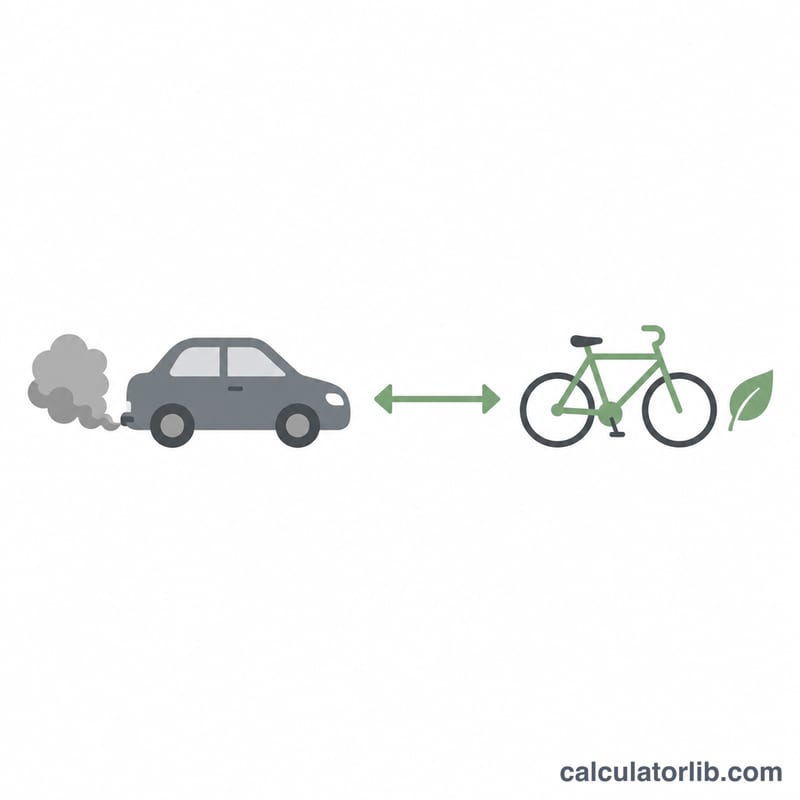
This calculator estimates how much carbon dioxide (CO2) you avoid by cycling instead of driving a car for routine trips such as commuting, shopping, or the school run. It compares the tailpipe emissions of your car against a bicycle, which produces effectively zero CO2 while you ride, and shows the difference as kilograms of CO2 saved over the period you choose.
How to use it
Enter the one-way distance of a typical trip in kilometres, how many trips you make per week, and the number of weeks you want to count (52 for a full year). Add your car's CO2 emission factor in grams per kilometre — a typical petrol car is around 170–200 g/km, while an efficient hybrid may be closer to 100 g/km. The tool doubles the distance to account for the return journey and totals the emissions.
The formula explained
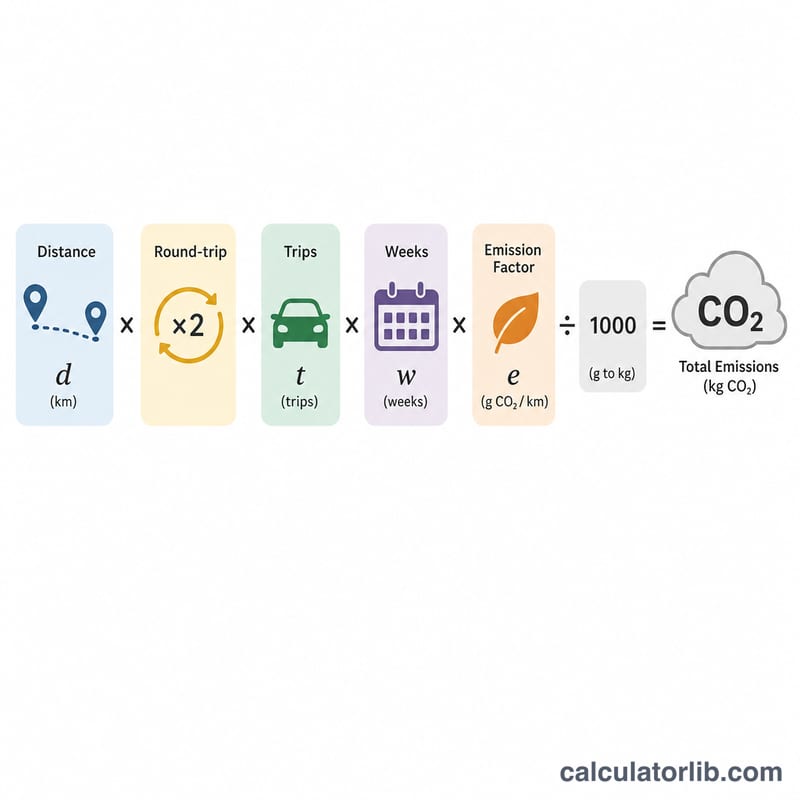
The total distance is distance × 2 × trips × weeks. Multiplying that by the emission factor gives grams of CO2, which we divide by 1000 to get kilograms. Because biking emits essentially no CO2, the savings equal the car's total emissions.
$$\text{CO}_2\text{ Saved (kg)} = \frac{\left(\text{Distance} \times 2 \times \text{Trips/Week} \times \text{Weeks}\right) \times \text{Emission}}{1000}$$
Worked example
Suppose your commute is 10 km each way, you ride 10 times a week for 52 weeks, and your car emits 180 g/km. Total distance = \(10 \times 2 \times 10 \times 52 = 10{,}400\) km. Car CO2 = \(10{,}400 \times 180 \div 1000 = 1{,}872\) kg. Since the bike emits 0 kg, you save about 1,872 kg of CO2 per year.
FAQ
Does biking really produce zero CO2? Riding itself has no tailpipe emissions. There are small upstream emissions from manufacturing and extra food energy, but they are negligible compared with a car, so we treat the bike as ~0.
What emission factor should I use? Check your car's official g/km rating, or use 170–200 for an average petrol car, 120–150 for diesel, and under 120 for hybrids.
How do I find my yearly savings? Set weeks to 52. For a single month use about 4.3 weeks.