
What this calculator does
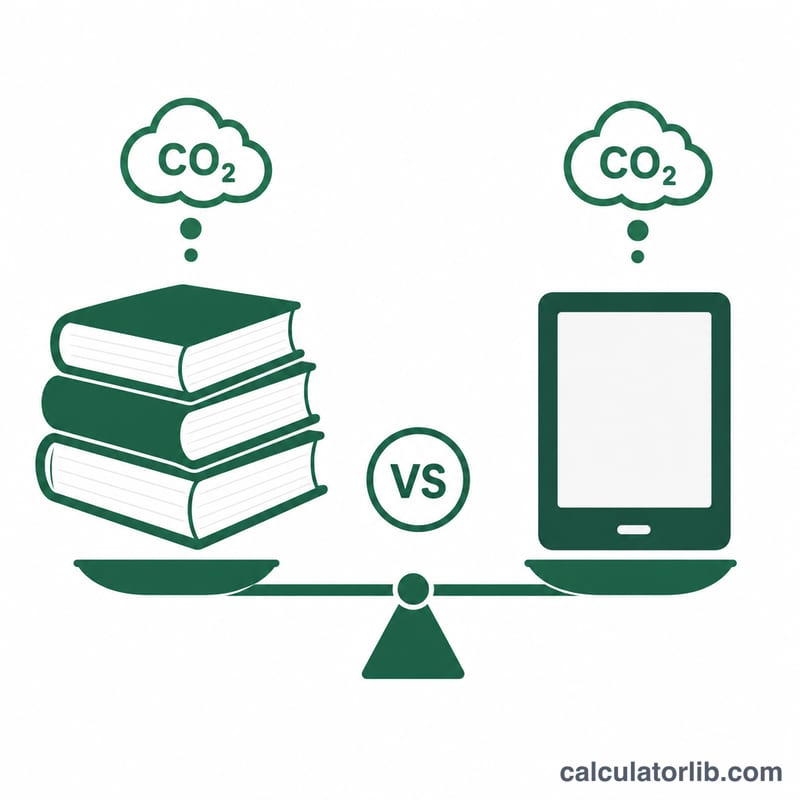
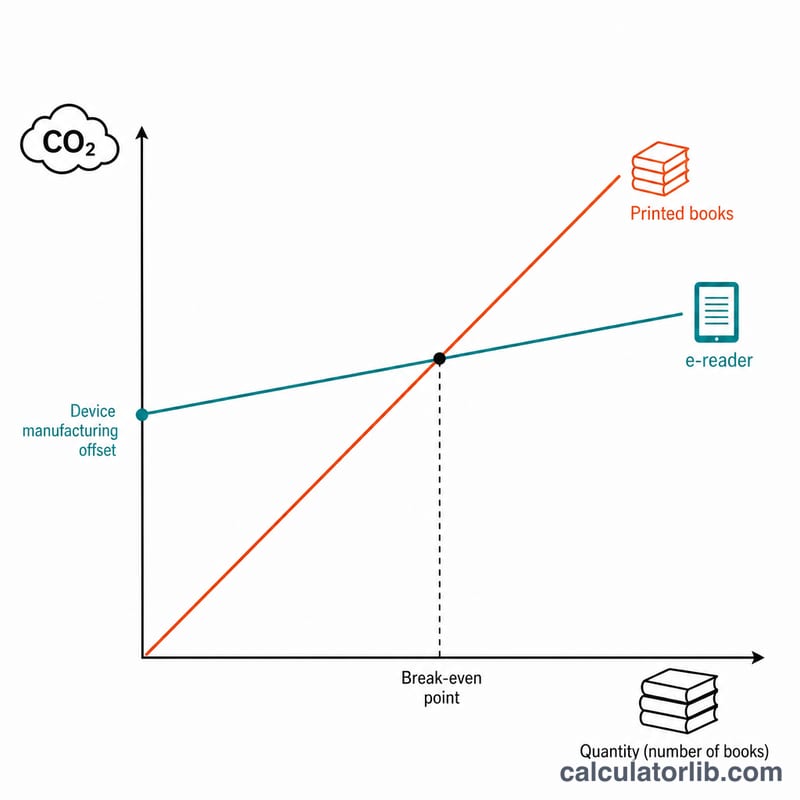
This tool compares the lifetime carbon footprint of reading printed books against reading e-books on an e-reader. An e-reader has a large one-time manufacturing footprint, but each e-book read on it adds very little. A printed book carries a footprint every single time you buy a new copy. The more you read, the better the e-reader looks — but only above a certain number of books.
How to use it
Enter how many books you read per year, the CO₂ of a typical printed book, the manufacturing footprint of your e-reader, the per-e-book footprint, and the device's expected lifespan in years. The calculator multiplies your annual reading by the lifespan to compare the same total number of books on both sides, then reports which option emits less CO₂ and the break-even point.
The formula explained
Printed footprint = total books × CO₂ per book. E-book footprint = device manufacturing CO₂ + (total books × CO₂ per e-book). The break-even number of books is the device footprint divided by the difference between per-book and per-e-book emissions: $$\text{Break-Even} = \frac{D}{C_{\text{book}} - C_{\text{ebook}}}$$ Read more than this many books on the device and e-books win.
Worked example
Suppose you read 25 books/year, a printed book is 1.2 kg CO₂, the e-reader is 60 kg, an e-book is 0.2 kg, and the device lasts 4 years. Total books = 100. Print = $$100 \times 1.2 = 120 \text{ kg}.$$ E-book = $$60 + 100 \times 0.2 = 80 \text{ kg}.$$ E-books save 40 kg. Break-even = $$\frac{60}{1.2 - 0.2} = 60 \text{ books}.$$
Typical CO₂ Footprint Values for Books and E-Readers
The carbon footprint of reading depends on two very different things: the embodied emissions of physical books (paper, printing, transport) versus the one-time manufacturing emissions of an e-reader plus the small per-title energy cost of downloading and reading e-books. The values below are widely cited ranges from published lifecycle assessments and manufacturer reports; treat them as planning estimates rather than exact figures, since they vary with paper type, shipping distance, electricity grid, and device model.
| Item | Typical CO₂ estimate | Notes |
|---|---|---|
| Paperback book | ~1 kg CO₂e | Often quoted near 1–1.2 kg; covers pulp, paper, printing, and distribution. |
| Hardback book | ~2–3 kg CO₂e | Heavier paper, board cover, and higher shipping mass raise the footprint. |
| E-reader manufacturing (lifecycle) | ~30–100 kg CO₂e | A Kindle is commonly cited around 30–65 kg lifecycle; full tablets and larger devices trend higher. |
| Per e-book (download + reading) | ~0.1–0.2 kg CO₂e | Server/network energy plus device charging over the hours spent reading; depends on grid intensity. |
| Library or used book (effective) | ~0.05–0.3 kg CO₂e per read | The manufacturing footprint is shared across many borrowers/owners, so the per-read share is small. |
Source notes: Per-book figures derive from publishing-industry and academic lifecycle assessments (the ~1 kg paperback estimate is widely reported). E-reader figures combine manufacturer environmental reports and independent LCAs. Per-e-book values are estimated from streaming/data-transfer energy studies and typical device charging. Because grid carbon intensity differs by region, the e-book side scales with your local electricity emissions.
Key Terms Explained
- Total books (N)
- The total number of titles you read over the period being compared — usually the device's lifespan. It is books per year multiplied by the number of years, and it is the main driver of which format wins.
- CO₂ per printed book
- The lifecycle emissions of producing and delivering one physical book: paper and pulp, printing, binding, and transport. Roughly 1 kg for a paperback and 2–3 kg for a hardback.
- Device manufacturing CO₂ (D)
- The one-time embodied carbon of making the e-reader (materials, components, assembly, shipping). This is a fixed up-front cost that the e-book option carries regardless of how many books you read, typically 30–100 kg.
- Per-e-book CO₂
- The recurring emissions of downloading and reading one digital title — data-transfer/server energy plus the electricity used to charge and run the device while reading. Usually a small 0.1–0.2 kg per book, tied to your local grid's carbon intensity.
- Device lifespan
- How many years you expect to use the e-reader before replacing it. A longer lifespan spreads the fixed manufacturing footprint over more books, lowering the effective per-book cost of the digital option.
- Break-even point
- The number of books at which print and e-book emit the same total CO₂. Read fewer than this and print is greener; read more and the e-reader comes out ahead. It is calculated as \(N = D / (\text{CO}_2\text{/book} - \text{CO}_2\text{/e-book})\).
FAQ
Are these CO₂ values accurate? They are editable estimates. A paperback is often cited around 1 kg CO₂ and an e-reader around 50–100 kg; adjust to your sources.
What about used or library books? Borrowing or sharing dramatically lowers the per-book figure — lower the "CO₂ per printed book" to reflect that.
Why multiply by years? An e-reader's footprint is spread across its whole life, so a fair comparison uses all the books read during that life.