
What this calculator does
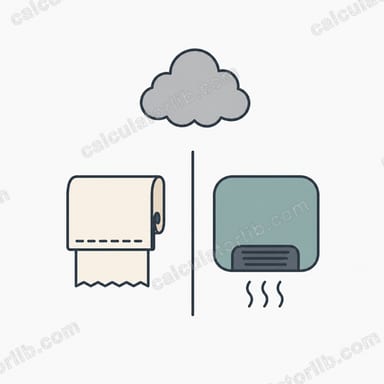
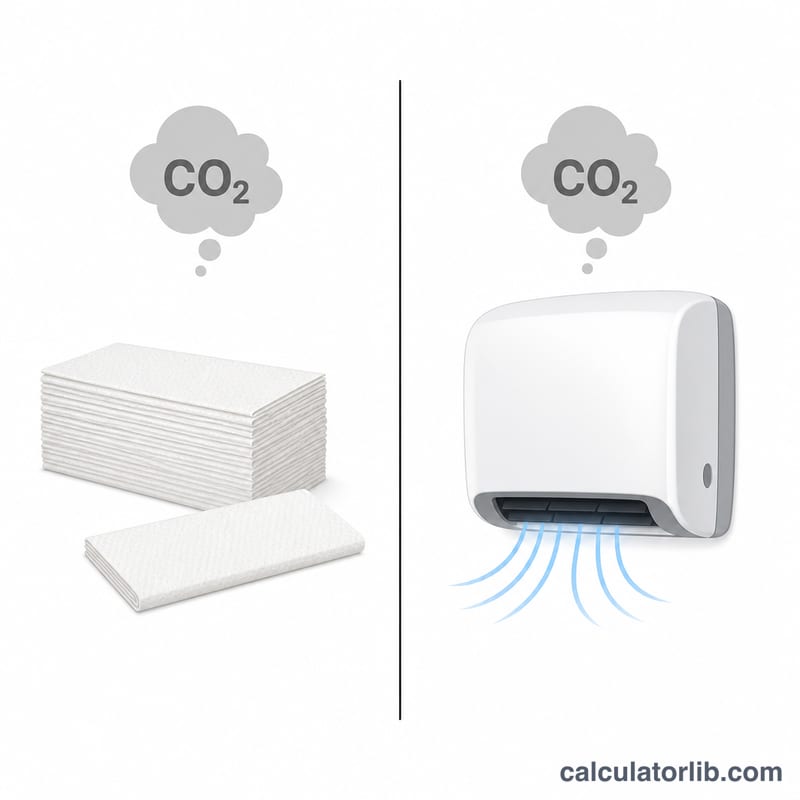
The Hand Drying Footprint Calculator estimates how much carbon dioxide (CO₂) your hand-drying habit produces over a year. It compares two common options: drying with paper towels and using an electric warm-air dryer. The result is expressed in kilograms of CO₂ per year so you can see the real-world impact of a small daily choice multiplied across hundreds of uses.
How to use it
Select your drying method, enter how many times you dry your hands on a typical day, and the number of days per year you do so (365 for everyday use). The calculator multiplies these into total dries and applies an emission factor for the method you chose.
The formula explained
The core equation is CO₂ = uses × days × CO₂ per dry. Based on widely cited life-cycle studies, we assume roughly 11 g CO₂ for a typical two-sheet paper-towel dry and about 9 g CO₂ for a standard electric air dryer. Grams are divided by 1,000 to give kilograms. These factors are estimates — local electricity mix, towel recycling, and dryer efficiency all shift the true number.
$$\text{CO}_2\ (\text{kg/yr}) = \frac{\text{Dries/day} \times \text{Days/yr} \times 11}{1000}$$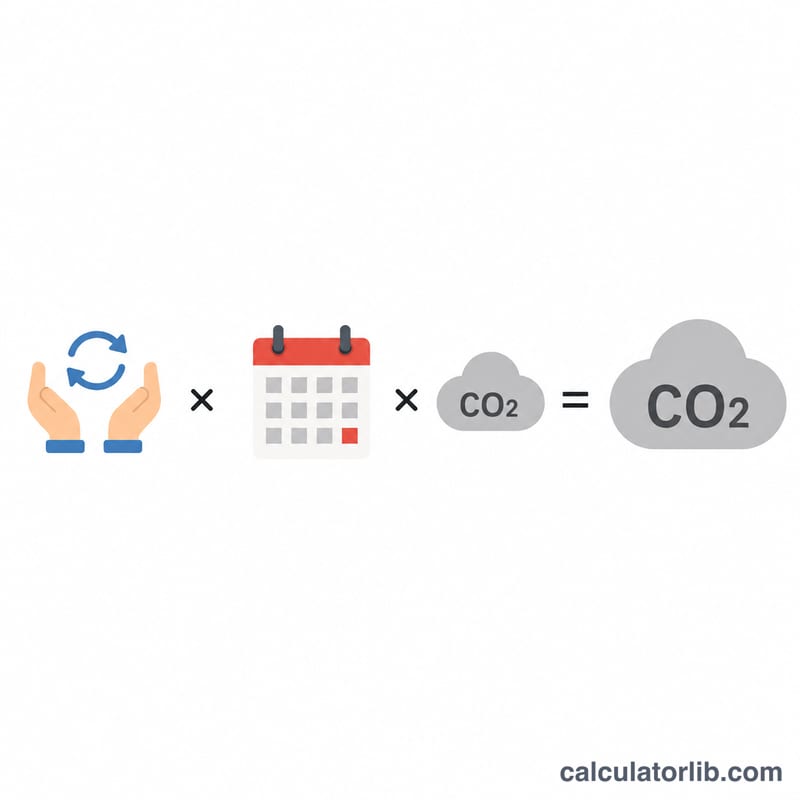
Worked example
Suppose you dry your hands 5 times a day, every day, with paper towels. That is \(5 \times 365 = 1{,}825\) dries. At 11 g each, that is \(1{,}825 \times 11 = 20{,}075\) g, or about 20.08 kg CO₂ per year. Switching to an air dryer at 9 g would drop this to 16.43 kg.
FAQ
Are air dryers always greener? Usually, but it depends on your grid. A dryer powered by coal-heavy electricity can rival or exceed paper towels.
Why two sheets for paper? Studies show most people use about two sheets per dry; using one halves the footprint.
Is recycled paper better? Yes — recycled-content towels and proper composting reduce emissions versus virgin paper.