

What is the Meat Footprint Calculator?
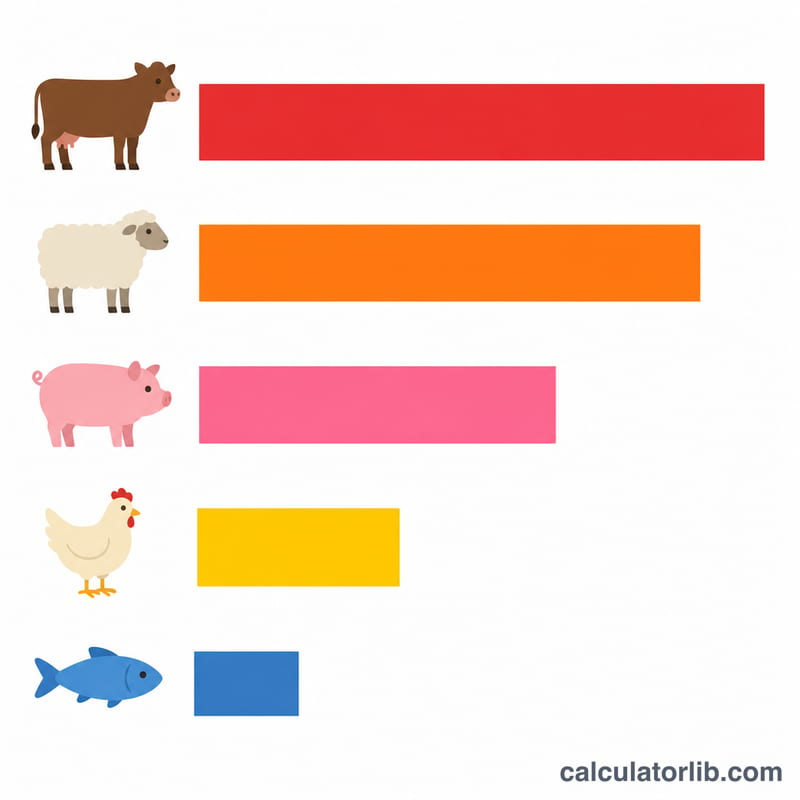
This tool estimates the greenhouse-gas emissions associated with producing the meat you eat, expressed in kilograms of carbon dioxide equivalent (kg CO₂e). Different meats have very different footprints: beef is by far the most carbon-intensive, while chicken and pork are much lower. The emission factors used here are global averages drawn from life-cycle assessment research (Poore & Nemecek, 2018) and cover farming, feed, processing and supply chain emissions.
How to use it
Pick the meat type from the dropdown — each option lists its emission factor in kg CO₂e per kilogram. Enter how much meat you ate (or plan to eat) in kilograms. The calculator multiplies the two values to give your footprint, and also projects an annual total if you ate that amount every week.
The formula explained
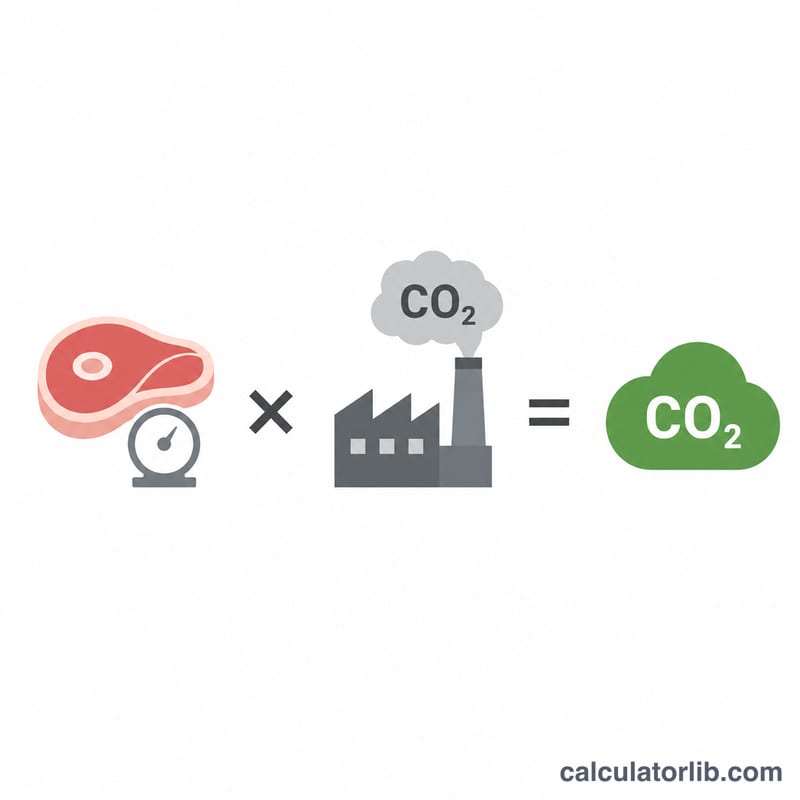
The calculation is simple:
$$\text{CO}_2 \text{ (kg)} = \text{meat weight (kg)} \times \text{emission factor}$$The emission factor (EF) bundles every stage of production into one number. For example, beef's 60 kg CO₂e/kg reflects methane from cattle, land-use change and feed production.
Worked example
Suppose you eat 2 kg of beef. With an emission factor of 60 kg CO₂e/kg:
$$2 \times 60 = 120 \text{ kg CO₂e}$$If you ate that every week, the annual figure would be \(120 \times 52 = 6{,}240\) kg CO₂e — roughly the same as a long-haul flight.
FAQ
Why is beef so high? Cattle release methane during digestion and require large amounts of land and feed, making beef several times more carbon-intensive than poultry.
Are these numbers exact? No. They are global average estimates; your actual footprint depends on farming methods, region and supply chain. Use them for comparison, not precision.
Can I lower my footprint? Yes — swapping beef and lamb for chicken, fish or plant-based proteins dramatically reduces emissions.