
What Is the Water Demand Calculator?
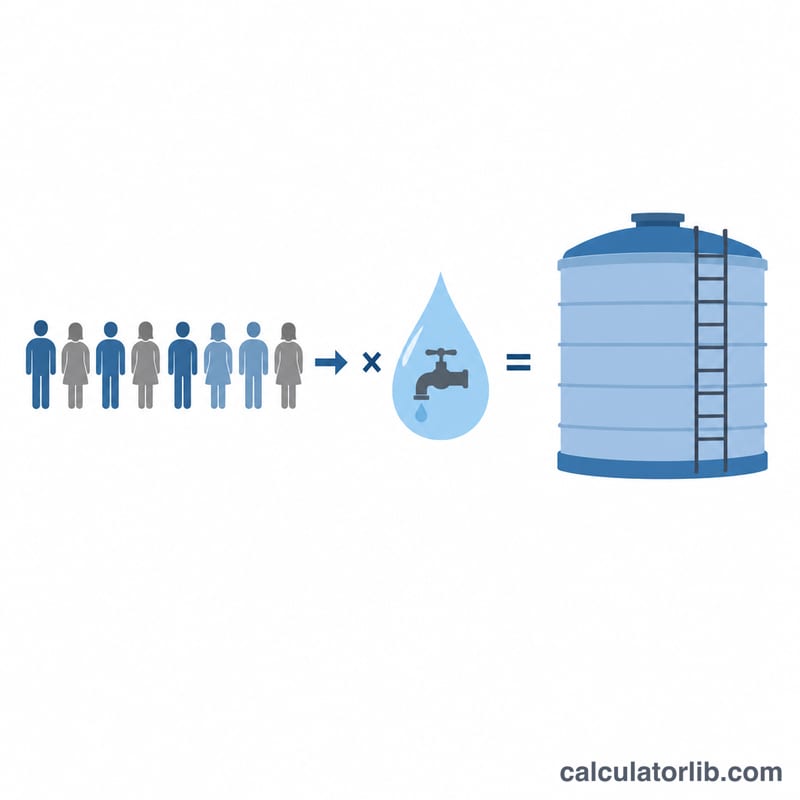
The Water Demand Calculator estimates how much water a community, town, or development requires each day. It is a fundamental tool in water supply engineering, used to size reservoirs, pipelines, pumps, and treatment plants. By multiplying the served population by the average per capita demand, you obtain the total volume of water that must be supplied daily.
How to Use It
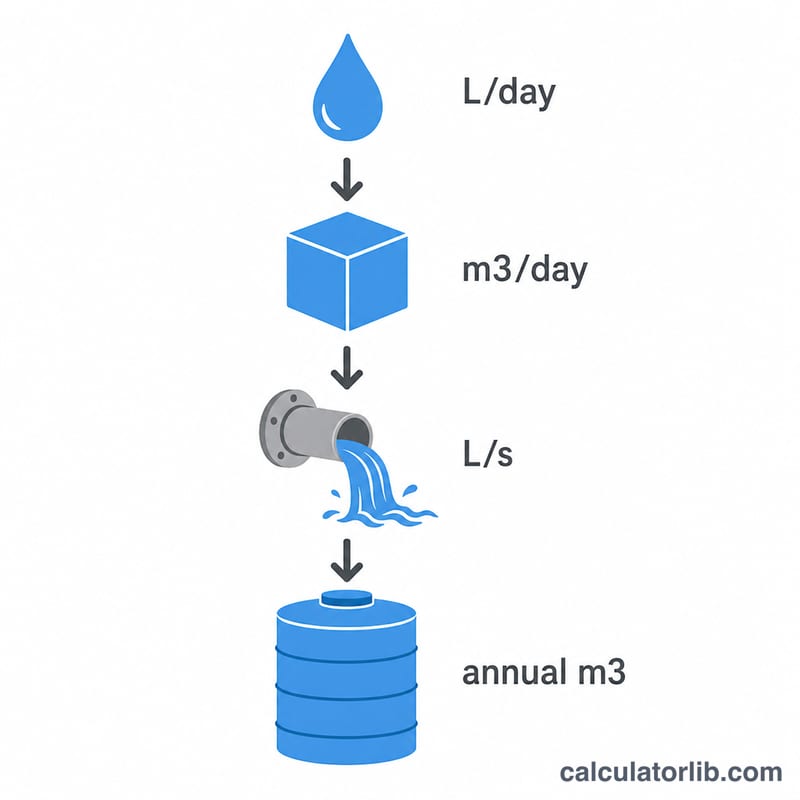
Enter the population to be served and the per capita demand in litres per person per day. Typical per capita figures range from about 100–150 L/day in many regions for domestic use, rising to 200+ L/day where commercial and industrial demand is included. The calculator returns the total demand in litres per day, cubic metres per day, the equivalent average flow rate in litres per second, and the annual demand in cubic metres.
The Formula Explained
The core equation is $$Q = P \times q$$ where \(Q\) is total demand (L/day), \(P\) is population, and \(q\) is per capita demand (L/person/day). To express results in m³/day, divide by 1,000. To find the average flow rate in L/s, divide the daily litres by 86,400 (the number of seconds in a day). Note that this gives the average flow — peak hourly and peak daily flows are higher and are obtained by applying peaking factors.
Worked Example
For a town of 50,000 people with a per capita demand of 150 L/day: $$Q = 50{,}000 \times 150 = 7{,}500{,}000 \text{ L/day} = 7{,}500 \text{ m}^3\text{/day}$$ The average flow rate is \(7{,}500{,}000 \div 86{,}400 \approx 86.81\) L/s, and the annual demand is \(7{,}500 \times 365 = 2{,}737{,}500\) m³/year.
FAQ
Does this include peak demand? No — it gives average daily demand. Multiply by a peak factor (often 1.5–2.5) for peak design flows.
What per capita value should I use? Use local guidelines; 135–150 L/day is a common domestic planning figure, but add allowances for commercial, industrial, and losses.
Should I add water losses? Yes — real systems lose water (non-revenue water). Increase per capita demand or add a percentage to account for leakage.