
What Is Water Horsepower?
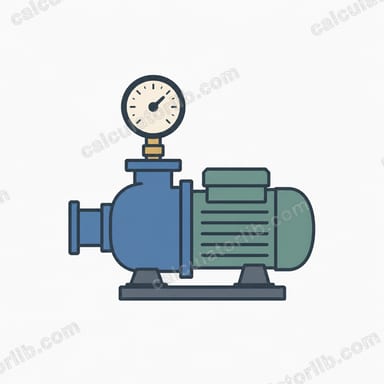
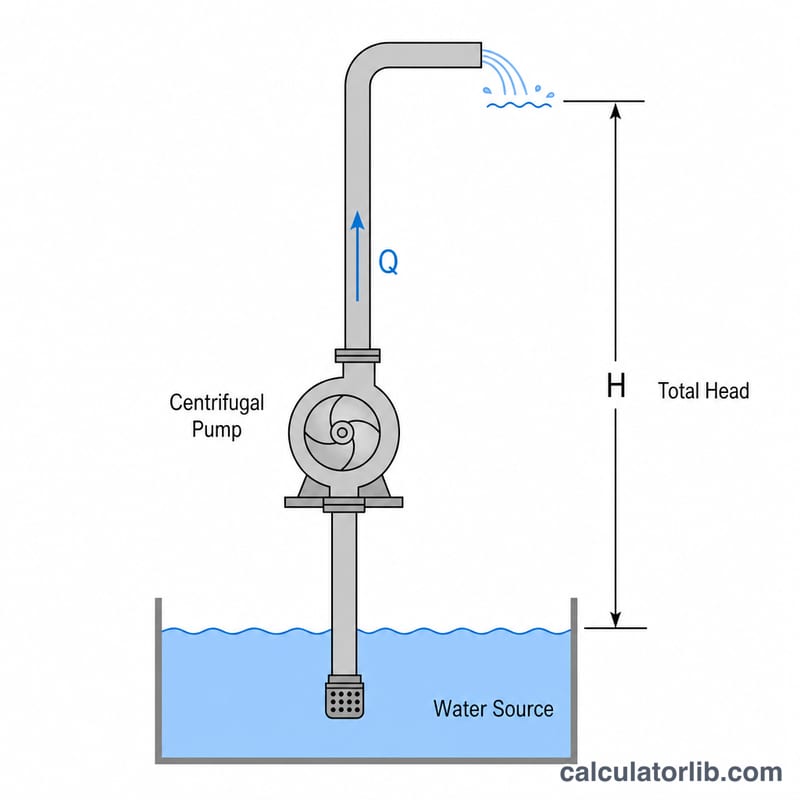
Water horsepower (WHP), also called hydraulic horsepower, is the theoretical power actually imparted to a fluid as it is moved through a pumping system. It represents the useful output power needed to lift a given flow rate to a given height. Unlike brake horsepower, WHP ignores pump and motor inefficiencies, so it is always the smallest power figure in a pump calculation and forms the baseline for sizing equipment.
How to Use This Calculator
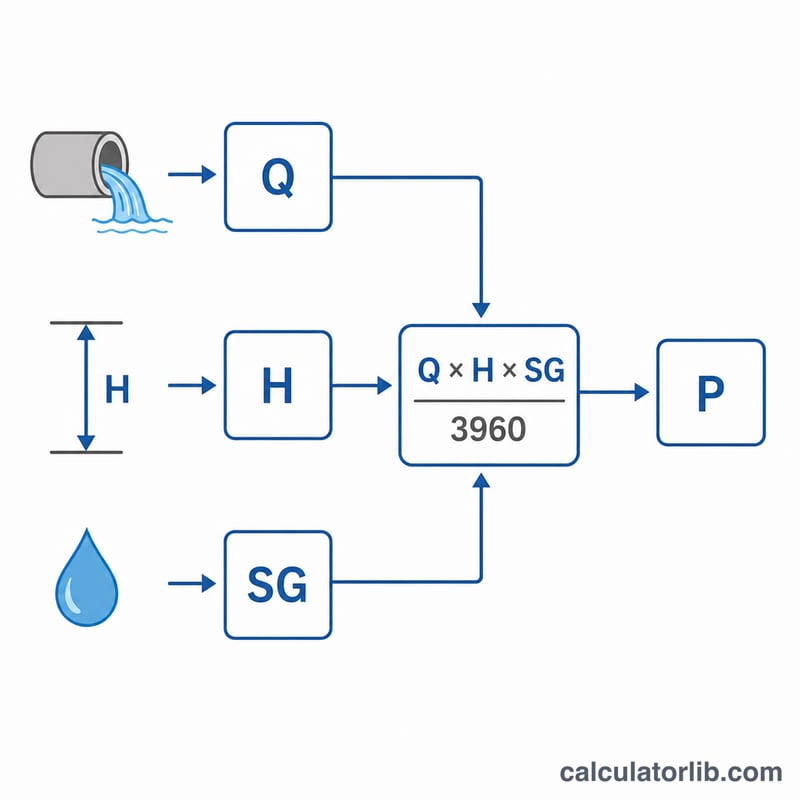
Enter three values: the flow rate Q in US gallons per minute (gpm), the total dynamic head H in feet, and the specific gravity (SG) of the liquid. Water at standard conditions has SG = 1.0; brines, oils, and slurries differ. Click calculate to see the water horsepower and its equivalent in watts.
The Formula Explained
The standard US-unit equation is $$\text{WHP} = \frac{\text{Flow }Q\text{ (gpm)} \times \text{Head }H\text{ (ft)} \times \text{SG}}{3960}$$ The denominator 3960 is a unit-conversion constant: 33,000 ft·lb/min per horsepower divided by 8.33 lb per gallon of water. Multiplying head and flow gives the rate of work, while specific gravity scales the result for fluids heavier or lighter than water.
Worked Example
Suppose a pump moves 500 gpm of water (SG = 1.0) against 100 ft of total head. Then $$\text{WHP} = \frac{500 \times 100 \times 1.0}{3960} = \frac{50{,}000}{3960} \approx 12.626 \text{ hp}$$ To find the brake horsepower you would divide this by the pump efficiency (e.g. 0.75 → about 16.8 bhp).
FAQ
Is this water horsepower or brake horsepower? This is water (hydraulic) horsepower — the ideal output. Divide by pump efficiency to get brake horsepower.
What units does this use? US units: gallons per minute, feet of head, and dimensionless specific gravity, with the 3960 constant.
What if I am pumping something other than water? Enter the fluid specific gravity. Diesel is roughly 0.85, seawater about 1.025, and concentrated brine can exceed 1.2.