
What is the IV Infusion Rate Calculator?
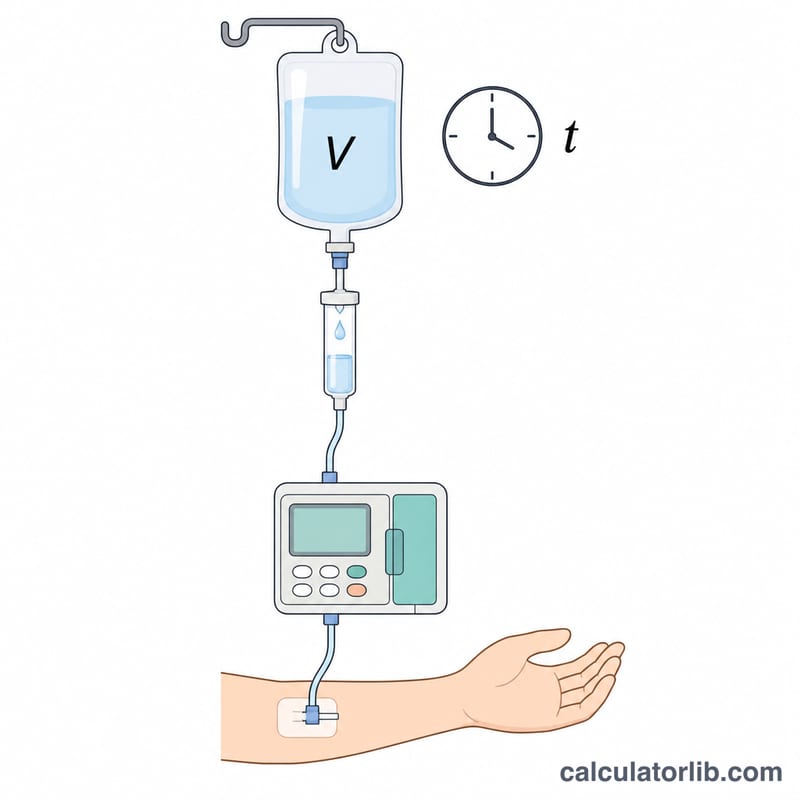
This calculator determines the flow rate for an intravenous (IV) infusion. Given the total volume of fluid to be administered and the time over which it should run, it returns the rate in milliliters per hour (mL/hr) for an infusion pump, and optionally the drip rate in drops per minute (gtt/min) for gravity-fed sets. It is a general clinical math tool and is not a substitute for professional judgment or institutional protocols.
How to use it
Enter the total volume in mL (for example a 1000 mL bag). Enter the infusion time using hours and/or minutes. If you are running the line by gravity rather than a pump, enter the drop factor printed on the IV tubing (commonly 10, 15, 20, or 60 gtt/mL) to also get the drip rate. The calculator combines hours and minutes into total time before dividing.
The formula explained
The pump rate is simply total volume divided by total time in hours: $$\text{mL/hr} = \text{Volume} \div \text{Time}$$ To convert to a gravity drip rate, multiply the volume by the drop factor and divide by the total time in minutes: $$\text{gtt/min} = (\text{Volume} \times \text{DropFactor}) \div \text{Minutes}$$
Worked example
You need to infuse 1000 mL over 8 hours using tubing with a 20 gtt/mL drop factor. $$\text{Rate} = 1000 \div 8 = 125 \text{ mL/hr}$$ Total time is 480 minutes, so the drip rate $$= (1000 \times 20) \div 480 = 20000 \div 480 \approx 41.67 \text{ gtt/min}$$ rounded to about 42 drops per minute.
FAQ
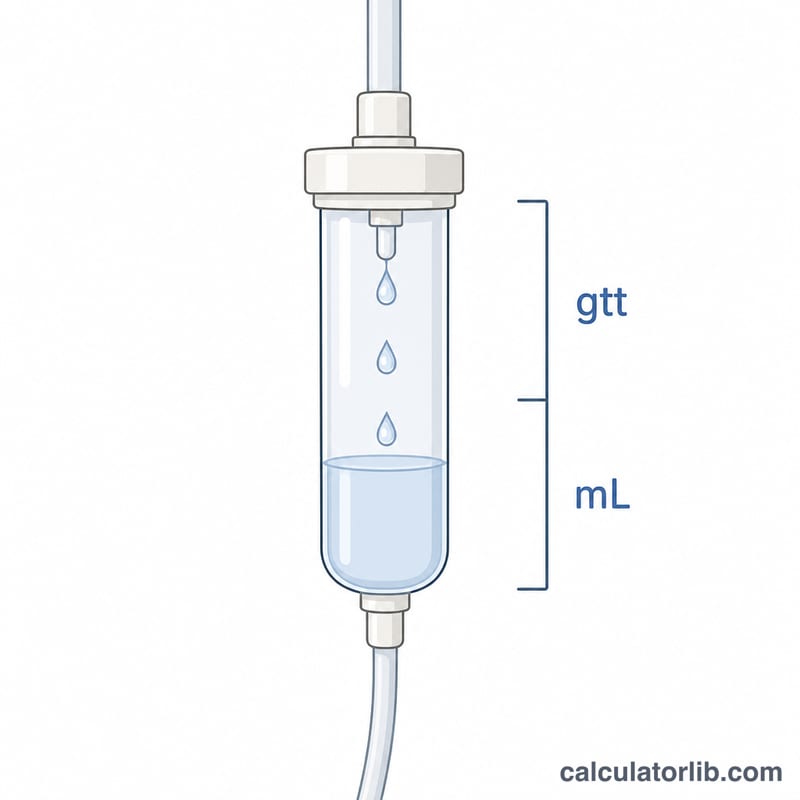
What is a drop factor? It is the number of drops that make up 1 mL for a given IV administration set, printed on the package. Macrodrip sets are usually 10-20 gtt/mL; microdrip sets are 60 gtt/mL.
What if I only know minutes? Leave hours at 0 and enter the time in minutes; the tool converts everything to hours internally.
Why does mL/hr equal gtt/min for a 60 drop factor? Because there are 60 minutes per hour, a 60 gtt/mL microdrip set produces a drip rate numerically equal to the mL/hr rate.