
What is the Rate Constant Calculator?
This tool computes the reaction rate constant k using the Arrhenius equation, one of the cornerstones of chemical kinetics. Given the pre-exponential factor (frequency factor) A, the activation energy Ea, and the absolute temperature T, it returns k in the same units as A. It is universal physical chemistry — no country or jurisdiction applies.
How to use it
Enter the pre-exponential factor A (often around 1013 1/s for simple unimolecular reactions), the activation energy Ea in joules per mole, and the temperature in kelvin. The calculator uses the gas constant R = 8.314 J/(mol·K). Make sure your activation energy is in J/mol, not kJ/mol — multiply kJ/mol values by 1000 first.
The formula explained
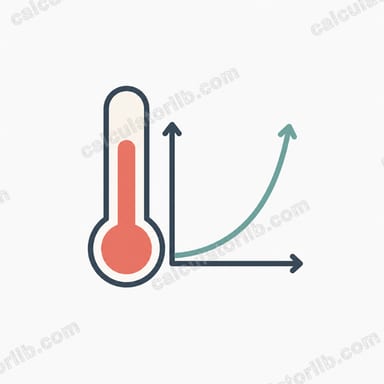
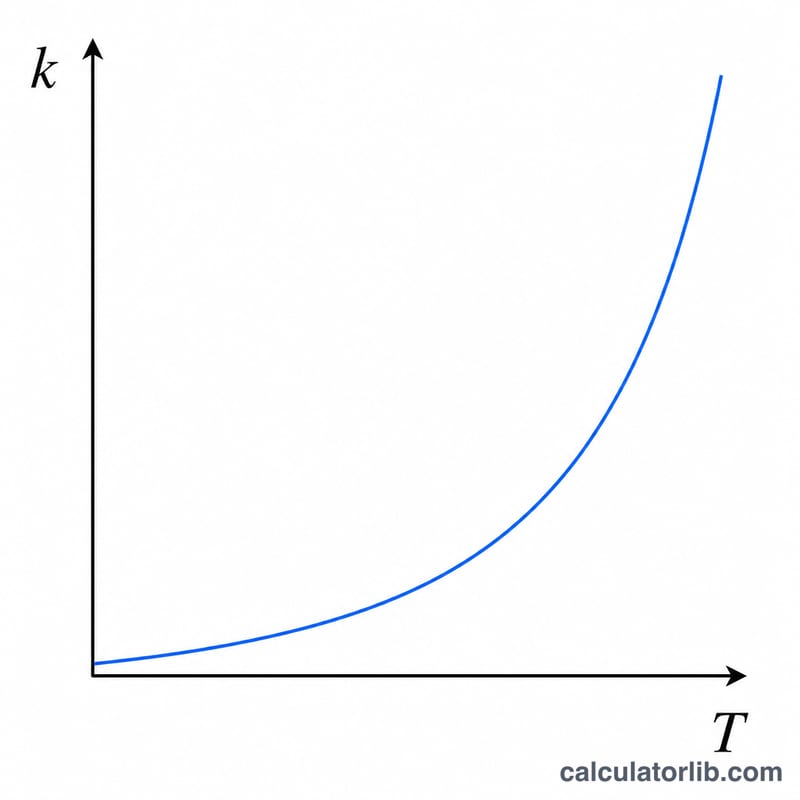
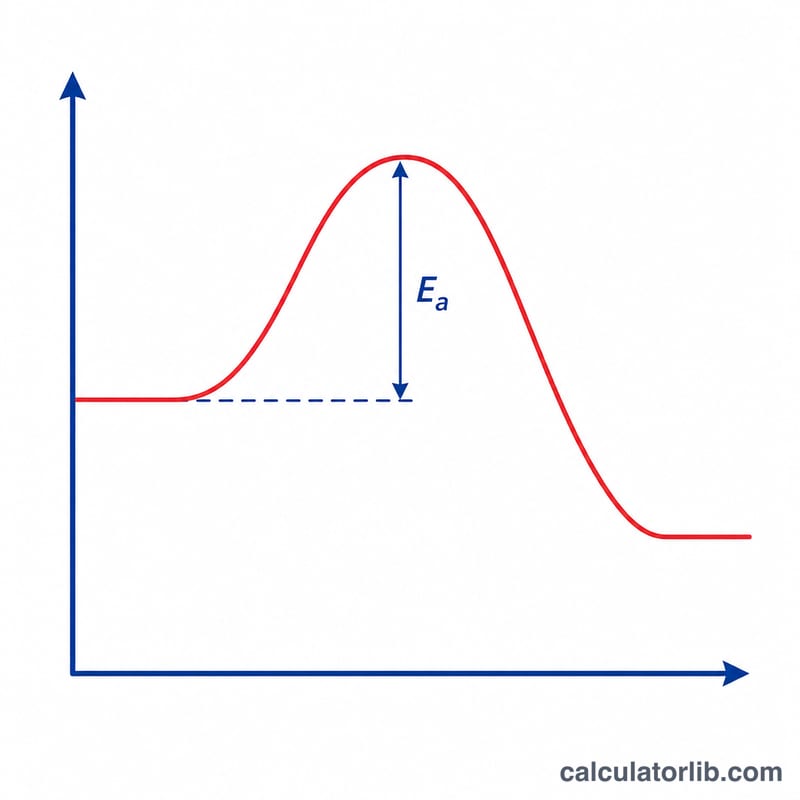
The Arrhenius equation is $$k = A \cdot e^{-E_a / (R \cdot T)}$$ The exponential term is the Boltzmann factor: it gives the fraction of molecular collisions with enough energy to react. As temperature rises, the exponent becomes less negative, so k grows rapidly. Higher activation energy makes the exponent more negative, slowing the reaction.
Worked example
With \(A = 1\times10^{13}\) 1/s, \(E_a = 75{,}000\) J/mol, and \(T = 298\) K: $$R \cdot T = 8.314 \times 298 = 2477.572 \text{ J/mol}$$ The exponent is $$\frac{-75000}{2477.572} = -30.272$$ Then $$k = 10^{13} \times e^{-30.272} \approx 10^{13} \times 7.13\times10^{-14} \approx 0.713 \text{ 1/s}$$
FAQ
What units does k have? The same as A. For first-order reactions A and k are in 1/s; for second-order reactions they are in L/(mol·s).
Should Ea be in kJ or J? This calculator expects J/mol. Convert kJ/mol to J/mol by multiplying by 1000.
Why does a small temperature change matter so much? Because temperature appears inside an exponential, even a modest rise can multiply the rate constant several-fold — a rule of thumb is that rates roughly double for every 10 K increase.