
What is the Rate Law Calculator?
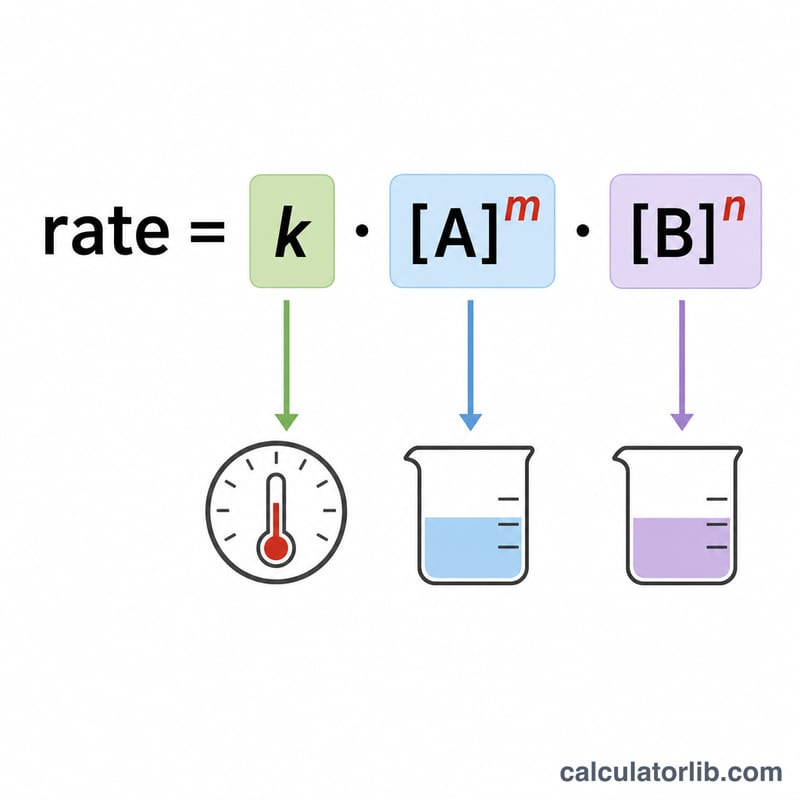
The rate law (or rate equation) links the speed of a chemical reaction to the concentrations of its reactants. For a general reaction involving reactants A and B, the rate is expressed as $$\text{rate} = \text{k} \cdot [\text{A}]^{\text{m}} \cdot [\text{B}]^{\text{n}}$$, where k is the rate constant, [A] and [B] are molar concentrations, and m and n are the reaction orders with respect to each reactant. This calculator evaluates that expression instantly and also reports the overall reaction order, \(m + n\).
How to use it
Enter the rate constant k, the concentration and order for reactant A, and optionally for reactant B. If your reaction only depends on one reactant, set the second order to 0 (its term becomes 1 and has no effect). The tool returns the instantaneous reaction rate along with each concentration term so you can see how they contribute.
The formula explained
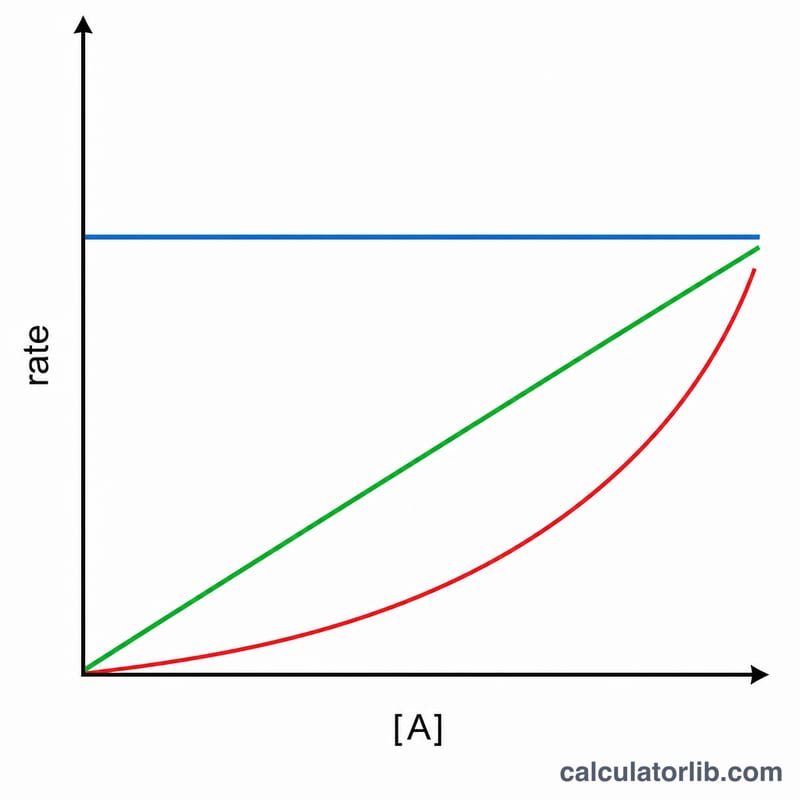
Reaction orders are determined experimentally, not from stoichiometric coefficients. A zero-order term contributes a factor of 1 regardless of concentration; a first-order term scales linearly with concentration; a second-order term scales with the square. The rate constant k carries units that depend on the overall order so that the rate always comes out in mol·L⁻¹·s⁻¹.
Worked example
Suppose \(k = 0.5\), \([A] = 2\) mol/L with order \(m = 2\), and \([B] = 3\) mol/L with order \(n = 1\). Then \([A]^2 = 4\) and \([B]^1 = 3\), so $$\text{rate} = 0.5 \times 4 \times 3 = 6 \ \text{mol}\cdot\text{L}^{-1}\cdot\text{s}^{-1}.$$ The overall order is \(2 + 1 = 3\).
FAQ
Can reaction orders be fractional or negative? Yes — experimentally determined orders may be fractions or even negative; this calculator accepts any real value via the power function.
What if I only have one reactant? Leave [B] at any value and set its order n to 0, which makes the [B] term equal to 1.
How do I find the rate constant k? Measure rate and concentrations in an experiment and rearrange the rate law: $$\text{k} = \frac{\text{rate}}{[\text{A}]^{\text{m}} \cdot [\text{B}]^{\text{n}}}.$$