
What Is Raoult's Law?
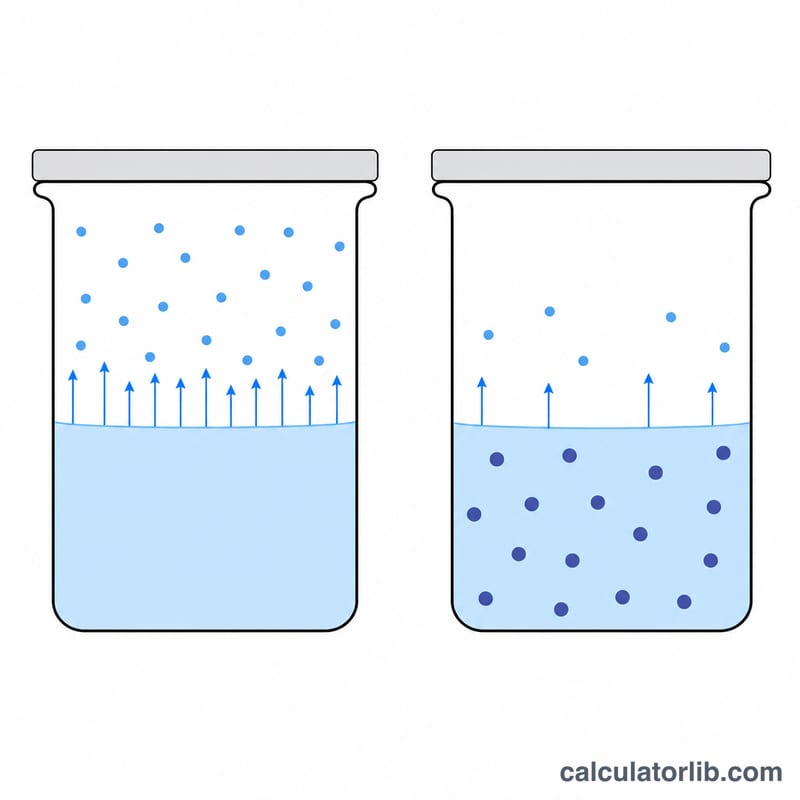
Raoult's Law is a fundamental principle in physical chemistry describing how a dissolved solute affects the vapor pressure of a solvent. It states that the partial vapor pressure of a solvent above an ideal solution is equal to the vapor pressure of the pure solvent multiplied by its mole fraction in the solution. When a nonvolatile solute is added, the solvent mole fraction drops below 1, so the solution's vapor pressure is always lower than that of the pure solvent.
How to Use This Calculator
Enter two values: the mole fraction of the solvent (a number between 0 and 1) and the vapor pressure of the pure solvent (commonly in mmHg, but any pressure unit works as long as you stay consistent). The calculator returns the vapor pressure of the solution and the vapor pressure lowering — how much the solute reduced the pressure.
The Formula Explained
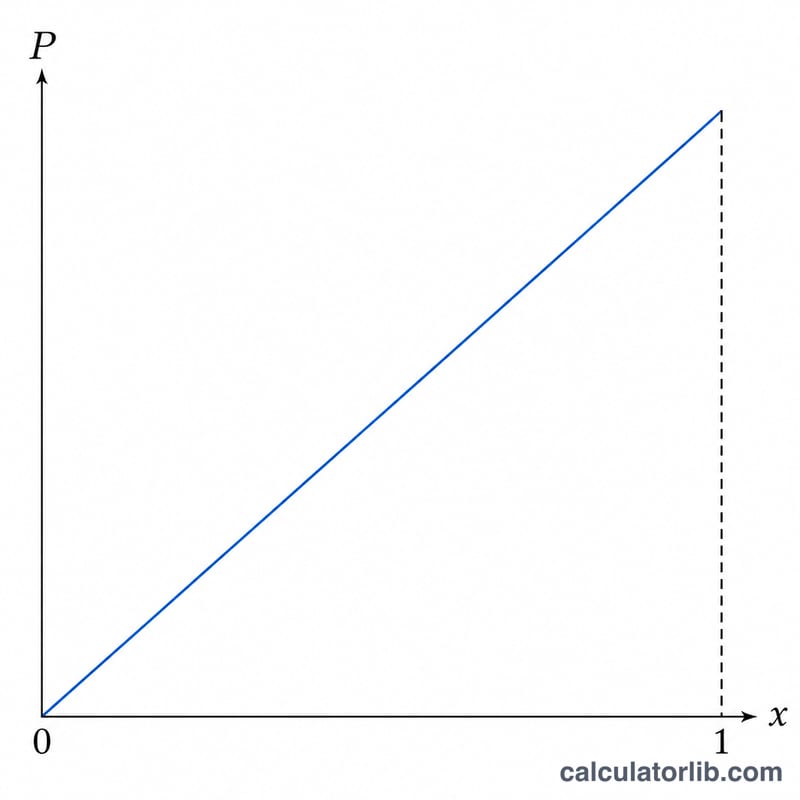
The core equation is $$P_{\text{solution}} = x_{\text{solvent}} \times P^{\circ}_{\text{solvent}}$$ Here \(x_{\text{solvent}}\) is the mole fraction of the solvent (moles of solvent divided by total moles), and \(P^{\circ}_{\text{solvent}}\) is the vapor pressure of the pure solvent. The vapor pressure lowering is simply $$\Delta P = P^{\circ}_{\text{solvent}} - P_{\text{solution}}$$
Worked Example
Suppose pure water has a vapor pressure of 100 mmHg, and a sugar solution has a water mole fraction of 0.80. Then $$P_{\text{solution}} = 0.80 \times 100 = 80 \text{ mmHg}$$ The vapor pressure lowering is $$100 - 80 = 20 \text{ mmHg}$$
FAQ
Does Raoult's Law work for all solutions? It is exact only for ideal solutions. Real solutions deviate, especially at high solute concentrations, but it is an excellent approximation for dilute solutions.
What if the solute is volatile? Then both components contribute to vapor pressure, and the total is the sum of each component's partial pressure (each given by its own Raoult's Law term).
What units should I use? Any consistent pressure unit (mmHg, kPa, atm) works because mole fraction is dimensionless. The result comes out in the same unit you entered.