
What is the Integrated Rate Law Calculator?
This tool applies the integrated rate laws of chemical kinetics to find the concentration of a reactant [A] remaining after a given time t, along with the reaction's half-life. It supports the three most common reaction orders — zero, first, and second — using a single reactant model A → products.
How to Use It
Pick the reaction order, then enter the initial concentration [A]₀ (mol/L), the rate constant k, and the elapsed time t (seconds). The calculator returns the concentration at time t and the half-life. Be sure your k units match the order: zero order uses mol·L⁻¹·s⁻¹, first order uses s⁻¹, and second order uses L·mol⁻¹·s⁻¹.
The Formulas Explained
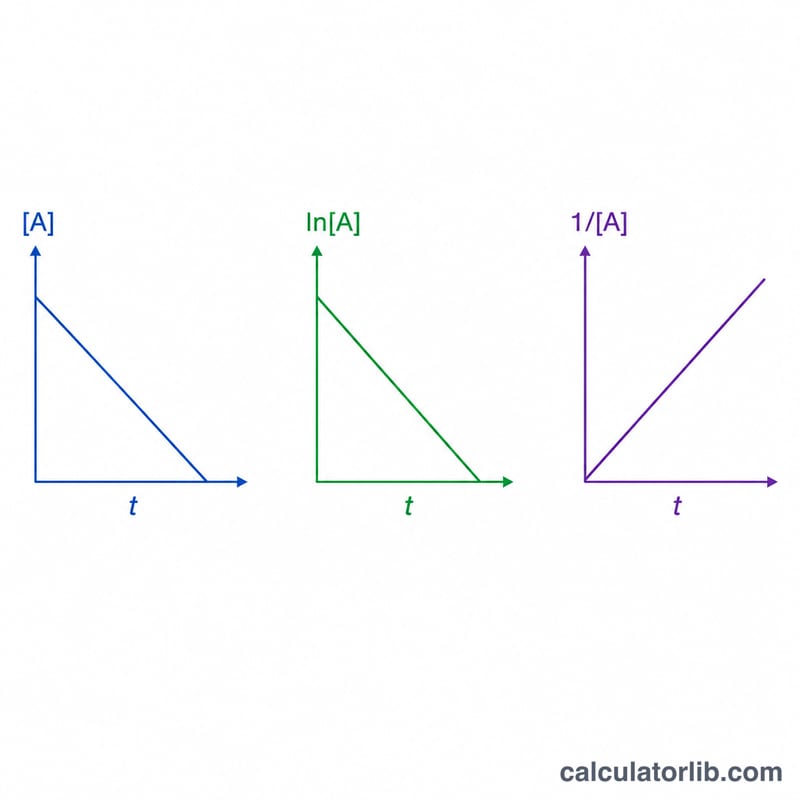
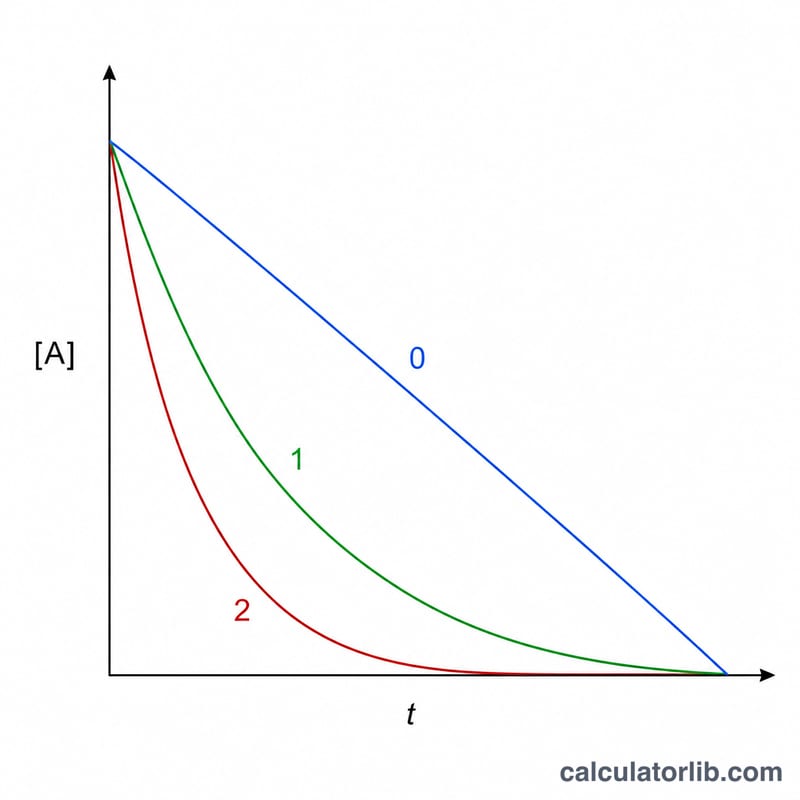
Zero order: \([\text{A}]_t = [\text{A}]_0 - k \cdot t\), with half-life \(t_{1/2} = \frac{[\text{A}]_0}{2\,k}\). The concentration falls in a straight line until it hits zero.
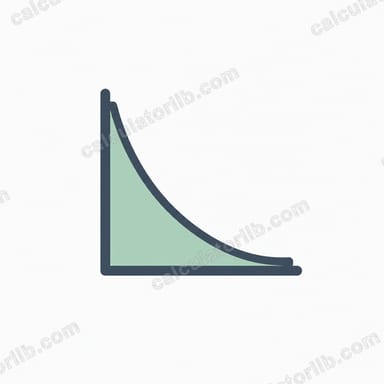
First order: \(\ln[\text{A}]_t = \ln[\text{A}]_0 - k \cdot t\), equivalently \([\text{A}]_t = [\text{A}]_0 \, e^{-k \cdot t}\). The half-life \(t_{1/2} = \frac{\ln 2}{k}\) is constant and independent of starting concentration.
Second order: \(\frac{1}{[\text{A}]_t} = \frac{1}{[\text{A}]_0} + k \cdot t\), with half-life \(t_{1/2} = \frac{1}{k \cdot [\text{A}]_0}\).
Worked Example
A first-order reaction has \(k = 0.05 \text{ s}^{-1}\), \([\text{A}]_0 = 1.0 \text{ mol/L}\), and \(t = 10 \text{ s}\). Then $$[\text{A}]_t = 1.0 \times e^{-0.5} = 1.0 \times 0.60653 = 0.6065 \text{ mol/L}.$$ The half-life is $$t_{1/2} = \frac{\ln 2}{0.05} = \frac{0.6931}{0.05} = 13.86 \text{ s}.$$
FAQ
Why does first-order half-life not depend on concentration? Because the rate is directly proportional to [A], the fractional decay per unit time is constant, giving a fixed half-life.
Can concentration go negative? Only the zero-order math can produce a negative value if t is large; physically the reactant is exhausted, so this calculator floors it at zero.
What units should k be in? They depend on order — s⁻¹ for first order, mol⁻¹ or L-based units otherwise. Always match k, [A], and t consistently.