
What this calculator does
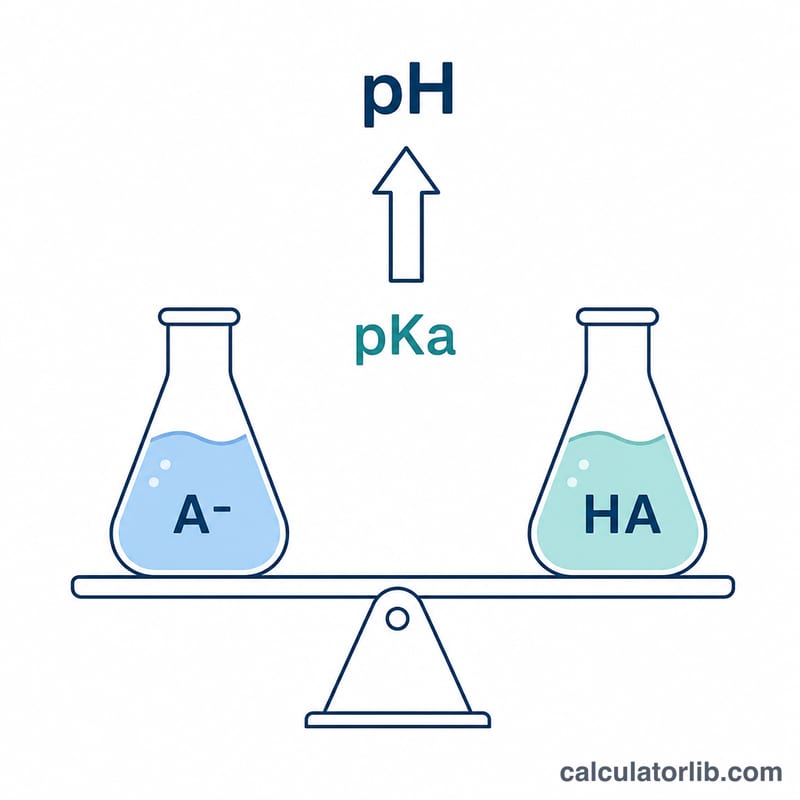
A buffer resists changes in pH because it contains a weak acid (HA) and its conjugate base (A⁻) in equilibrium. This tool tells you exactly how much of each species to combine to reach a desired pH at a chosen total concentration and volume. It works for any conjugate acid–base pair — acetate, phosphate, Tris, carbonate, citrate and more — as long as you know the relevant pKa.
The formula explained
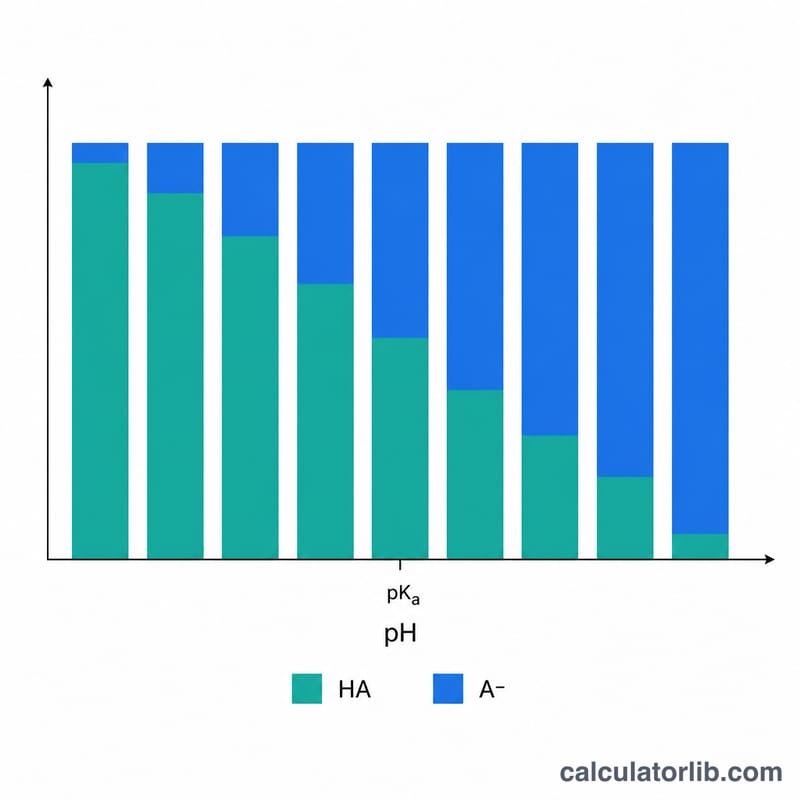
The Henderson-Hasselbalch equation states \( \text{pH} = \text{pKa} + \log_{10}\left(\frac{[A^-]}{[HA]}\right) \). Rearranging for the ratio gives $$ r = \frac{[A^-]}{[HA]} = 10^{\,\text{pH} - \text{pKa}}. $$ Once you know \(r\), the total buffer concentration \(C\) is split so that the conjugate base fraction is \( \frac{r}{1+r} \) and the acid fraction is \( \frac{1}{1+r} \). Multiplying each concentration by the target volume \(V\) gives the number of moles you need to weigh out or pipette.
How to use it
Enter your target pH, the pKa of the weak acid, the total buffer molarity you want, and the volume you intend to prepare. The calculator returns the \( \frac{[A^-]}{[HA]} \) ratio, the concentration of each component, the moles required, and what percentage of the buffer each species represents. Choose a pKa within about ±1 pH unit of your target for good buffering capacity.
Worked example
Suppose you want 1 L of a 0.1 M phosphate buffer at pH 7.4 using a pKa of 7.21. The ratio $$ = 10^{\,7.4 - 7.21} = 10^{0.19} \approx 1.549. $$ The base fraction is \( \frac{1.549}{2.549} \approx 0.6077 \), so \( [A^-] \approx 0.0608\ \text{M}\ (0.0608\ \text{mol}) \) and \( [HA] \approx 0.0392\ \text{M}\ (0.0392\ \text{mol}) \). Dissolve those amounts together and top up to 1 L.
FAQ
Which pKa should I use for a polyprotic acid? Use the pKa closest to your target pH. Phosphate near pH 7 uses \( \text{pKa}_2 \approx 7.21 \).
Does this account for ionic strength? No — it uses ideal Henderson-Hasselbalch behavior. For precise work, verify with a calibrated pH meter and adjust.
Can I use grams instead of moles? Multiply the moles output by the molar mass of each salt to get grams to weigh.