
What is the Photon Energy from Frequency Calculator?
This tool computes the energy carried by a single photon given its frequency, using the fundamental relation \(E = hf\), where h is Planck's constant. It is a universal physics calculator and applies everywhere — no country or jurisdiction restrictions. The result is shown both in joules (the SI unit) and in electronvolts (eV), which is convenient for atomic, molecular, and quantum-scale work.
How to use it
Enter the photon's frequency in hertz (Hz). You can use scientific notation such as 5e14 for \(5 \times 10^{14}\) Hz. Press calculate to see the photon energy in joules and electronvolts. Higher frequencies (like X-rays and gamma rays) yield more energetic photons, while low frequencies (radio waves) yield very small energies.
The formula explained
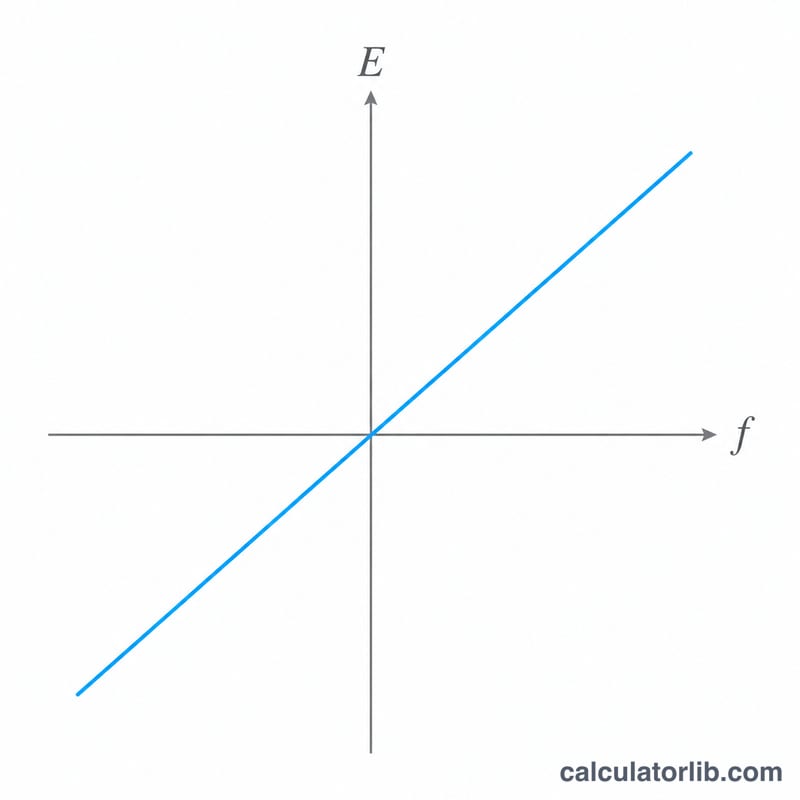
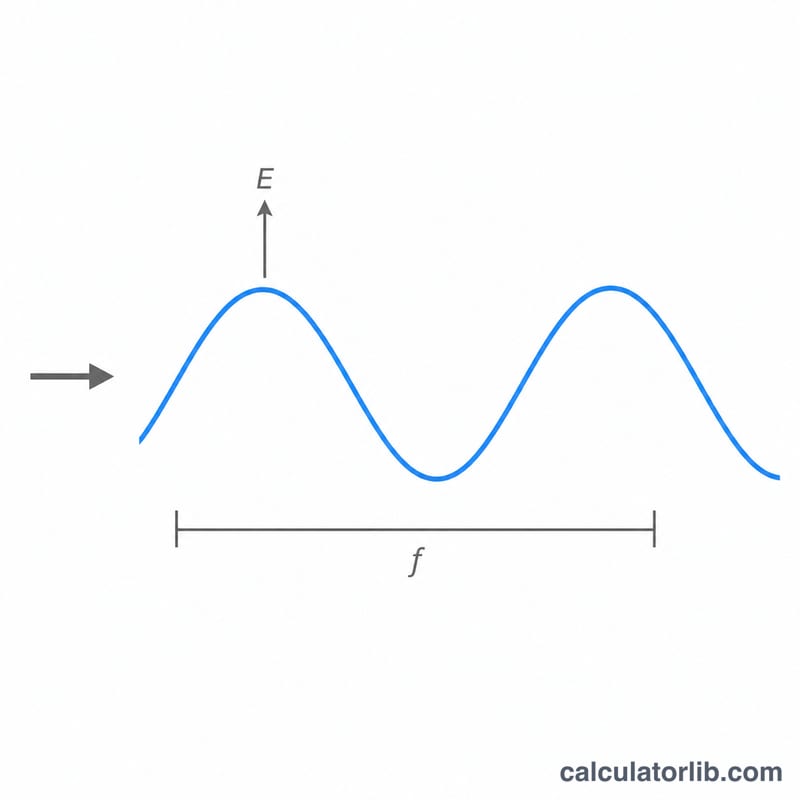
The energy of a photon is directly proportional to its frequency: $$E = h \times f$$ Planck's constant is fixed at \(h = 6.62607015 \times 10^{-34}\) joule-seconds. To convert the result from joules into electronvolts, divide by the elementary charge, \(1.602176634 \times 10^{-19}\) coulombs, since 1 eV is the energy gained by an electron across one volt.
Worked example
For green light at \(f = 5 \times 10^{14}\) Hz: $$E = 6.62607015 \times 10^{-34} \times 5 \times 10^{14} = 3.313 \times 10^{-19} \text{ J}$$ Dividing by \(1.602176634 \times 10^{-19}\) gives about 2.068 eV — a typical energy for visible-light photons.
FAQ
What is Planck's constant? It is a fundamental constant of quantum mechanics that links a photon's energy to its frequency, with a defined value of \(6.62607015 \times 10^{-34}\) J\(\cdot\)s.
Can I enter frequency in THz or GHz? Convert to hertz first: \(1 \text{ THz} = 1 \times 10^{12}\) Hz and \(1 \text{ GHz} = 1 \times 10^{9}\) Hz. Then enter the value (e.g. 1e12).
Why show electronvolts too? In atomic and quantum physics, photon energies are tiny in joules, so eV provides a more readable, conventional scale.