
What This Calculator Does
This tool computes the standard Gibbs free energy change (\(\Delta G\)) of an electrochemical reaction from its cell potential using the thermodynamic relationship \(\Delta G = -nFE\). It links electrochemistry to thermodynamics, telling you whether a redox reaction is spontaneous and how much useful electrical work it can deliver. The relationship is universal and applies to any galvanic or electrolytic cell.
How to Use It
Enter three values: n, the number of moles of electrons transferred in the balanced half-reactions; E, the cell potential in volts (use the standard potential E° for standard conditions); and F, the Faraday constant, which is 96,485 coulombs per mole of electrons (you can leave the default). The calculator returns \(\Delta G\) in both joules and kilojoules per mole and states whether the reaction is spontaneous.
The Formula Explained
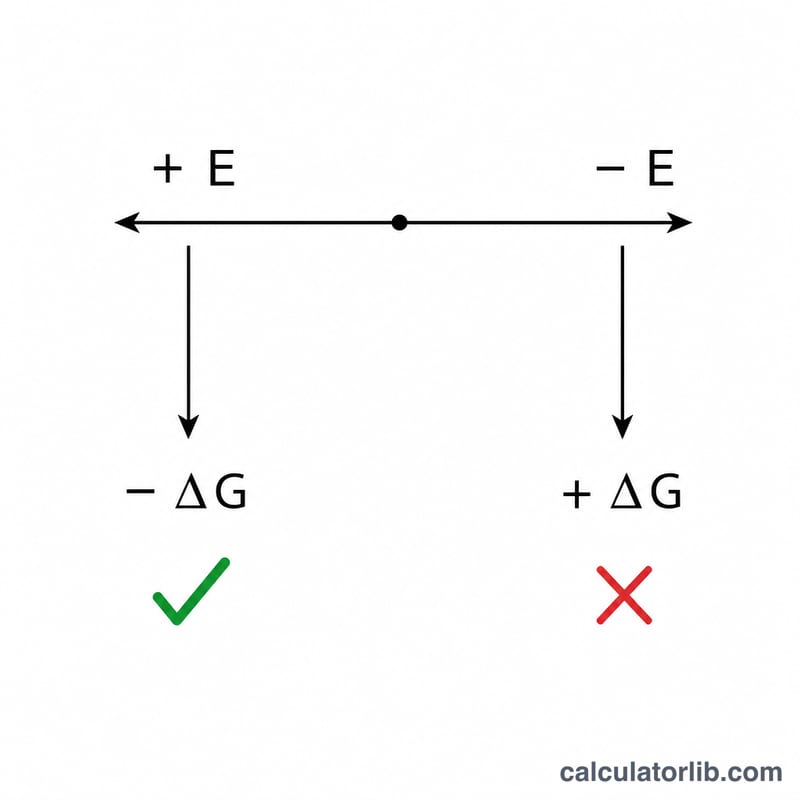
The equation $$\Delta G = -\,\text{n} \cdot \text{F (C/mol)} \cdot \text{E (V)}$$ comes from equating the maximum electrical work a cell can do (\(w = -nFE\)) with the Gibbs free energy change. Here \(F = 96{,}485\ \text{C/mol}\) converts moles of electrons and volts into joules, since one volt times one coulomb equals one joule. A positive cell potential gives a negative \(\Delta G\), signalling a spontaneous (energy-releasing) reaction.
Worked Example
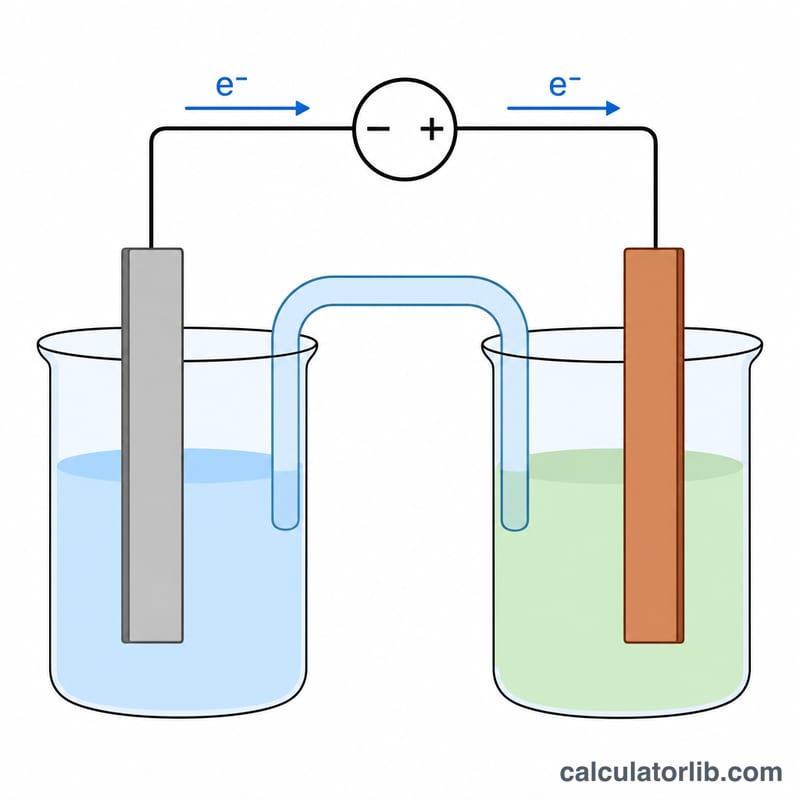
Consider the Daniell cell (Zn/Cu) with E° = 1.10 V and n = 2 electrons transferred. $$\Delta G = -(2)(96485)(1.10) = -212{,}267\ \text{J/mol} = -212.27\ \text{kJ/mol}$$ The large negative value confirms the cell reaction is strongly spontaneous, consistent with the battery producing usable voltage.
FAQ
Why is \(\Delta G\) negative when E is positive? The minus sign in \(\Delta G = -nFE\) means a positive potential corresponds to a negative (favorable) free energy change.
What value of F should I use? The standard Faraday constant is 96,485 C/mol. Some textbooks round to 96,500.
Can E be negative? Yes. A negative cell potential gives a positive \(\Delta G\), meaning the reaction is non-spontaneous and requires energy input (as in electrolysis).