
What this calculator does
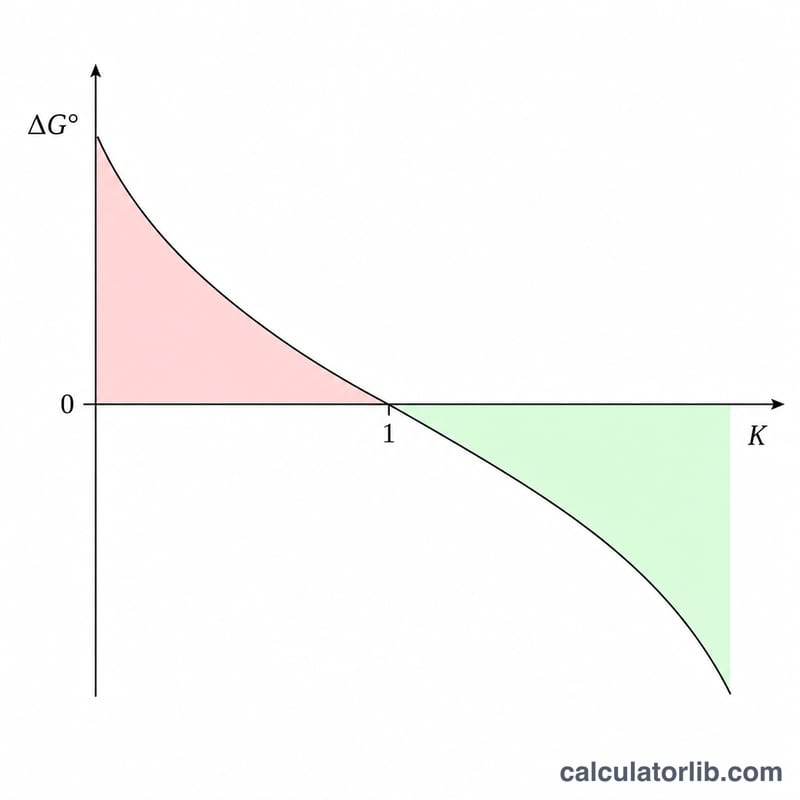
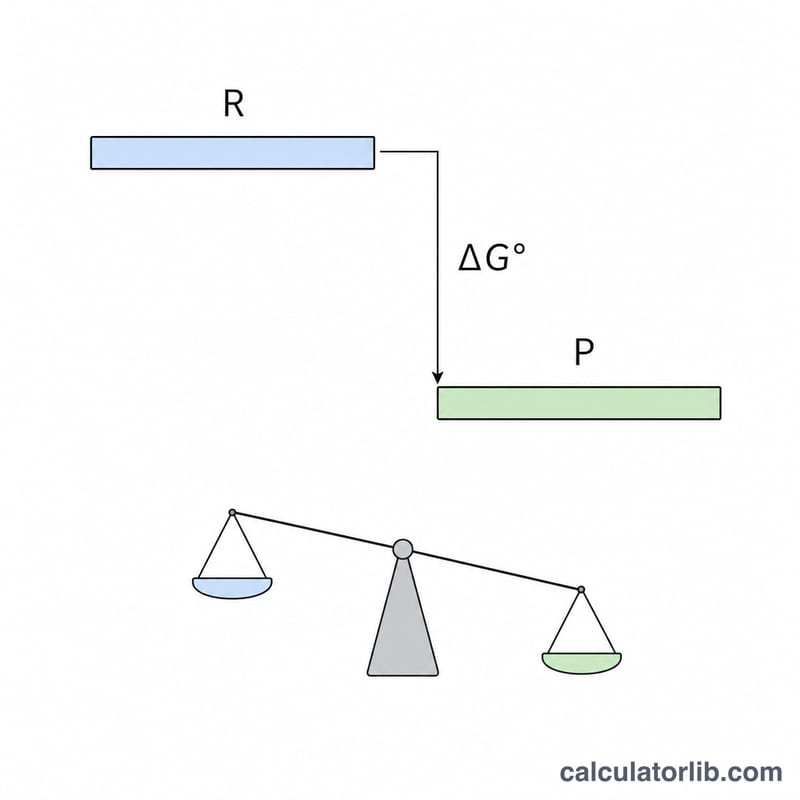
This tool computes the standard Gibbs free energy change (ΔG°) of a chemical reaction from its equilibrium constant K and the absolute temperature T. The relationship \(\Delta G^{\circ} = -RT \ln K\) links thermodynamics and chemical equilibrium: it tells you whether a reaction is spontaneous under standard conditions. A negative ΔG° (K > 1) indicates a product-favored reaction, while a positive ΔG° (K < 1) indicates a reactant-favored reaction.
How to use it
Enter the dimensionless equilibrium constant K (it must be greater than zero) and the temperature in kelvin (K). For 25 °C, use 298.15 K. The calculator returns ΔG° in both kJ/mol (the headline value) and J/mol, along with ln(K) so you can check intermediate steps.
The formula explained
The equation is $$\Delta G^{\circ} = -RT \ln K,$$ where \(R = 8.314462618\ \text{J/(mol}\cdot\text{K)}\) is the universal gas constant, \(T\) is absolute temperature in kelvin, and \(K\) is the equilibrium constant. Because \(\ln K\) is dimensionless and \(RT\) carries units of J/mol, ΔG° comes out in joules per mole; dividing by 1000 converts it to kJ/mol.
Worked example
Suppose K = 1000 at T = 298.15 K. Then \(\ln(1000) \approx 6.907755\). $$\Delta G^{\circ} = -(8.314462618)(298.15)(6.907755) \approx -17{,}123\ \text{J/mol} \approx -17.12\ \text{kJ/mol}.$$ The large positive K and negative ΔG° confirm a strongly product-favored reaction.
FAQ
Why must temperature be in kelvin? Thermodynamic equations require absolute temperature. Convert Celsius to kelvin by adding 273.15.
What if K equals 1? \(\ln(1) = 0\), so \(\Delta G^{\circ} = 0\) — the reaction is exactly at equilibrium under standard conditions with no net driving force.
Can K be negative or zero? No. An equilibrium constant is always positive because concentrations and partial pressures are positive, so \(\ln K\) is undefined for \(K \le 0\).