
What Is the Bond Enthalpy Calculator?
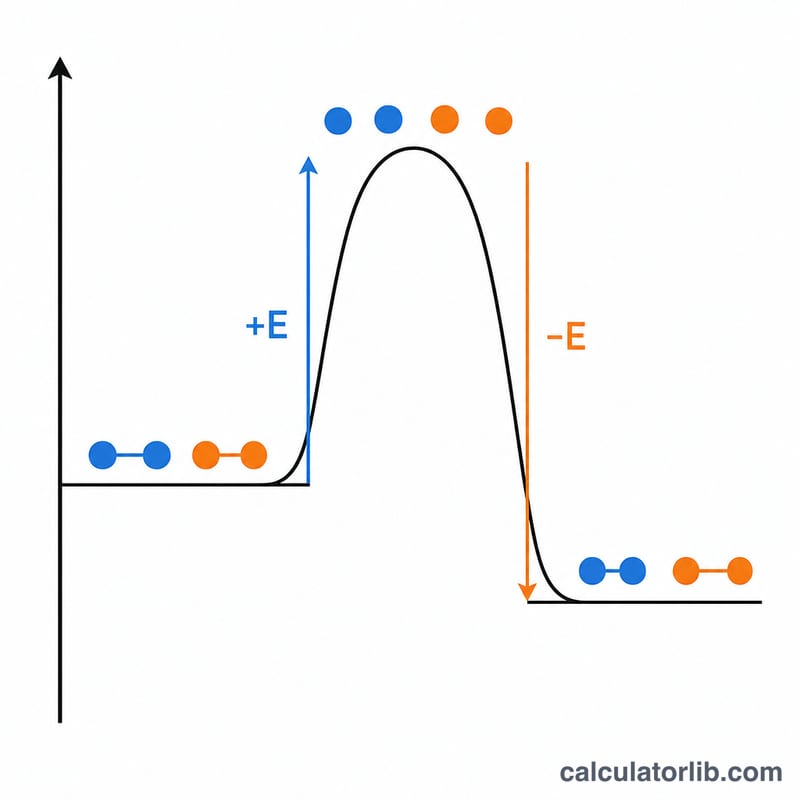
Breaking a chemical bond requires energy (an endothermic process), while forming a bond releases energy (exothermic). The overall enthalpy change of a reaction, ΔH, can be estimated from average bond enthalpies using a simple energy balance. This calculator subtracts the total energy released by bonds formed from the total energy absorbed to break bonds.
The Formula
ΔH = Σ(bonds broken) − Σ(bonds formed). Each term is the sum of the average bond enthalpies (in kJ/mol) for every bond broken in the reactants and every bond formed in the products. A negative ΔH means the reaction is exothermic; a positive ΔH means it is endothermic.
How to Use It
Add up the bond enthalpies for all bonds broken in the reactants and enter that value. Then add up the bond enthalpies for all bonds formed in the products and enter that. The calculator returns ΔH and tells you whether the reaction is exothermic or endothermic.
Worked Example
For the combustion of methane, CH₄ + 2O₂ → CO₂ + 2H₂O, you break 4 C–H bonds (4×413 = 1652) and 2 O=O bonds (2×498 = 996), giving 2648 kJ/mol broken. You form 2 C=O bonds (2×799 = 1598) and 4 O–H bonds (4×463 = 1852), giving 3450 kJ/mol formed. ΔH = 2648 − 3450 = −802 kJ/mol, a strongly exothermic reaction.
Average Bond Enthalpy Values
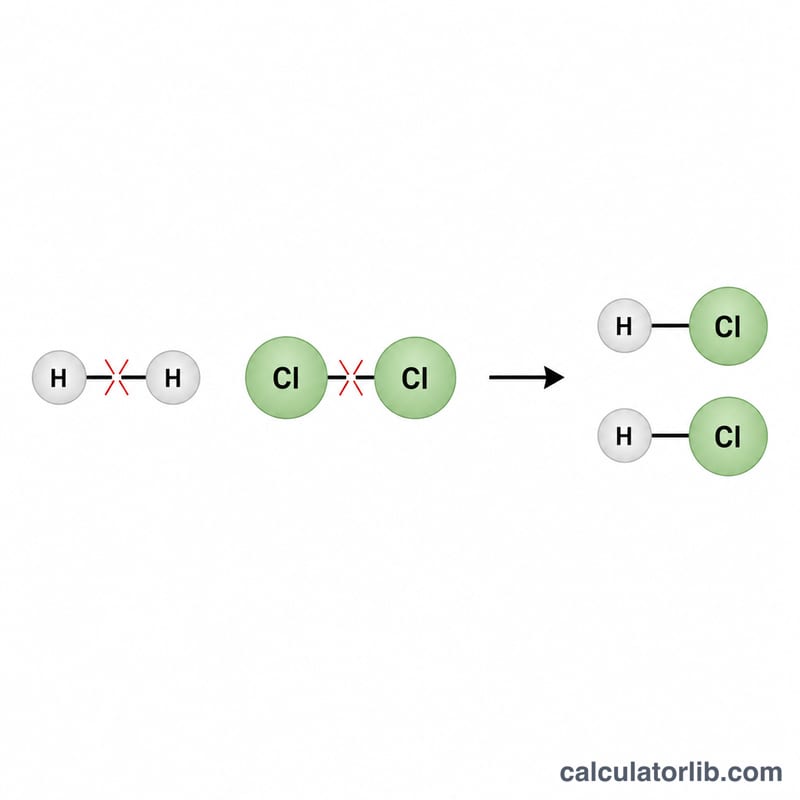
The values below are average bond enthalpies (also called mean bond energies), in kJ/mol. They represent the energy required to break one mole of a given bond in the gas phase, averaged over many different molecules. Because the local chemical environment varies, real bond energies differ slightly from these averages, so calculations using them give approximate reaction enthalpies.
| Bond | Average bond enthalpy (kJ/mol) |
|---|---|
| C–H | 413 |
| C–C | 347 |
| C=C | 614 |
| C≡C | 839 |
| C–O | 358 |
| C=O (general) | 799 |
| C=O (in CO₂) | 745 |
| O–H | 463 |
| O=O | 498 |
| H–H | 436 |
| Cl–Cl | 243 |
| H–Cl | 431 |
| N≡N | 945 |
| N–H | 391 |
| C–Cl | 328 |
| N=O | 607 |
| F–F | 159 |
| H–F | 567 |
| Br–Br | 193 |
| H–Br | 366 |
To use these values, count every bond that breaks in the reactants and every bond that forms in the products, then apply \(\Delta H = \Sigma\,(\text{bonds broken}) - \Sigma\,(\text{bonds formed})\).
Key Terms Explained
- Bond enthalpy (bond energy)
- The energy required to break one mole of a particular covalent bond in the gas phase, breaking the molecule into gaseous atoms. It is always a positive value because breaking a bond requires energy.
- Average bond enthalpy
- A bond enthalpy averaged over many different molecules that contain the same type of bond (for example, the C–H bond in methane, ethane and ethanol). Tabulated averages let you estimate \(\Delta H\) for reactions even when exact measured values are unavailable.
- Bond dissociation energy
- The energy needed to break one specific bond in one specific molecule. Unlike an average value, it applies to a single defined bond, so it can differ noticeably from the tabulated average for that bond type.
- Endothermic
- A reaction that absorbs energy from its surroundings, giving a positive \(\Delta H\). This happens when more energy is used breaking bonds than is released forming new ones.
- Exothermic
- A reaction that releases energy to its surroundings, giving a negative \(\Delta H\). This happens when more energy is released forming bonds than is needed to break the original bonds.
- \(\Delta H\) (enthalpy change)
- The heat absorbed or released by a reaction at constant pressure. Calculated from bond energies as \(\Delta H = \Sigma(\text{bonds broken}) - \Sigma(\text{bonds formed})\), reported in kJ/mol.
- \(\Sigma\) (summation)
- The Greek capital sigma, meaning “sum of.” In this context it instructs you to add together the energies of all bonds broken (or all bonds formed) across the balanced equation.
FAQ
Why is bond-energy ΔH only an estimate? Average bond enthalpies are averages across many molecules, so the result is approximate. Standard enthalpies of formation give more precise values.
What does a negative ΔH mean? The reaction releases heat to the surroundings — it is exothermic.
What units should I use? Use kJ/mol consistently for both inputs; the answer is in kJ/mol.