
What Is Bond Order?
Bond order is a measure of the number of chemical bonds between a pair of atoms, derived from molecular orbital (MO) theory. It tells you how strong and how stable a bond is: a higher bond order means a stronger, shorter bond, while a bond order of zero means no stable bond forms. This calculator works for any diatomic or molecular system once you know the electron occupancy of the molecular orbitals.
How to Use This Calculator
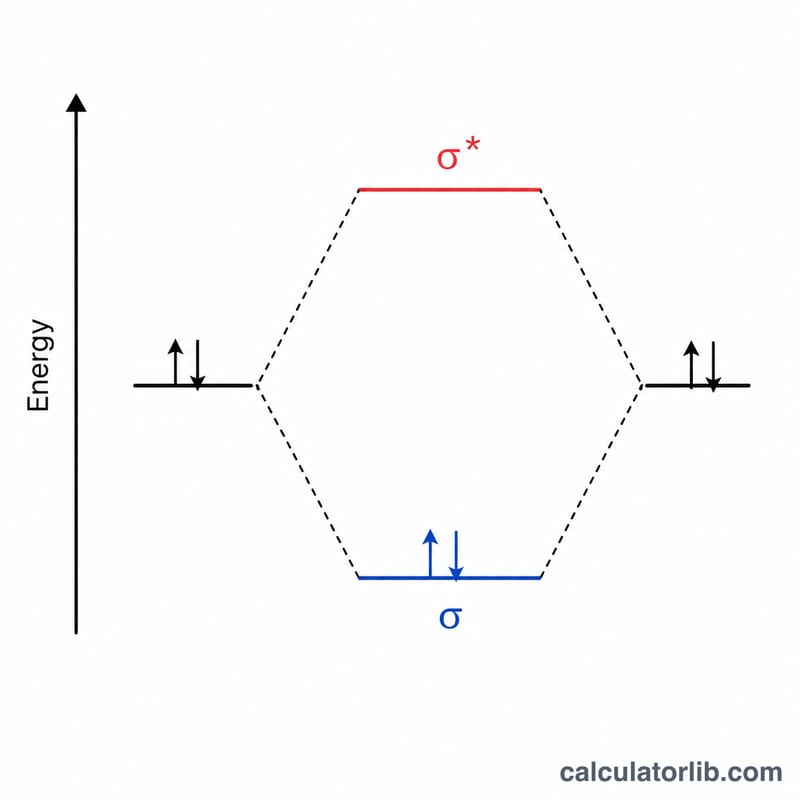
Enter the total number of electrons occupying bonding molecular orbitals and the number occupying antibonding orbitals (the ones usually marked with an asterisk, e.g. \(\sigma^*\) and \(\pi^*\)). Click calculate and the tool returns the bond order instantly. You can read electron counts directly from an MO energy-level diagram.
The Formula Explained
The bond order is given by:
$$\text{Bond Order} = \frac{N_b - N_a}{2}$$
where \(N_b\) is the number of bonding electrons and \(N_a\) is the number of antibonding electrons. Dividing by two reflects the fact that a single covalent bond consists of a pair of electrons. Fractional bond orders (like 1.5 or 2.5) are entirely valid and occur in species such as O₂⁻ and NO.
Worked Example
Consider the nitrogen molecule, N₂. It has 10 electrons in bonding orbitals and 4 in antibonding orbitals. $$\text{Bond Order} = \frac{10 - 4}{2} = \frac{6}{2} = 3$$ confirming the famous nitrogen triple bond, which is why N₂ is so unreactive.
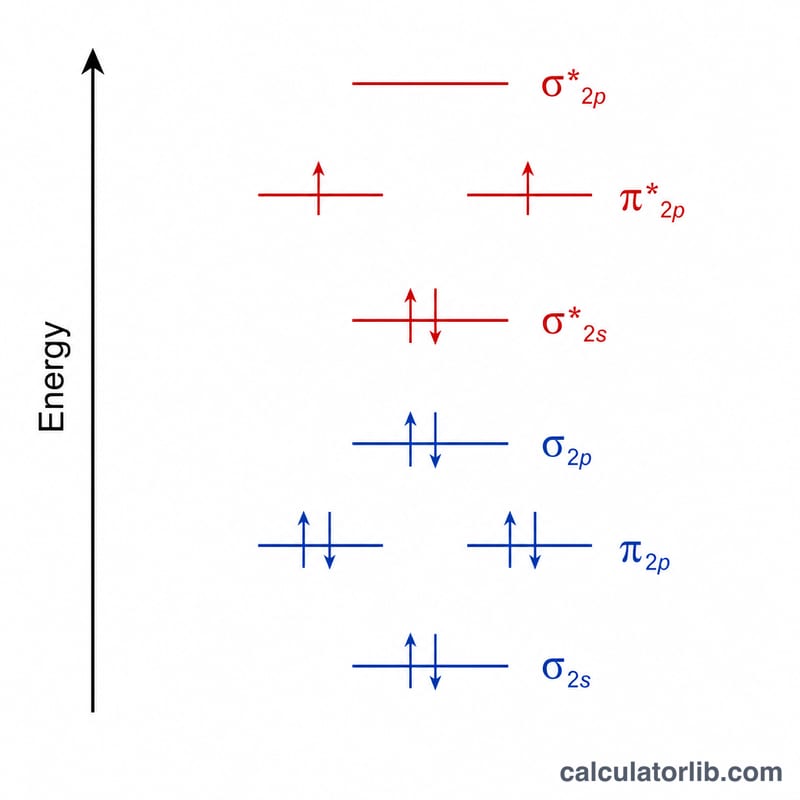
Bond Orders of Common Diatomic Molecules
Bond order in molecular orbital (MO) theory is the net number of bonding electron pairs holding two atoms together. It is calculated as:
$$\text{Bond Order} = \frac{N_b - N_a}{2}$$where \(N_b\) is the number of electrons in bonding molecular orbitals and \(N_a\) is the number in antibonding molecular orbitals. The table below lists the standard results for common second-period diatomic molecules and ions, along with their experimentally observed magnetic behavior.
| Species | Total valence electrons | Bonding electrons (\(N_b\)) | Antibonding electrons (\(N_a\)) | Bond order | Magnetic property |
|---|---|---|---|---|---|
| H₂ | 2 | 2 | 0 | 1 | Diamagnetic |
| He₂ | 4 | 2 | 2 | 0 | Not bound |
| B₂ | 6 | 4 | 2 | 1 | Paramagnetic |
| C₂ | 8 | 6 | 2 | 2 | Diamagnetic |
| N₂ | 10 | 8 | 2 | 3 | Diamagnetic |
| O₂ | 12 | 8 | 4 | 2 | Paramagnetic |
| O₂⁻ (superoxide) | 13 | 8 | 5 | 1.5 | Paramagnetic |
| O₂²⁻ (peroxide) | 14 | 8 | 6 | 1 | Diamagnetic |
| F₂ | 14 | 8 | 6 | 1 | Diamagnetic |
| NO | 11 | 8 | 3 | 2.5 | Paramagnetic |
| CO | 10 | 8 | 2 | 3 | Diamagnetic |
Note: electron counts above are tallied over the molecular orbitals formed from the valence (2s and 2p, or 1s for H/He) atomic orbitals. He₂ is included to illustrate a bond order of zero — equal bonding and antibonding population means no net bond, which is why diatomic helium does not exist as a stable molecule.
Interpreting Your Bond Order Result
Bond order is a direct numerical measure of how strongly two atoms are held together. In general, a higher bond order corresponds to a shorter bond length and a higher bond dissociation energy (the energy needed to break the bond). The sign and magnitude of your result tell you whether a molecule should exist and how stable it is.
- Bond order = 0: There is no net bond. Bonding and antibonding electrons cancel exactly, so the two atoms are not held together (e.g., He₂, Be₂). The molecule is predicted not to exist as a stable species.
- Bond order = 1: A single net bond, analogous to a Lewis single bond (e.g., H₂, F₂). Relatively long bond, relatively low dissociation energy compared with double or triple bonds.
- Bond order = 1.5: A fractional value between a single and double bond, typical of species with an odd electron in an antibonding orbital (e.g., superoxide O₂⁻). Indicates delocalization or partial bonding and intermediate bond length/strength.
- Bond order = 2: A double bond (e.g., O₂, C₂). Shorter and stronger than a single bond.
- Bond order = 3: A triple bond — among the strongest and shortest bonds (e.g., N₂, CO). N₂ has one of the highest known dissociation energies, which is why it is so unreactive.
Fractional bond orders (such as 0.5, 1.5, or 2.5) arise whenever the number of net bonding electrons is odd. They are perfectly valid in MO theory and reflect electron delocalization that simple Lewis structures cannot show. A species with a positive but fractional bond order is generally a real, if sometimes reactive, molecule or ion.
A zero or negative bond order indicates that the antibonding electrons meet or outnumber the bonding electrons, so no net bond forms and the species is predicted to be unstable. When comparing related species, the one with the larger bond order is expected to have the shorter, stronger bond.
Key Terms & Definitions
- Bonding orbital
- A molecular orbital formed by constructive overlap (in-phase combination) of atomic orbitals. Electrons in it are concentrated between the nuclei, lowering the energy and holding the atoms together.
- Antibonding orbital
- A molecular orbital formed by destructive overlap (out-of-phase combination) of atomic orbitals, with a node between the nuclei. It is higher in energy; electrons in it weaken or cancel bonding. Often marked with an asterisk (e.g., \(\sigma^*\), \(\pi^*\)).
- Sigma (\(\sigma\)) orbital
- A molecular orbital that is symmetric about the internuclear axis, formed by head-on (end-to-end) overlap of atomic orbitals. Sigma bonds are typically the strongest single-component bonds.
- Pi (\(\pi\)) orbital
- A molecular orbital formed by sideways overlap of p orbitals, with electron density above and below the internuclear axis. Pi orbitals account for the additional bonding in double and triple bonds.
- \(N_b\) (bonding electrons)
- The total number of electrons occupying bonding molecular orbitals.
- \(N_a\) (antibonding electrons)
- The total number of electrons occupying antibonding molecular orbitals.
- MO diagram (molecular orbital diagram)
- An energy-level diagram showing how atomic orbitals combine into bonding and antibonding molecular orbitals, into which electrons are filled according to the Aufbau principle, Hund's rule, and the Pauli exclusion principle.
- Bond order
- The net number of bonding electron pairs between two atoms, calculated as \((N_b - N_a)/2\). It correlates with bond strength and inversely with bond length.
- Paramagnetic
- Describes a species with one or more unpaired electrons, which is attracted to an external magnetic field (e.g., O₂).
- Diamagnetic
- Describes a species in which all electrons are paired, which is weakly repelled by an external magnetic field (e.g., N₂).
FAQ
Can bond order be a fraction? Yes. Odd-electron species such as the superoxide ion O₂⁻ have a bond order of \(1.5\).
What does a bond order of zero mean? It means equal numbers of bonding and antibonding electrons, so no net bond forms — for example, hypothetical He₂.
Does higher bond order mean a shorter bond? Generally yes; greater bond order correlates with shorter bond length and higher bond dissociation energy.