
What Is the Order of Magnitude?
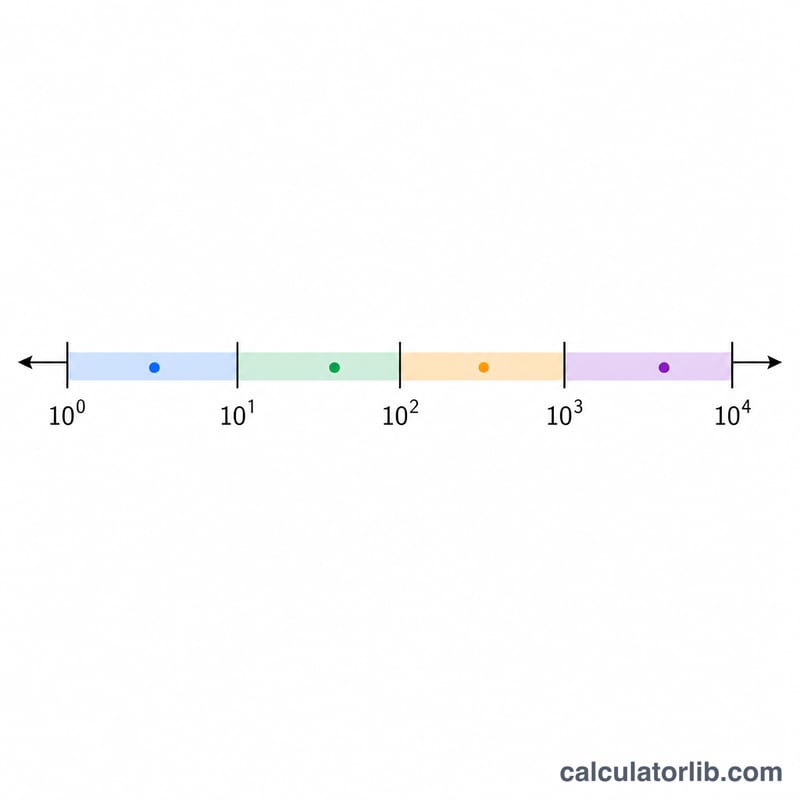
The order of magnitude of a number is the power of 10 that best describes its scale. Formally it is the integer n such that \( 10^n \le |x| < 10^{n+1} \). Scientists, engineers, and analysts use it to compare quantities that differ by huge factors — for example, the mass of an atom versus the mass of a planet — without getting lost in the digits.
How to Use This Calculator
Enter any non-zero number (positive or negative; the sign is ignored). The calculator returns the order of magnitude, the absolute value, and the nearest power of 10 that anchors the number's scale.
The Formula Explained
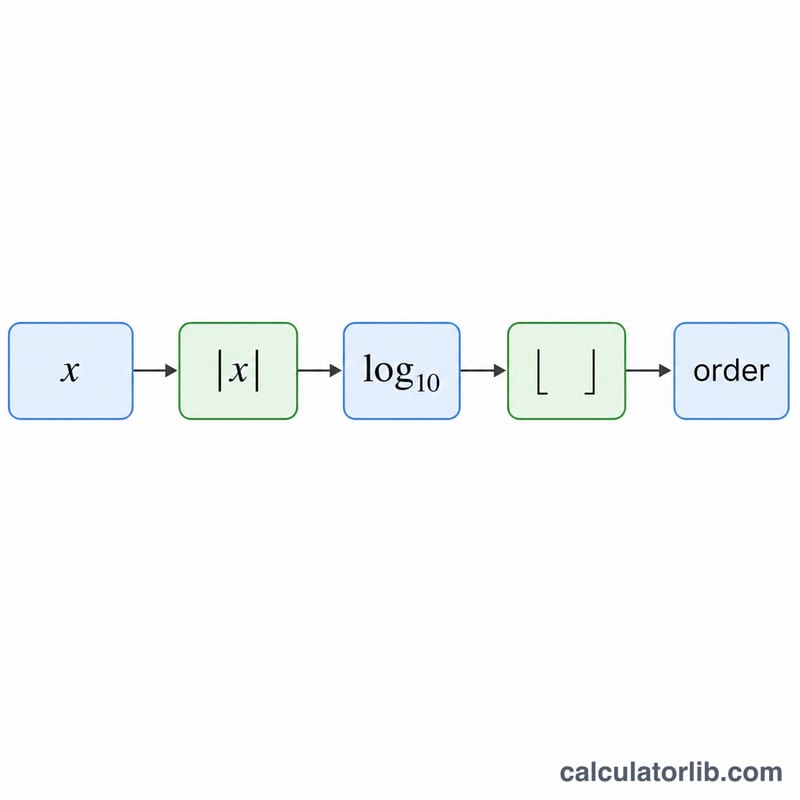
The core formula is $$\text{Order} = \left\lfloor \log_{10}\left| \text{Number} \right| \right\rfloor$$ First take the absolute value so negatives are handled, then take the base-10 logarithm, and finally round down to the nearest integer with the floor function. The result tells you how many times you would multiply 10 by itself to reach the number's scale.
Worked Example
Suppose \( x = 4500 \). Then $$\log_{10}(4500) \approx 3.653$$ Applying floor gives 3, so the order of magnitude is 3, and the nearest power of 10 is \( 10^3 = 1000 \). This makes sense: 4500 sits between 1000 (\(10^3\)) and 10000 (\(10^4\)), closer in scale to thousands.
FAQ
What about numbers less than 1? They have negative orders. For example 0.0042 has \( \log_{10} \approx -2.377 \), floor = \(-3\), so its order of magnitude is \(-3\) (\(10^{-3} = 0.001\)).
Can I enter zero? Zero has no defined order of magnitude because \( \log_{10}(0) \) is undefined. This tool returns 0 as a safe placeholder.
Does the sign matter? No. Order of magnitude depends only on the absolute value, so \(-7000\) and 7000 both have order 3.