
What is the Order Least to Greatest Calculator?
This tool takes any list of numbers and arranges them in order — either from least to greatest (ascending) or greatest to least (descending). It works with whole numbers, decimals, and negative values, making it handy for homework, statistics, and quick data tidy-ups.
How to use it
Type your numbers into the box, separated by commas or spaces (for example 5, 2, 8, 1, 9). Choose whether you want them ordered from least to greatest or greatest to least, then submit. The calculator returns the sorted list along with the count, minimum, and maximum.
The formula explained
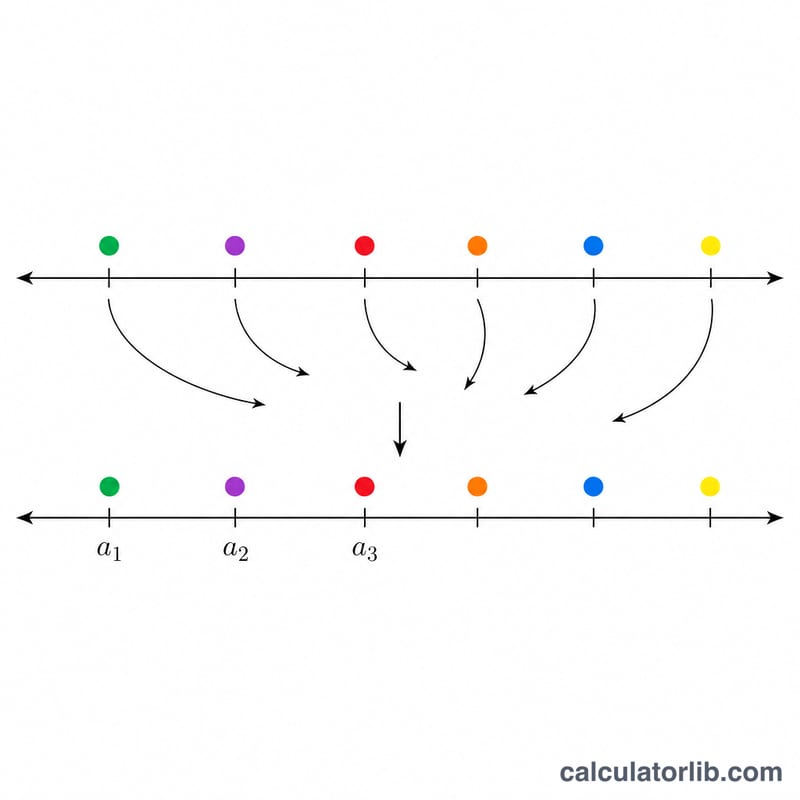
Sorting in ascending order means producing a sequence where every element is less than or equal to the one after it: \(a_1 \le a_2 \le \cdots \le a_n\).
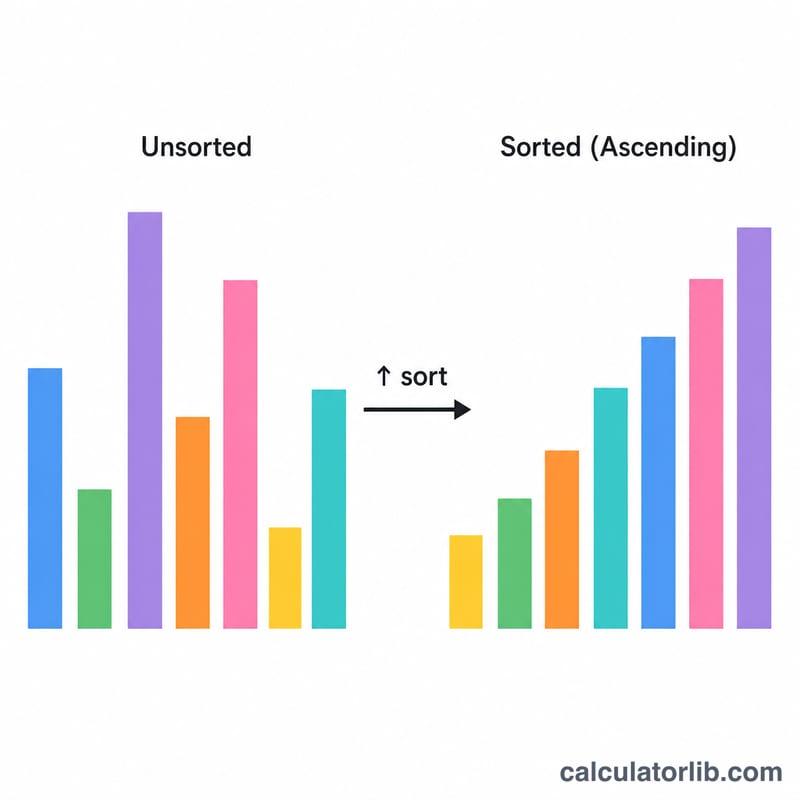
$$\text{Sorted} = \operatorname{sort}_{\uparrow}\left(\text{Numbers}\right),\quad a_1 \le a_2 \le \cdots \le a_n$$Descending order simply reverses this so \(a_1 \ge a_2 \ge \cdots \ge a_n\).
$$\text{Sorted} = \operatorname{sort}_{\downarrow}\left(\text{Numbers}\right),\quad a_1 \ge a_2 \ge \cdots \ge a_n$$The calculator compares each value numerically (not as text), so 9 correctly comes after 10? No — numerically \(9 < 10\), so 9 is placed first.
Worked example
Given the list \(5, 2, 8, 1, 9\) in ascending order: the smallest value is 1, then 2, 5, 8, and finally 9. The result is 1, 2, 5, 8, 9 with a count of 5, minimum 1, and maximum 9.
FAQ
Can it sort decimals and negatives? Yes. Values like \(-3.5\) or \(2.75\) are compared by their true numeric value.
What separators can I use? Commas, spaces, semicolons, tabs, or new lines all work.
What happens to duplicate numbers? Duplicates are kept and placed next to each other in the sorted list.