
What is the Order of Operations Calculator?
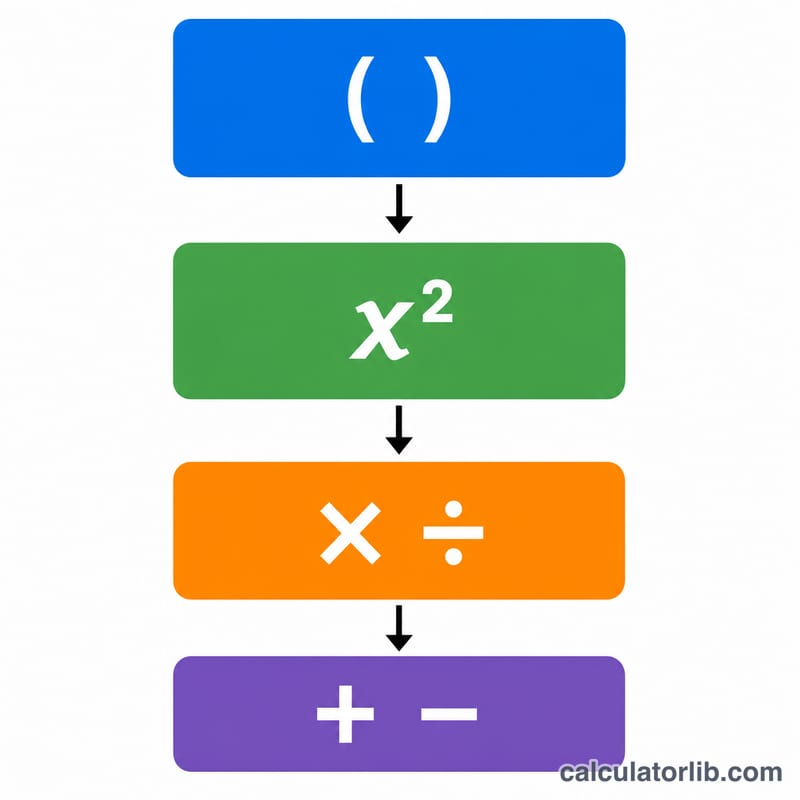
This tool evaluates a math expression using the standard PEMDAS / BODMAS order of operations: Parentheses, Exponents, Multiplication and Division (left to right), then Addition and Subtraction (left to right). Type any arithmetic expression and it returns the correct, unambiguous result.
How to use it
Enter an expression using numbers and the operators + - * / ^ along with parentheses ( ). For example, type 3 + 4 * 2 ^ 2 - (1 + 1). The calculator parses the expression, applies operator precedence, and shows the evaluated value.
The formula explained
$$\text{Result} = \operatorname{eval}\Big( \text{Math expression} \Big)\quad\text{following}\quad \underbrace{(\,)}_{\text{P}} \;\rightarrow\; \underbrace{x^{y}}_{\text{E}} \;\rightarrow\; \underbrace{\times\;\div}_{\text{MD}} \;\rightarrow\; \underbrace{+\;-}_{\text{AS}}$$
PEMDAS defines the precedence each operator carries. Exponentiation (^) binds tightest and is right-associative, so \(2 ^ 3 ^ 2 = 2 ^ 9 = 512\). Multiplication and division share the next level and are evaluated left to right, so \(8 / 4 \times 2 = 4\), not 1. Addition and subtraction come last, also left to right. Parentheses override everything by forcing their contents to be computed first.
Worked example
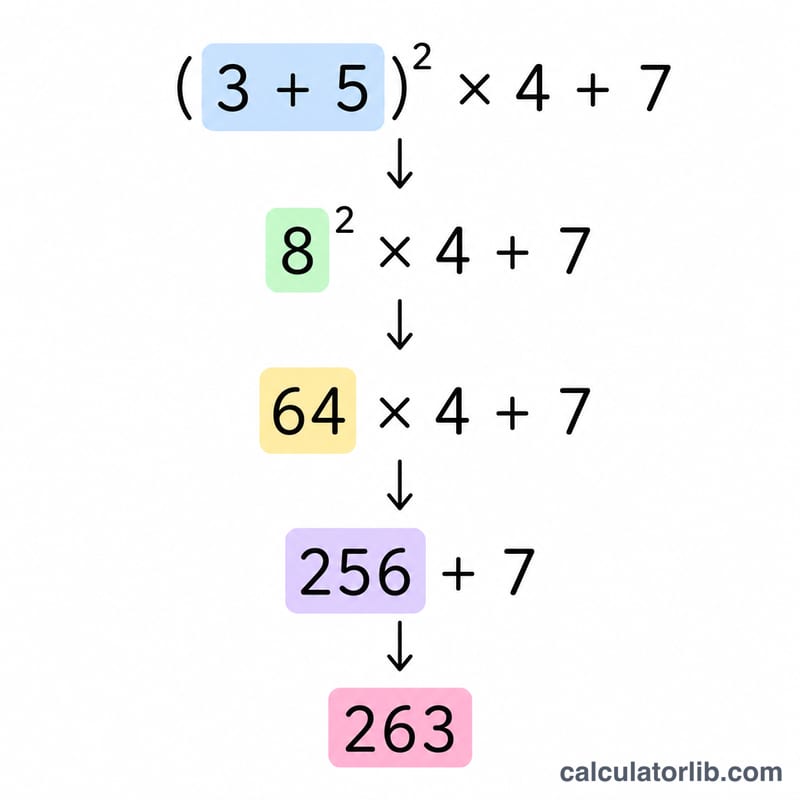
Evaluate 3 + 4 * 2 ^ 2 - (1 + 1): first the parentheses give \(2\); the exponent gives \(2 ^ 2 = 4\); multiplication gives \(4 \times 4 = 16\); then left to right addition/subtraction gives
.
FAQ
Does it handle negative numbers? Yes — a leading minus (e.g. -3 ^ 2) is treated as unary negation applied after the exponent, so \(-3 ^ 2 = -9\).
What about division by zero? The calculator detects division by zero and reports that the expression could not be evaluated.
Is multiplication implied by parentheses? No — write the * explicitly, e.g. 2 * (3 + 1), not 2(3 + 1).