
What is the Equilibrium Concentration Calculator?
This tool solves a common chemical-equilibrium problem using the ICE-table (Initial, Change, Equilibrium) method. Given an equilibrium constant Kc and an initial concentration C₀, it finds the reaction shift x that satisfies the equilibrium expression \(\text{K}_c = \frac{x^{2}}{\text{C}_0 - x}\). From x it reports the equilibrium concentrations of reactant and product and the percent dissociation.
How to use it
Enter the equilibrium constant Kc (for example \(1.8\times10^{-5}\) for acetic acid) and the initial concentration C₀ in mol/L. The calculator returns x, the equilibrium reactant concentration \((\text{C}_0 - x)\), the equilibrium product concentration \((x)\), and the percent dissociation \(\frac{x}{\text{C}_0} \times 100\). It solves the full quadratic rather than using the small-x approximation, so it stays accurate even when dissociation is large.
The formula explained
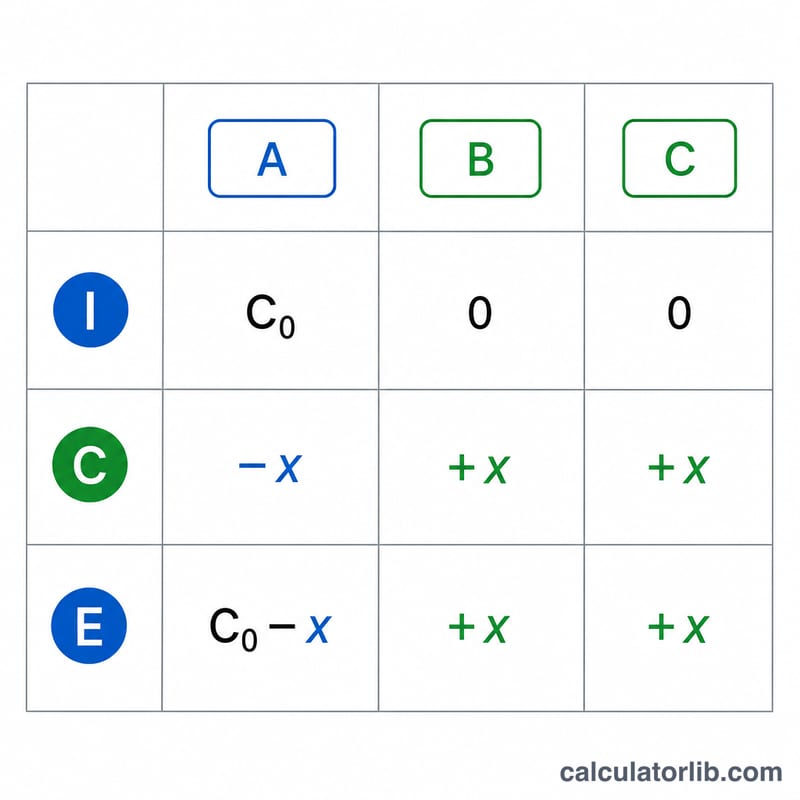
For a process such as HA ⇌ H⁺ + A⁻ starting from C₀ with no products, the ICE table gives equilibrium values of \((\text{C}_0 - x)\) for the reactant and \(x\) for each product. Substituting into \(\text{K}_c = \frac{[\text{H}^+][\text{A}^-]}{[\text{HA}]}\) yields \(\text{K}_c = \frac{x^{2}}{\text{C}_0 - x}\). Rearranging gives the quadratic \(x^{2} + \text{K}_c\,x - \text{K}_c\,\text{C}_0 = 0\), whose positive root is
$$x = \frac{-\text{K}_c + \sqrt{\text{K}_c^{2} + 4\,\text{K}_c\,\text{C}_0}}{2}$$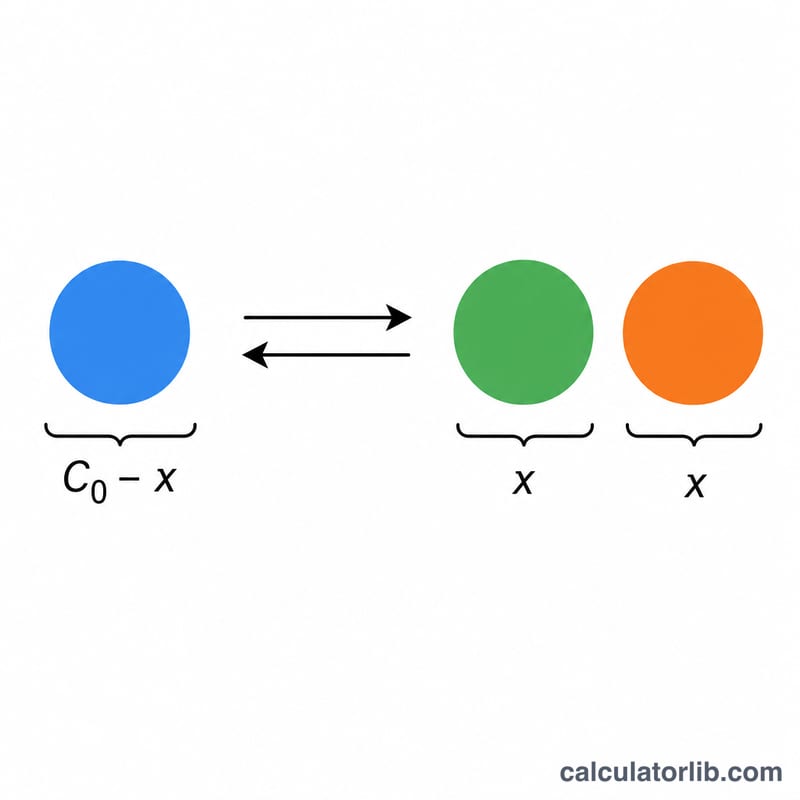
Worked example
Take \(\text{K}_c = 1.8\times10^{-5}\) and \(\text{C}_0 = 0.10 \text{ mol/L}\). Then
$$\text{K}_c^{2} + 4\,\text{K}_c\,\text{C}_0 = 3.24\times10^{-10} + 7.2\times10^{-6} \approx 7.2\times10^{-6}$$Its square root is \(\approx 2.683\times10^{-3}\), so
$$x = \frac{-1.8\times10^{-5} + 2.683\times10^{-3}}{2} \approx 1.333\times10^{-3} \text{ mol/L}$$The percent dissociation is about 1.33%.
FAQ
Does this assume a 1→2 stoichiometry? Yes — the expression \(\frac{x^{2}}{\text{C}_0 - x}\) matches a reactant dissociating into two product units (each at concentration \(x\)), the most common textbook case.
Why solve the quadratic instead of approximating? The small-x shortcut (\(x \approx \sqrt{\text{K}_c\,\text{C}_0}\)) fails when dissociation exceeds ~5%; the quadratic is always valid.
What units should I use? Use consistent molar concentrations (mol/L). Kc is dimensionless in this context.